Pentagon officials took to PBS and the Pentagon press room to warn Wednesday about the impending sequester’s impact on military spending.
“We’re really trying to keep on protecting the country and delivering the defense under these circumstances,” Deputy Defense Secretary Ash Carter said on the PBS NewsHour Wednesday evening. “In some cases, that’s not going to be possible.” On March 1, assuming no White-House-congressional deal on a $1.2 trillion deficit reduction package over the coming decade, more than $500 billion in Pentagon cuts will kick in automatically, including a $46 billion cut between March 1 and October 1.
“Two-thirds of the Army active combat brigade teams, other than those that are currently deployed, would be at below acceptable levels of readiness,” Pentagon money chief Robert Hale said. “It could affect their ability to deploy to a new contingency, if one occurred, or if this goes on long enough, even to Afghanistan.”
Yet slightly more than an hour before Carter appeared on television, the Air Force slipped Lockheed Martin a little something extra to keep their fleet of F-22s flying:
Students and alumni at Yale University are organizing against a proposed campus center to train special operations forces in interview techniques. The center would be funded by a $1.8 million grant from the Pentagon and could open as early as April. Dubbed an “interrogation center” by critics, the facility would be housed at the Yale School of Medicine and led by Charles Morgan, a professor of psychiatry who previously conducted research on how to tell whether Arab and Muslim men are lying. We speak to two students at Yale who co-authored an editorial titled “DoD Plans are Shortsighted, Unethical,” and with Michael Siegel, professor of community health sciences at Boston University School of Public Health and a 1990 graduate of the Yale School of Medicine. “Yale has now crossed a line,” Siegel says. “Using the practice of medicine and medical research to help design advanced interrogation techniques, or even just regular civilian intelligence-gathering techniques, interviewing techniques, is not an appropriate use of medicine. The practice of medicine was designed to improve people’s health. And the school of medicine should not be taking part in either training or research that is primarily designed to enhance military objectives.” [includes rush transcript]
FORT LAUDERDALE, Fla. — Data scientists are the most in demand job for the military, according to Reggie Brothers, the deputy assistant secretary of defense for Research.
The military has a problem with “big data” — the problem being that it collects too much of it. The infatuation with unmanned vehicles and the sensors mounted onto them has spurred a wave of data collected on the battlefield.
Using that data has caused military leaders headaches. Brothers said here at the Association of the U.S. Army’s Winter Symposium on Wednesday that the Army and the other services have placed their focus on PED, or processing, exploitation, and dissemination.
He used the ARGUS-IS as an example of the major advances being made in the world of intelligence sensors. The ARGUS-IS can stream up to a million terabytes of data and record 5,000 hours of high definition footage per day. It can do this with the 1.8 gigapixel camera and 368 different sensors all housed in the ARGUS-IS sensor that can fly on an MQ-9 Reaper.
My Harvard/MIT colleague Todd Mostak wrote his award-winning Master’s Thesis on ”Social Media as Passive Polling: Using Twitter and Online Forums to Map Islamism in Egypt.” For this research, Todd evaluated the “potential of Twitter as a source of time-stamped, geocoded public opinion data in the context of the recent popular uprisings in the Middle East.” More specifically, “he explored three ways of measuring a Twitter user’s degree of political Islamism.” Why? Because he wanted to test the long-standing debate on whether Islamism is associated with poverty.
So Todd collected millions of geo-tagged tweets from Egypt over a six month period, which he then aggregated by census district in order to regress proxies for poverty against measures of Islamism derived from the tweets and the users’ social graphs. His findings reveal that “Islamist sentiment seems to be positively correlated with male unemployment, illiteracy, and percentage of land used in agriculture and negatively correlated with percentage of men in their youth aged 15-25. Note that female variables for unemployment and age were statistically insignificant.” As with all research, there are caveats such as the weighting scale used for the variables and questions over the reliability of census variables.
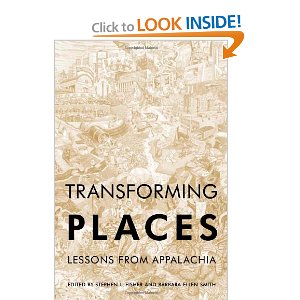
In this era of globalization's ruthless deracination, place attachments have become increasingly salient in collective mobilizations across the spectrum of politics. Like place-based activists in other resource-rich yet impoverished regions across the globe, Appalachians are contesting economic injustice, environmental degradation, and the anti-democratic power of elites. This collection of seventeen original essays by scholars and activists from a variety of backgrounds explores this wide range of oppositional politics, querying its successes, limitations, and impacts. The editors' critical introduction and conclusion integrate theories of place and space with analyses of organizations and events discussed by contributors. Transforming Places illuminates widely relevant lessons about building coalitions and movements with sufficient strength to challenge corporate-driven globalization.
Review
“I cannot recall a book that has excited me more than Transforming Places. This work is a major step forward in the study of social change, our understanding of ‘free spaces,' and local resistance – how people get power and how they can use it to get more.” Richard A. Couto, editor of Political and Civic Leadership: A Reference Handbook “Transforming Places addresses timely issues and tracks changes in political movements in Appalachia, assessing the devastating economic, social, and environmental costs amid hints of optimism for a more sustainable future. This work is significant for Appalachian studies and its overlapping disciplines but also will be useful outside of academia for agencies and organizations focused on sustainable development, strengthening community, and building alliances.” Patricia D. Beaver, co-editor of Tales from Sacred Wind: Coming of Age in Appalachia “The range of topics covered in this volume provides an exciting view of the new directions grassroots activism is taking in Appalachia: immigrants' rights, the history and dissolution of an organizing training program, collaborations between faith-based institutions and labor, coalitions that address farming and hunger, and a variety of analyses of recent activism against mountaintop removal. This is undoubtedly a major contribution to Appalachian studies.” Mary K. Anglin, University of Kentucky
About the Author
Steve Fisher taught for 35 years at Emory & Henry College where he helped create an Appalachian Studies minor, the Appalachian Center for Community Service, and an interdisciplinary service-learning major. He was the 1999 Carnegie Foundation Outstanding Baccalaureate College Professor of the Year and has won a number of other teaching-related awards. He is the editor of Fighting Back in Appalachia: Traditions of Resistance and Change and co-editor of Transforming Places: Lessons from Appalachia, and has written extensively on a variety of Appalachian issues, including identity, resistance, and political economy, and on teaching and community-based education. He has been active in a number of Appalachian resistance efforts including the land study, Appalachian Alliance, and the Pittston strike and has worked to build links between the academic community and activists in the region. He was co-founder and columnist for The Plow, an alternative regional newspaper in the late 1970s. He recently served on the board of the Highlander Center, is an active member of the Appalachian Peace Education Center and the Virginia Organizing Project, and served on his county's Planning Commission from 2000-2012. He was the program chair of the first Appalachian Studies Conference, has served as President of the Appalachian Studies Association (ASA), and has received the ASA's Cratis Williams/James Brown Service Award. He currently hosts a weekly radio show (“Rise Up Singing”) on WEHC 90.7 FM.