John Robb: Life in the Networked Age — P2P versus Google-zilla

Advanced Cyber/IO
John Robb
John Robb

Life in a Networked Age

Posted: 18 Feb 2013 12:11 PM PST

Here's some idle thinking for a sunny afternoon at the end of winter.

To access it, let's make a simple assumption that economics, politics, and warfare are all a function of the dominant technological substrate.

A technological substrate is the family of related technologies that we rely upon.  In the 20th Century, we were clearly reliant on an industrial substrate.

The challenges posed by industrial age technologies dictated the development of two management forms:  bureaucracy and markets.   Bureaucracies and markets are both decision making systems. These management forms dominated economics, politics, and warfare for centuries.

Neither system of management is sufficient as a solution for industrial economics, politics, or warfare.

Continue reading “John Robb: Life in the Networked Age — P2P versus Google-zilla”

Berto Jongman: Carbon Trust Launches Scheme to Tackle Water Waste

12 Water
Berto Jongman
Berto Jongman

Carbon Trust launches scheme to tackle water waste

By Mark Kinver Environment reporter, BBC News

An international standard on water reduction has been launched in an effort to order to encourage businesses to use water more sustainably.

The UK's Carbon Trust, which developed the scheme, said many business leaders did not see the issue as a priority.

The Water Standard will require firms to measure water use and demonstrate efforts taken to reduce consumption.

It is estimated that more than 60% of Europe's largest cities consume water faster than it can be replenished.

UN data shows that 70% of global freshwater use is for irrigation, 22% is used by industry and 8% is used in homes.

Water use is forecast to increase in developing nations by 50% by 2025 and by 18% in developed nations.

“We know that most businesses that are very big users of water don't really have a handle on [water stewardship],” explained Carbon Trust chief executive Tom Delay.

“Very few measure it, even fewer have targets to reduce consumption. So even if there is not a significant cost penalty for water use, there is a very significant business risk.”

Read full article.

Phi Beta Iota:  Free energy, clean water, and safe food are the tri-fecta of the future that most are ignoring.  Solutions are available by corrupt governments are continuing to subsidize corrupt legacy systems in these field.

See Also:

Water: Soul of the Earth, Mirror of Our Collective Souls

Anthony Judge: The Cognitive Glass Ceiling — Enabling Questions, Challenged Audiences — Psychic Numbing and the Need for a Transformation of HOW We Think

Collective Intelligence, Cultural Intelligence, Earth Intelligence
Anthony Judge
Anthony Judge

We have a challenge before us.  I have invested heavily over decades in engaging with the UN as a rational pattern and pont of influence.  I no longer believe this to be the case.  However much we might succeed in placing the truth before any given organization, the chances of its over-coming built in biases is slim to none.  I have variously argued why this is the case.

Put simply there is zero capacity to absorb information in any collective sense. This constitutes a form of cognitive glass ceiling.

Hence my preoccupation with framing questions otherwise for other audeinces without getting locked intio marketing understandings of impact

One articulation of this (with links) is Embodiment of Change: Comprehension, Traction and Impact?: Discovering enabling questions for the future.

There is a degree of strategic and cognitive paradox required to which various authors refer and I endeavour to cite,.

I recall decades ago the remark of a top UN official to me that It was impossible to move anything of signifiance throygh the decisions processes of the UN system. Hence an early piece of mine on  The Art of Non-Decision-Making and the manipulation of categories.

But I salute your efforts.  Do not give up.

As a further remark, the issue is the capacity for uptake of any new insight.  Even presented on a plate, with a ticking bomb behind it, the capacity for uptake is far lower than we would like to assume.

This for me is the essence of the problem. Seeking greater impact by conventional means will not ensure uptake. People are overloaded with nio time or inclination to absorb new information

I have written variously on the matter, notably in summary form in Governing Civilization through Civilizing Governance: Global challenge for a turbulent future.

Continue reading “Anthony Judge: The Cognitive Glass Ceiling — Enabling Questions, Challenged Audiences — Psychic Numbing and the Need for a Transformation of HOW We Think”

Anthony Judge: Internyet Nescience? Doing the Wrong Things Righter is Still Doing the Wrong Thing

Collective Intelligence, Commercial Intelligence, Cultural Intelligence
Anthony Judge
Anthony Judge

Internyet Nescience?

Self-referential upgrading of obsolete Internet conference processes inhibiting emergence of integrative knowledge

Introduction
Internet science?
Methodological possibilities
Representation possibilities
Conclusion
References

Paper originally envisaged for the 1st International Conference on Internet Science (10-13 April 2013, Brussels)
held under the aegis of the European Commission, by the EINS project, the FP7 European Network of Excellence in Internet Science.

Read full paper with many links.

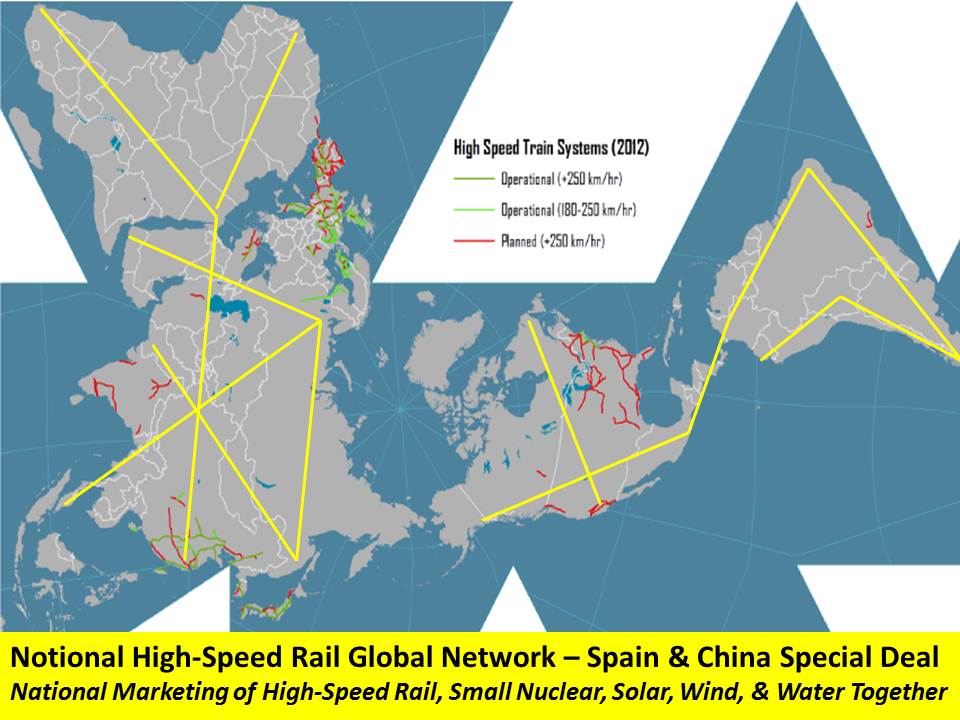
SmartPlanet: High-Speed Rail — Teaching Governments, Mobilizing All Eight Tribes to Press Forward on High-Speed Rail and Localized Everything

02 China, 03 Economy

smartplanet logo“The Morning Briefing” is SmartPlanet’s daily roundup of must-reads from the web. This morning we’re reading about high-speed rail.

Click on Image to Enlarge

1.) Protests bring Italian high-speed rail mega-tunnel to its knees. High-speed rail has garnered a lot of praise recently. The U.S. has a new national high-speed network map. China has unveiled the world’s longest high-speed line. Japan is beginning construction of their long-anticipated Maglev train line. But not all the news surrounding high-speed rail is so rosy.

2.) India and France to strengthen cooperation in railway sector. India and France have singed a Memorandum of Understanding (MoU) to strengthen cooperation in the railway sector.

3.) Is there hope for high-speed rail In Austin? A California transit company recently proposed a map of a national high speed rail network that places Austin as a major hub on the east/west southern rail lines. As KUT News reports, Austin would be mere hours away from major cities like Los Angeles and Chicago, not to mention Dallas and Houston.

Continue reading “SmartPlanet: High-Speed Rail — Teaching Governments, Mobilizing All Eight Tribes to Press Forward on High-Speed Rail and Localized Everything”

Yoda: Understanding Governance — Without Money, Righteous; With Money Corrupt

03 Economy, 11 Society, Communities of Practice, Corruption, Economics/True Cost, Ethics
Got Crowd? BE the Force!

Confused, force is.

First the good.

Stigmergic Governance Via the Web

In My piece, The End of Entropy  I propose the following:

With a central website, in forum style, to address major issues – divided into local sections, regional sections and global sections, with “votes” at a certain level elevating the problems and solutions to the next level to be voted on by a greater number – we can collectively coordinate to solve the issues of this planet.  Social responsibility will be seen as spending 15 minutes a day (or more) reviewing the issues on this site.  This seed parameter will see an emergence of human unity as a race and as a planet.

What is there proposed is a stigmergic governance – a way to govern society without a governMENT.  In a system with no money or need for exchange, stigmergic governance will work – as long as there are money interests, it is unlikely to, with votes bought, up or down, and other disruptive aspects.  This is what I propose in a free energy/robot system where no money is needed (read The End of Entropy for a picture of how this works).  If You are unfamiliar with the term, stigmergy, a good place to get a handle on the term is here.

A very good illustration of stigmergy is Linux.  In this case, one Individual created a basic program and offered it freely in open source.  Others came along and began to improve upon it, create software to run on it, and so on.  There was no “leader” in this group – those who wanted to get involved did so – and from the initial basic program, a whole creative “empire” came to be…all entirely free and freely.

Read full post.

and now the bad.

Continue reading “Yoda: Understanding Governance — Without Money, Righteous; With Money Corrupt”

noble gold