Outgoing Defense Secretary Leon Panetta is slated to testify before lawmakers on the Benghazi attacks, Sen. Carl Levin (D-Mich.), the Chairman of the Senate Armed Services Committee, told reporters Tuesday.
Hagel's legislative record belies his potential role as bit player on the stage of the American empire, unlikely to wield the kind of influence suggested by the controversy over his nomination.
Ideological elements of both the Left and the Right have inflated the nomination of Chuck Hagel for Secretary of Defense to symbolize far more than he can possibly achieve in office, good or bad. The controversy over his nomination is based on a handful of his comments and valedictory Senate addresses. His actual legislative record is a lot thinner. From my time as a Senate staffer, I do not remember any significant legislation he was personally responsible for, nor did he involve himself to any great extent in floor debates on authorization or appropriation bills having to do with national security.
Let the banks go down says Olafur Grimsson at the World Economic Forum in Davos
[Editors Note: Virginia is retired from the Vanderbilt University Medical School and at Harvard's before that. She has been a long time American Heritage activist, and has spent many years fighting our corrupt illegal immigration system…Jim W. Dean]
Iceland is a small country, under 1 million citizens with a very homogeneous culture, so perhaps its lessons are not broadly applicable.
Nevertheless, I have been proud of the Icelanders since they let their banks take the consequences – bankruptcy – of their greedy bets on derivatives and other financial “products”.
Recalling the history of a few years ago, the Icelandic government initially said that the innocent Icelandic citizens would bear the burden of the banks’ irresponsible practices. But mass protests led to a rethink.
The Icelandic President called for a referendum on the general public assuming bank debts. The bankers lost.
Citizens voted to let the banks fail. Iceland went through a rough patch but, after four years, is prospering. At least one Icelandic banker has gone to jail.
This all makes one think that Americans should have started protesting when Alan Greenspan arranged for a bailout of Long Term Capital Management in 1999. Or maybe earlier, when Chrysler was bailed out in the 1980s, because nothing is sacred about car companies, either.
Bailing out businesses that make a mistake creates “moral hazard”. For the sake of super-profits, businesses [or households] are encouraged to take risks on the assumption that any losing bets will be covered by the all-suffering tax-payer.
A grim Federal Security Services (FSB) report circulating in the Kremlin confirming the validity of the just released hacked emails of the British based defence company, Britam Defence, stunningly warns that the Obama regime is preparing to unleash a series of attacks against both Syria and Iran in a move Russian intelligence experts warn could very well cause World War III.
According to this report, Britam Defence, one of the largest private mercenary forces in the world, was the target of a “massive hack” of its computer files by an “unknown state sponsored entity” this past week who released a number of critical emails between its top two executives, founder Philip Doughty and his Business Development Director David Goulding.
The two most concerning emails between Doughty and Goulding, this report says, states that the Obama regime has approved a “false flag” attack in Syria using chemical weapons, and that Britam has been approved to participate in the West’s warn on Iran, and as we can read:
Read any government security document, any of the national security strategies produced by a now large number of states and you will get a feel for the proliferation in the number of threats they feel they face. The preamble will normally contain a paragraph explaining that after the Cold War or after 9/11 everything got a little more complex, a little less explicable.
Heightened complexity in the international system appears to have coincided (and is only partially causally linked) to the increased levels of activity/ improvements in technology, social media etc. The rate at which information can be collected has increased, even if the sort of information being collected is broadly the same.
The problem of accounting for events like the Algerian gas-plant siege a few weeks ago (or the development of the insurgency in Syria, or in the hijacking of the state in Mali) for state-based security organisations is that their resources allocated in such a way that it logical for them to be looking the wrong way when this happens. It would be unlikely – although we can’t be sure, obviously – that there’s a bod in every security community across Europe pondering the safety of gas-plants in the ME and Maghreb. So, when this happens the information required to rapidly come down the pipe needs to be hastily scoped and drawn in. And this got me thinking about Robert Steele’s ‘open source everything’ manifesto (I declare the interest that Robert has written a chapter for the Routledge Handbook on Intelligence that I, Mike Goodman and Claudia Hillebrand have compiled and which will be in a good bookshops from August, and that he and I have corresponded at length about these issues), and how it could be used or applied in these circumstances. I have my own take on this, and I’ve provided the link above to the source: Robert also has a good search on his name I think so I’d guess he’ll correct me in comments too! But my wonder is more in the aggregation of huge quantities of information.
Qualities of folly and wisdom – with factors that support each aspect of participatory wisdom
A. Fairness vs. bias
1. Folly comes from narrow-mindedness, bias, partisanship
2. Wisdom depends on open-mindedness, equity, objectivity
3. Factors supporting this aspect of participatory wisdom include balanced information; attention to “broad benefit” and “general welfare”; balance of power; neutral conveners and facilitators; all voices heard; holistic thinking; attending to deep needs/interests of all parties; identifying lies and manipulation; legitimate mini-publics / random selection; citizens considered experts on community values; public visibility; transparency
B. Knowledge vs. ignorance
1. Folly comes from ignorance, denial, obliviousness
2. Wisdom depends on awareness, insight, understanding
3. Factors supporting this aspect of participatory wisdom include balanced information; access to diverse experts; systems thinking; 21st century info access (online, open source, crowd sourced, citizen science); focus on “taking into account what needs to be taken into account”; deliberation; iteration (reviewing results); all voices heard; understandable information; free flow of information; holistic thinking; respect for science; identifying lies and manipulation
C. Responsiveness vs. arrogance
1. Folly comes from arrogance, hubris, dogmatism
2. Wisdom depends on humility, judiciousness, responsiveness
3. Factors supporting this aspect of participatory wisdom include focus on learning; listening; integrating multiple viewpoints; iteration; collective intelligence; dialogue; systems thinking; holistic thinking; identifying lies and manipulation; citizens considered experts on community values
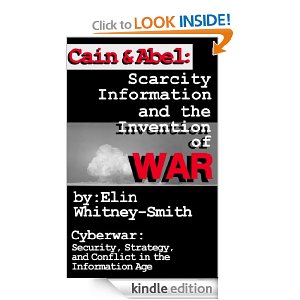
We have not always been warriors. War was invented along with political hierarchy, writing, and the invention of kingship.
This chapter tells the history of war starting with the end of the last ice age, 10,000 years ago, (before war was invented) up till the present when we may be seeing war becoming obsolete.
It examines various information revolutions and how they impacted the way war has been waged.
One thing which is constantly overlooked is that to have a successful war it is necessary that both parties have the same definition of what constitutes winning. The chapter shows how, from the very beginning of war, there were two different definitions of group violence – that of the agricultural peoples and that of the herding peoples. This difference in definition has been relevant throughout history and continues to this day.
Phi Beta Iota: $1.99 for Kindle. 33 pages. Elin Whitney-Smith is one of the original thinkers that the US Government has chosen to ignore for the past 20 years, because her ideas are affordable, practical, and would eradicate corruption while creating a prosperous world at peace.