Berto Jongman: US Spends 7.4 Billion a Year on Bio-Defense, to Zero Effect

07 Health, Commerce, Corruption, Earth Intelligence, Government, Ineptitude
Berto Jongman
Berto Jongman

Bio-Terror & Infectious Disease Outbreak: Detection Technologies and Global Markets – 2012 Edition

The US Bipartisan Bio-Detection 2011 Report Card Status Evaluation
(Source: The US Bipartisan WMD Terrorism Research Center, October 2011 Bio Response Report Card)

Events of the recent decade confirm that the threats of bio-terrorism and infectious disease outbreaks are real. Attacks such as the 2001 Anthrax scare, the 2004 Ricin letters, the 2003 SARS and 2009 H1N1 outbreaks have driven governments to increase their bio-surveillance budgets. Public healthcare and HLS agencies' urgent need to establish an early and reliable bio-surveillance detection infrastructure will drive the market onto a much higher trajectory than ever before. We forecast that the cumulative 2012-2016 market (including: systems sale, consumables, upgrades and service) will reach $22.8 billion.
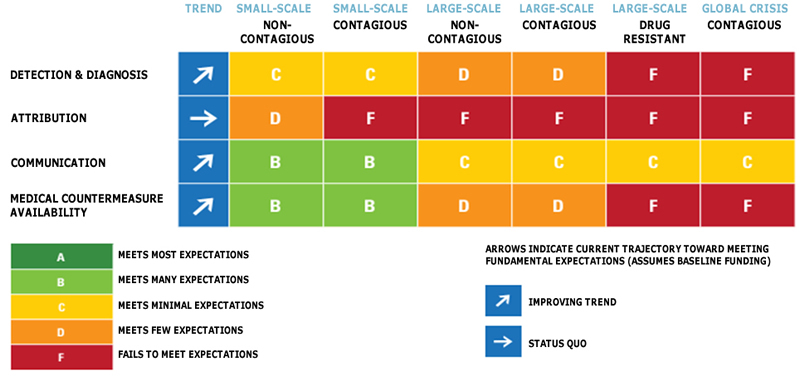
Click on Image to Enlarge

The recent year that saw the seventh review round of the Biological and Toxic Weapons Convention, demonstrated that demand for biosecurity remains high. As developed countries continue to refine their organizational and technological approach to potential bio-terror and disease outbreak threats, many key emerging markets are also ramping up programs to acquire solutions that provide early outbreak-attack detection. These will require the shortening of bio-attack alarm response time and the proliferation of 3rd generation cost-effective bio-detection technologies and reagent-less detection assays.

In contrast to the US colossal spending of $67 billion on biodefense programs during the 2001-2011 period, the US bipartisan WMD Terror Response Center report card (September 2011) graded the world's leading “US bio-detection and attribution programs” as the Achilles heel of the US BioWatch program. It received a score ranging from “meets minimal expectations” to a catastrophic “fails to meet expectations” (see table above). It stated that “Although naturally occurring disease remains a serious threat, a thinking enemy armed with these same pathogens, or with multi–drug resistant or synthetically   engineered pathogens could produce catastrophic consequences“.

Over the next five years, we forecast that, led by the US, Germany, France, China, Japan and India, the global bio-detection market (including systems sale, service, upgrades and consumables) will reach $5.6 billion by 2016.

Continue reading “Berto Jongman: US Spends 7.4 Billion a Year on Bio-Defense, to Zero Effect”

SchwartzReport: Corrupt Health System, Urban Farming Lowers Crime

01 Agriculture, 07 Health, 09 Justice, 11 Society

schwartz reportHealth Insurers Raise Rates Bigtime Despite Obamacare
NEAL COLGRASS – Newser

This is the flaw in Obamcare. You simply can't create a viable nationwide healthcare system when it's principal function is to produce profit. Other countries have shown profit can be part of the program, but not its principal function. The greed in America is so great we cannot seem to muster the political will to overcome its drag. As a result we have some of the worst healthcare in the developed world, and pay! vastly more than any other country.

During The Worst Flu Season In A Decade, Workers Across The Country Can’t Stay Home Sick
PAT GAROFALO – Think Progress

Here is an unintended consequence of a system which does not make national wellness a priority. If you get the flu there is a good chance this is how you contracted it — a worker who can't afford to stay in bed because they have no sick leave.

Plant Tomatoes. Harvest Lower Crime Rates.
ALEX KOTLOWITZ – Mother Jones

This is a wonderful story. An inexpensive, life-affirming reconnecting of people with growing plants. Such programs illustrate how our problem as a society is not money, it's a lack of vision and a failure of respect.


Mongoose: BIll Clinton Wrong on Mass Shootings

IO Impotency
Mongoose
Mongoose

Clinton says 50% since ban expired. Wrong. Try 20%.

Bill Clinton’s over-the-top ‘fact’ on mass shootings

at 06:02 AM ET, 01/11/2013

“Half of all mass killings in the United States have occurred since the assault weapons ban expired in 2005, half of all of them in the history of the country.”

— Former president Bill Clinton, at the Consumer Electronics Show in Las Vegas, Jan. 9, 2013

A colleague spotted this eye-popping statistic by the former president and wondered if it was correct.

President Clinton signed the assault weapons ban into law in 1994, but it expired after 10 years and was not renewed. Even supporters have said it was riddled with loopholes, limiting its effectiveness. But the rash of mass shootings in recent years, including the Newtown tragedy, have provided new impetus for a renewed ban.

So let’s dig into the data and see what we find.

Read full article.

Continue reading “Mongoose: BIll Clinton Wrong on Mass Shootings”

Berto Jongman: US to Fund Rare Earths Institute — Doing the Wrong Thing Righter Once Again

Academia, Commerce, Corruption, Earth Intelligence, Government, Ineptitude
Berto Jongman
Berto Jongman

US to build $120m rare earth research institute

By Katia Moskvitch

BBC News, 11 January 2012

The US Department of Energy is giving $120m (£75m) to set up a new research centre charged with developing new methods of rare earth production.

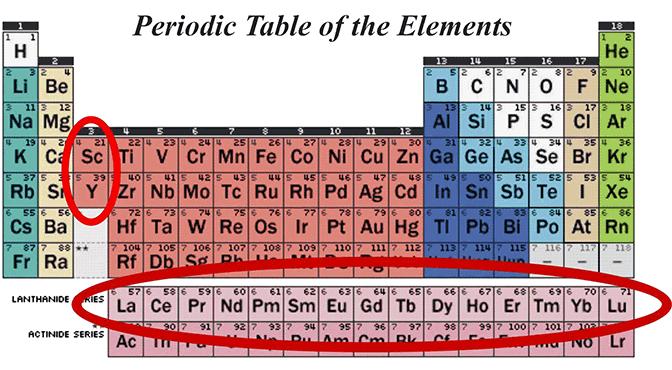
Rare earths are 17 chemically similar elements crucial to making many hi-tech products, such as phones and PCs.

Click on Image to Enlarge

The Critical Materials Institute will be located in Ames, Iowa.

The US wants to reduce its dependency on China, which produces more than 95% of the world's rare earth elements, and address local shortages.

According to the US Geological Survey, there may be deposits of rare earths in 14 US states.

Besides being used for hi-tech gadgets, the elements are also crucial for manufacturing low-carbon resources such as wind turbines, solar panels and electric cars, said David Danielson, the US assistant secretary for renewable energy.

“The Critical Materials Institute will bring together the best and brightest research minds from universities, national laboratories and the private sector to find innovative technology solutions that will help us avoid a supply shortage that would threaten our clean energy industry as well as our security interests,” he said in a statement.

Rare earth elements are also used for military applications, such as advanced optics technologies, radar and radiation detection equipment, and advanced communications systems, according to a 2011 research report by the US Government Accountability Office.

Recycling issue

Read full article

Phi Beta Iota:  An Open Source Agency (OSA) at IOC $125M and FOC $3B, would be a vastly better investment.  Once again pork finds a home and a new stove-pipe is being built.

See Also:

21st Century Intelligence Core References 2.9

Rare earths

Continue reading “Berto Jongman: US to Fund Rare Earths Institute — Doing the Wrong Thing Righter Once Again”

John Steiner: Idle No More — Indigenous Uprising Sweeping Across North America?

Ethics
John Steiner
John Steiner

Idle No More: Indigenous Uprising Sweeps North America

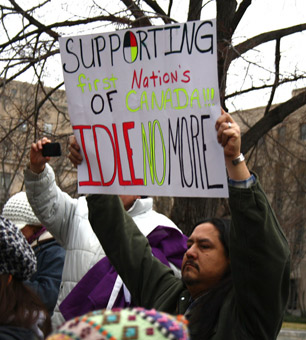
Idle No More has organized the largest mass mobilizations of indigenous people in recent history. What sparked it off and what’s coming next?

It took weeks of protests, flash mobs, letters, rallies, and thousands of righteous tweets, but Canadian Prime Minister Stephen Harper finally caved. He agreed to a meeting with the woman who had been petitioning him for twenty-four days, subsisting on fish broth, camped in a tepee in the frozen midwinter, the hunger striker and Chief of the Attawapiskat Theresa Spence.

Click on Image to Enlarge

No, this is not normal parliamentary process. The hunger strike was a final, desperate attempt to get the attention of a government whose relationship with indigenous people has been ambivalent at best and genocidal at worst, and force it to address their rising concerns. The meeting, set for this Friday, January 11, is unlikely to result in any major changes to Canada’s aboriginal policy. Yet the mobilization around Chief Spence’s hunger strike has already grown to encompass broader ideas of colonialism and our collective relationship to the land. The movement has coalesced under one name, one resolution: Idle No More.

Closed-Door Negotiations Spark a Movement

Read full article.

Continue reading “John Steiner: Idle No More — Indigenous Uprising Sweeping Across North America?”

Berto Jongman: “National Information Power” Old Think

IO Impotency
Berto Jongman
Berto Jongman

SOME OBSERVATIONS ALONG THE ROAD TO “NATIONAL INFORMATION POWER”

WILLIAM GRAVELL*

I. INTRODUCTION

When examining the technologies associated with information in its many forms, America has truly been blessed—or cursed, depending on your point of view—with an abundance of energy and inventiveness. Through the genius of Bell and Edison, and more recently, the products of RCA, Bell Laboratories, Microsoft, Intel and others, America has consistently held the lead in the invention and application of information technology. The practical advantages of this position have been frequent, numerous and profound. At present, American-designed and manufactured microprocessors, the subatomic particles of computer technology, dominate the global market, at a time when virtually every aspect of life on Earth is hurtling headlong toward expression in informational form. Beyond that, the operating systems and software applications—the rules that cause things to actually happen inside computers—are also totally dominated not just by the ubiquitous Microsoft Corporation,1 but by America as a whole.

Read PDF 26 Pages Online

Phi Beta Iota: Down the rabbit hole.

See Also:

21st Century Intelligence Core References 2.9

Yoda: South Korea Slams Google Evil in Privacy Violations

Commerce, Corruption, IO Impotency
Got Crowd? BE the Force!

Korean DPA Faults Google's TOS Changes: Global Privacy Implications?

By  Graham Greenleaf, Whon-il Park (Privacy Laws & Business International Report, Issue 119: 22-25, October 2012)

Abstract:

The first decision of Korea’s Personal Information Protection Commission (PIPC) has borne out the perception that Korea’s new Personal Information Protection Act (PIP Act) is ‘Asia’s toughest data privacy law’ (Greenleaf and Park, Privacy Laws & Business International Report, Issue 117: 1, available at http://ssrn.com/abstract=2120983). The PIPC has decided that Google’s changes to the Terms of Service (TOS) of over 60 of its services, unifying them in a single TOS, may be in breach of various provisions of the Act.

Google’s TOS changes are considered by the Commission to likely to breach these laws in three ways: (i) they do not specify the purpose of collection clearly enough, and cannot comply with the requirement that personal information may only be collected and used to the minimum extent necessary for the purpose for which it is collected; (ii) they do not comply with the requirement that where personal information is to be used for purposes other than the purpose for which it was collected, it is necessary to obtain additional consents for such uses; and (iii) they do not specify that that personal information will be erased immediately upon the expiration of its retention period or on request from a data subject.

This article analyses this decision, considering the PIPC’s reasoning, and the terms of the Korean legislation, in order to determine whether the PIPC’s findings (and the potential remedial action) are a result of features which are unique to the Korean law, or are they features which are common to at least some other countries’ data privacy laws.

Read full paper.

Continue reading “Yoda: South Korea Slams Google Evil in Privacy Violations”

noble gold