SmartPlanet: 1 Earth-Changing Idea, 9 Other Ideas

Communities of Practice, Earth Intelligence, True Cost

Scientific American’s list of 10 ideas about to change the world

6. A single sustainability index for products

How do you compare the environmental impact of, say, a bottle of laundry detergent versus an LCD screen? The Sustainability Consortium, a group of 10 universities, non-profits and 80 international companies including Walmart and Coca-Cola, are creating an index that includes every step of the supply chain. The group has already released the measure it will use to evaluate its first 100 products.

Right now, a similar rating system, Good Guide, is based solely on public information. The new system would take into account “emissions, waste, labor practices, water usage and other sensitive factors that will become available only as large corporate players exert pressure on suppliers to disclose them,” says Scientific American.

Read full article with 9 Other Ideas

Continue reading “SmartPlanet: 1 Earth-Changing Idea, 9 Other Ideas”

Yoda: Online Augmented Reality Education

04 Education, Advanced Cyber/IO
Got Crowd? BE the Force!

20 Coolest Augmented Reality Experiments in Education So Far

4 Ways Augmented Reality is Changing Education

Augmented reality is exactly what the name implies — a medium through which the known world fuses with current technology to create a uniquely blended interactive experience. While still more or less a nascent entity in the frequently Luddite education industry, more and more teachers, researchers, and developers contribute their ideas and inventions towards the cause of more interactive learning environments. Many of these result in some of the most creative, engaging experiences imaginable, and as adherence grows, so too will students of all ages.

20 Experiments, Paragraphs, and Links Below the Line

Continue reading “Yoda: Online Augmented Reality Education”

SchwartzReport: Franken-Wheat Crime Against Humanity?

01 Agriculture, 07 Health

How Dangerous Is Genetically Modified Food?

ALEX DALEY, Chief Technology Investment Strategist – Casey Research

Here is an investment advisor's view of developments in GMO. These analysts, who are focused only on making money, have a very cold blooded view of issues like GMO, and when they are alarmed it is worth paying attention.

Last month, a group of Australian scientists published a warning to the citizens of the country and of the world who collectively gobble up some $34 billion annually of its agricultural exports. The warning concerned the safety of a new type of wheat.

As Australia's number-one export, a $6-billion annual industry, and the most-consumed grain locally, wheat is of the utmost importance to the country. A serious safety risk from wheat – a mad wheat disease of sorts – would have disastrous effects for the country and for its customers.

Which is why the alarm bells are being rung over a new variety of wheat being ushered toward production by the Commonwealth Scientific and Industrial Research Organisation (CSIRO) of Australia. In a sense, the crop is little different than the wide variety of modern genetically modified foods. A sequence of the plant's genes has been turned off to change the wheat's natural behavior a bit, to make it more commercially viable (hardier, higher yielding, slower decaying, etc.).

Read full article.

Continue reading “SchwartzReport: Franken-Wheat Crime Against Humanity?”

SchwartzReport: US Spends Tens of Billions Abroad–Better Spent at Home?

Government, Ineptitude, Military

Where Does Milllons in Pentagon Contracts Go?

NICK TURSE – Mother Jones

While American children are going to bed hungry, and their schools all too often are falling apart, we have squandered untold billions on the infrastructure and schools of the countries where we have created wars, producing astonishing profits for war contractors, and little else. It is such an upside down policy that it is amazing to me that American voters have so quietly sat still for it. This last election, for the first time, sug! gests they are now fed up. This report gives good reasons why that is a reasonable position.

A billion dollars from the federal government: that kind of money could go a long way toward revitalizing a country's aging infrastructure. It could provide housing or better water and sewer systems. It could enhance a transportation network or develop an urban waterfront. It could provide local jobs. It could do any or all of these things. And, in fact, it did. It just happened to be in the Middle East, not the United States.

Read full article.

Continue reading “SchwartzReport: US Spends Tens of Billions Abroad–Better Spent at Home?”

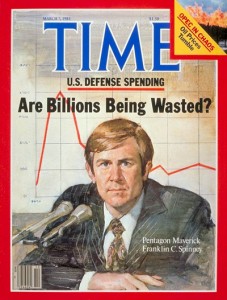
Chuck Spinney: Whithering Israel

06 Genocide, 07 Other Atrocities, 08 Wild Cards, Officers Call
Chuck Spinney

This is an excellent summary of the context for viewing Israel's latest attack on Gaza

A Pillar Built on Sand

John Mearsheimer, LRB Blog, 16 November 2012

In response to a recent upsurge in tit for tat strikes between Israel and the Palestinians in Gaza, Israel decided to ratchet up the violence even further by assassinating Hamas’s military chief, Ahmad Jabari. Hamas, which had been playing a minor role in these exchanges and even appears to have been interested in working out a long-term ceasefire, predictably responded by launching hundreds of rockets into Israel, a few even landing near Tel Aviv. Not surprisingly, the Israelis have threatened a wider conflict, to include a possible invasion of Gaza to topple Hamas and eliminate the rocket threat.

There is some chance that Operation ‘Pillar of Defence’, as the Israelis are calling their current campaign, might become a full-scale war. But even if it does, it will not put an end to Israel’s troubles in Gaza. After all, Israel launched a devastating war against Hamas in the winter of 2008-9 – Operation Cast Lead – and Hamas is still in power and still firing rockets at Israel. In the summer of 2006 Israel went to war against Hizbullah in order to eliminate its missiles and weaken its political position in Lebanon. That offensive failed as well: Hizbullah has far more missiles today than it had in 2006 and its influence in Lebanon is arguably greater than it was in 2006. Pillar of Defence is likely to share a similar fate.

Israel can use force against Hamas in three distinct ways.

Continue reading “Chuck Spinney: Whithering Israel”

Yoda: Missing Much Is, from Twitter

IO Impotency
Got Crowd? BE the Force!

Twtrland: A Social Analytics Tool And Simple Way To Discover New People In The Twitterverse

Twitter does a lot of things well, but it hasn’t really nailed context yet — or search. After you first join the service, it takes a significant amount of following and unfollowing before you settle on a stream (or Twitter hose, as some call it) that works for you. Search, too, is noisy and generally unhelpful. In May, Twitter started to test some personalization features to start making better suggestions in terms of who to follow, etc., and it continues to improve search and “Discover.”

In the meantime, a newly-launched platform called Twtrland wants to give you a simple way to figure out whether or not you should follow, along with a new way to search the Twitter graph.

Read full article

noble gold