2019 UPDATE:
LightSail Energy Storage and the Failure of the Founder Narrative
RELATED:
Continue reading “Eagle: Entire Cities Could Run on Compressed Air 2019 UPDATE: Company Failed”

The truth at any cost lowers all other costs — curated by former US spy Robert David Steele.
Texas Republican Wants State To Leave U.S. Over Obama Wins
A Republican official in Texas called for his state to separate from the United States and the “maggots” who reelected President Barack Obama in a newsletter he sent out this week.
Peter Morrison, who serves as treasurer of the Hardin County Republican Party, wrote in his post-election newsletter that there was a clear solution to the problem of Obama’s re-election.
“We must contest every single inch of ground and delay the baby-murdering, tax-raising socialists at every opportunity,” Morrison wrote. “But in due time, the maggots will have eaten every morsel of flesh off of the rotting corpse of the Republic, and therein lies our opportunity.”
Continue reading “SchwartzReport: Texas Republican Talks Secession”

The most important education technology in 200 years
Kurzweil, November 3, 2012
Education is about to change dramatically, says Anant Agarwal, who heads edX, a $60 million MIT-Harvard effort to stream a college education over the Web, free, with plans to teach a billion students, Technology Review reports.
“Massive open online courses,” or MOOCs, offered by new education ventures like edX, Coursera, and Udacity, to name the most prominent (see “The Crisis in Higher Education”) will affect markets so large that their value is difficult to quantify.
A quarter of the American population, 80 million people, is enrolled in K–12 education, college, or graduate school. Direct expenditures by government exceed $800 billion. Add to that figure private education and corporate training.
Continue reading “Berto Jongman: The most important education technology in 200 years”

Pararescuemen walk line between fierce warrior, caring savior
Laura Rauch
Stars and Stripes, 29 October 2012
While their core function is combat rescue and the personnel recovery of downed aircraft, Air Force pararescue teams also fly throughout Afghanistan augmenting the Army medevac mission.
Though medevac and pararescue overlap in terms of pulling the wounded from the battlefield, they are distinctively different. While medevac adheres to the Geneva Conventions by flying in unarmed helicopters marked with red crosses, pararescue flies in unmarked birds equipped with two .50 caliber machine guns. And they carry the guardian angels.
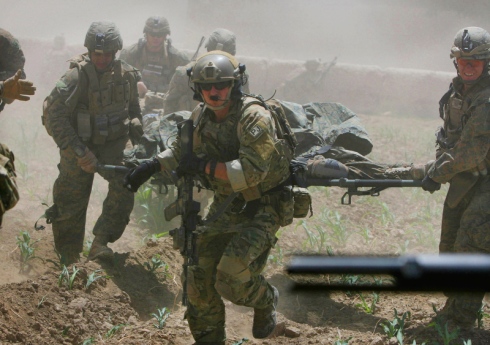
“We are a weapons system, we are armed,” Senior Airman and Pararescueman Jason Sweet said. “We’re shooters, divers, jumpers, technical rescue specialists. We’re ready to rescue anyone, anywhere, anytime.”
While the inception of Air Force combat rescue began in 1947, its legacy has been forged in every conflict since Korea.
The helicopters fly in pairs, one designated as the trail aircraft, and one as lead. Each is capable of landing in the hot zone or providing covering fire from above.
Phi Beta Iota: Peace Jumpers capable of calling in precision parachute drops are a variation of this idea. They too would have guardian angels, but the focus would be on protection from proven rapid delivery of what is needed on the ground in the moment.

Huh?
EXTRACT:
“Due to the incomplete intelligence picture on the ground, armed aircraft options were simply not feasible.”
DOD Releases Detailed Timeline for Benghazi Response
Dorian De Wind
The Moderate Voice, 10 November 2012
The Defense Department released a detailed timeline yesterday of the Pentagon’s response to the September attack in Benghazi, Libya, that left four Americans dead, including U.S. Ambassador J. Christopher Stevens.
The following is the verbatim 10 November news release by the American Forces Press Service:
A senior defense official, speaking on background with Pentagon reporters, emphasized the rapid consultation, planning and troop pre-deployment actions defense leaders undertook in the first hours following the attack.
“With naval, Marine, special operations and air forces either employed or en route to Libya during the attacks, we responded,” the official said. “We mourn the loss of four American heroes in Benghazi.”
The military’s initial response began within minutes of the first incident in Benghazi, the official said: the attack on the U.S. consulate began at 3:42 p.m. EDT [9:42 p.m. Benghazi time], and by 5:10 EDT an unarmed surveillance aircraft was on station over the Benghazi compound.
How the Internet of everything will change the world
From the Internet of Things (IoT), where we are today, we are just beginning to enter a new realm: the Internet of Everything (IoE), where things will gain context awareness, increased processing power, and greater sensing abilities, says Cisco in their blog.
Add people and information into the mix and you get a network of networks where billions or even trillions of connections create unprecedented opportunities and give things that were silent a voice.
Cisco says their IoE as bringing together people, process, data, and things to make networked connections more relevant and valuable than ever before — turning information into actions that create new capabilities, richer experiences, and unprecedented economic opportunity for businesses, individuals, and countries.
Phi Beta Iota: Until true cost information is available for each “thing” or process or service, the network will not be intelligence and will not have integrity in the holistic sense. At the same time, absent a commitment to open standards, open spectrum, open everything, the “things” will not inter-relate as efficiently as possible.

Sad, this is.
Research fraud exploded over the last decade
And retractions don't always mention when data's fraudulent (43% of the time, in fact).
A number of studies have spotted a worrisome trend: although the number of scientific journals and articles published is increasing each year, the rate of papers being retracted as invalid is increasing even faster. Some of these are being retracted due to obvious ethical lapses—fraudulent data or plagiarism—but some past studies have suggested errors and technical problems were the cause of the majority of problems. (…) The authors find that, since 1975, the rate of retracted articles as a percent of total publications has increased nearly tenfold. Duplicate publications and plagiarism, which didn't use to be a significant problem, have boomed since 2005. And while retractions due to errors have increased, those due to fraud have increased much faster.
. . . . . . . .
Patterns of deceit
When it comes to fraud, the traditional research powers are leading the way. The US has the largest number of cases, followed by Germany and Japan. But things like plagiarism and duplicating publications are quite different, with China being a major player, and India having a large presence. These sorts of copying problems are rare in high-profile journals like Nature and Science. Instead, there was a strong correlation between the incidence of fraud and the prominence of the journal, as measured by its impact factor.

