
Reference: Internet Censorship Circumvention

Autonomous Internet, Counter-Oppression/Counter-Dictatorship Practices, Tools, White Papers
Venessa Miemis

Global Voices Blog Critique from Jacob Appelbaum: My motivation for writing this response is to inform readers of the serious concerns that many people, myself included, have about the recent Freedom House report. I am always pleased to see more analysis of censorship circumvention and Internet security tools, but I have concerns about this report’s methodologies and resulting conclusions. The report in its current form could be dangerous to the users it aims to help.

The reporting methodology is sloppy at best and the information in the report is often inaccurate or poorly written. The report demonstrates a general disconnection from the language used by the projects and the circumvention community as a whole.
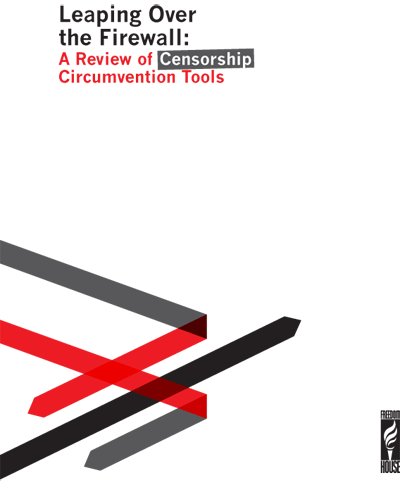
Read full critique.

Click on Image to Enlarge

Internet censorship poses a large and growing challenge to online freedom of expression around the world. Censorship circumvention tools are critical to bypass restrictions on the internet and thereby to protect free expression online.

Circumvention tools are primarily designed to bypass internet filtering. Therefore, the core principle behind these technologies is to find alternative paths for data packets. These alternative paths use one or more collaborative servers in order to bypass the network of blocking mechanisms.

This document provides a comparison among different circumvention tools, both in terms of their technical merits, as well as how users of these tools describe their experience with them. The countries included in this report are Azerbaijan, Burma, China and Iran.

Source: Freedom House

Phi Beta Iota: Within the emerging Autonomous Internet, these tools assume use of the existing grid, and can in turn be used by the authorities, sometimes with the collaboration of the Internet Service Providers, to identify dissidents.  The Autonomous Internet seeks first to bypass local interception points (local solar-powered nodes using leased satellite communications), and ultimately to permit all individuals everywhere to enjoy the Internet for free and in liberty.  Novices forget that anonymous is not the same as invisible, and that security is needed at the point of receipt as well (counter-intelligence outside the denied area is focused on identifying dissidents on the basis of leaks outside the denied area).  NOTE:  Freedom House has a trojan virus–if you don't see the deletion notice your security program is not up to par.


Worth a Look: The Daily Bail on End the Fed

Corruption, Worth A Look
Michael Ostrolenk Recommends...

The most important video they have every offered (we agree).

Sample headlines

Costliest Government Program Of All? – The $5 Trillion In Undeclared Wars Over The Last Decade

Senator's Husband’s Firm Cashes In On Crisis

“You put Lloyd Blankfein in pound-me-in-the-ass prison for one six-month term, and all this bullshit would stop, all over Wall Street,” says a former congressional aide, “That's all it would take, Just once”

Debt & Deficit Portal. Bailout News. Federal Reserve Corruption.

The Daily Bail

Liberation Technology Snap-Shot

02 Diplomacy, Cultural Intelligence, Government, IO Multinational, IO Technologies, Technologies

Liberation technology: dreams, politics, history

Armine Ishkanian, 5 April 2011

openDemocracy

The doctrinal commitment to new cyber and social technologies as a means of solving political problems needs to learn from the past and take a more realistic view, says Armine Ishkanian.

Read full article with many links.

From Google Group The Next Net:

I just finished a conference call on the minimal mandatory requirements for liberation technology for a specific area (there are at least another 50 that would need the same stuff–a generic capability–but in 50 other languages).

1.  $169 cell phone to satellite communications converters, but structured to look like some other popular digital music device, along with a turnkey solar-powered Internet hotspot.

2.  Open satellite channel over the area in question that can receive collect calls from anyone in the area of interest using an announced number and one of the devices.

3.  Downloadable encryption for any cell phone on a use and delete basis from the satellite channel…like digital one time pads with no residue.

3.  Satellite radio into the area of interest with real news relevant to that population including news of the diaspora and exile leadership.

4.  Internet steganography.

I thought CIA, BBG, and JSOG were supposed to be able to do all that.  Evidently not.  I am being told that a fund-raising campaign is starting up to provide these capabilities to no fewer than three areas, possibly expanding to sixteen, all privately funded because the USG is not doing it.

– – – – – –

Dawn McCall

Here is a sample headline that sums up the current state of US Government attention to “liberation technology.”

Bureau of International Information Programs Coordinator Dawn L. McCall Travels to Los Angeles and San Francisco, California April 11 – April 15

Phi Beta Iota: Ms. McCall is a very accomplished Discovery Channel executive with remarkable achievements in one to many broadcasting.  She has been in her current position since 27 July 2010 and does not appear to be headed for Assistant Secretary status anytime soon.  The Undersecretary of Public Diplomacy and Public Affairs is Ms. Judith A. McHale, formerly President and CEO of Discovery Communications, parent of the Discovery Channel.

See Also:

Reference: Open Source Agency (OSA) [Sister to BBG]
2009 DoD OSINT Leadership and Staff Briefings
2006 Briefing to the Coalition Coordination Center (CCC) Leadership at the U.S. Central Command (USCENTCOM)–Multinational Intelligence: Can CENTCOM Lead the Way? Reflections on OSINT & the Coalition
2004 The New Craft of Intelligence: How “State” Should Lead
2004: Information Peacekeeping A Nobel Objective

Creating a Healthy Society

Government, IO Multinational, Non-Governmental
Rob Sentse

Shaping the conditions to build a healthy society, a healthy nation consisting of healthy people who are motivated to look ahead..

To shape such conditions the international community should create a comprehensive approach.

It would be beneficial for the country, in this case South-Sudan (GoSS), if the UN / EU would deploy civil servants from crucial workplaces and from several levels of “our” own governmental management into South Sudan, to work as a coach for their fellow civil servants.

Continue reading “Creating a Healthy Society”

The State of the Internet of Things

Advanced Cyber/IO, IO Sense-Making

The State of the Internet of Things – Is There Enough Commercial Activity?
By Richard MacManus / April 12, 2011 10:42 PM

ReadWriteWeb (RWW)

Over the weekend there was a hackathon held to promote the Internet of Things (IoT), when real world objects get connected to the Internet. The event was run by London-based IoT platform company Pachube. So what got created at this hackathon and what does it tell us about how the Internet of Things is progressing?

Read article, photos, short video….

Tip of the Hat to Pierre Levy at LinkedIn.

Who’s Who in Peace Intelligence: Richard Falk

Alpha E-H, Peace Intelligence
Richard Falk

Richard Falk is the Albert G. Milbank Professor Emeritus of International Law at Princeton University and the Bette and Wylie Aitken Distinguished Visiting Professor of Law at Chapman University School of Law.

Web Stack

His book, The Great Terror War (2003), considers the American response to September 11, including its relationship to the patriotic duties of American citizens. He published Costs of War in 2008. He is also the author or coauthor of numerous additional books, including Religion and Humane Global Governance; Human Rights Horizons; On Humane Governance: Toward a New Global Politics; Explorations at the Edge of Time; Revolutionaries and Functionaries; The Promise of World Order; Indefensible Weapons; Human Rights and State Sovereignty; A Study of Future Worlds; and, This Endangered Planet. He is coeditor of Crimes of War.

He received his B.S. from the Wharton School, University of Pennsylvania; L.L.B. from Yale Law School; and J.S.D. from Harvard University.

Falk at Transnational Foundation for Peace and Future Research

See Also:

Chuck Spinney: Richard Falk on USG Learning Disability

Richard Falk: When Is An NGO Not an NGO?

UN Secretary General and Ambassador Susan Rice Violate Public Intelligence–We Stand with Richard Falk

noble gold