
Journal: Drones of War

08 Wild Cards, Military
Marcus Aurelius

America's Deadly Robots Rewrite The Rules (Sydney Morning Herald)

In the artistry of war, the insertion of a Jordanian double-agent who detonated his explosive vest inside this super-sensitive CIA bunker was flawless. But, in their payback, the enraged Americans confirmed the breadth of a new horizon in modern warfare – launching 15 clinical drone attacks in which more than 100 people died along the border, as Washington's electronic eyes and guns sought out Mehsud and his Taliban and al-Qaeda allies.

War does not get more radical than this – technically, politically and, perhaps, ethically.

Consider: for the first time ever, a civilian intelligence agency is manipulating robots from halfway around the world in a program of extrajudicial executions in a country with which Washington is not at war.   . . .

The US Air Force now has more drone operators in training than fighter and bomber pilots.
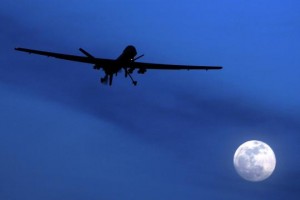
What Would Errol Flynn Think? (Boston Globe)

The drone has become the weapon of choice against Al Qaeda and Taliban leaders. CIA director Leon Panetta called it “the only game in town,’’ and the Pentagon recently announced it was doubling drone production. The US Air Force will soon have more drones than fighter aircraft.   . . .

As Jane Mayer described it in the New Yorker, he’s sitting at a screen. He can zoom in, see whom he wants to kill, and push a button. Sometimes he sees people running out of targeted houses for cover. This is so common, according to Mayer, that the running people are called “squirters’’ at Langley.
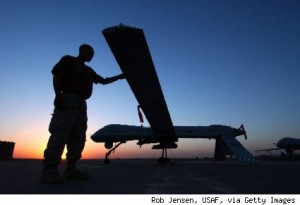
Obama's Drone War: Does The Killing Pay Off? (PoliticsDaily.com)

“The drone attacks have become very effective over time, hitting an increased number of targets, more precisely with less collateral damage,” said Haider Ali Hussein Mullick, a counterinsurgency analyst at the U.S. Joint Special Operations University.

But those stepping into vacant leadership positions, he added, “are more deadly. They do not have strong ideological links. They are dangerous. These are not guys you can talk to.”   . . .

These attacks, the resurgence of al-Qaeda, and the flare-up of its operations in Somalia, Yemen and elsewhere, suggest that the campaign to stop terrorists by killing off terrorist leaders has been less than successful.

“Killing leaders supports an illusion of progress, but not the reality,” said John McCreary, former strategic analyst for the Joint Chiefs of Staff.

Search: oss press cammaert

Searches

Generally Word Press search, which updates constantly, is much better with simpler searches.  Searching only for cammaert produces the following hits that we have resorted in relative order of value (Wrod Press delivers in reverse chronological order).  General Patrick Cammaert, RN NL (Ret) is the best qualified person we know to be the first Assistant-Secretary General for Decision-Support within the United Nations.

Who’s Who in Peace Intelligence: Patrick J. Cammaert

Intelligence in Peacekeeping Operations: Lessons for the Future

2003 Cammaert (NL) Reflections on Peace Intelligence with the Military Advisor to the Secretary General of the United Nations

2003 PEACEKEEPING INTELLIGENCE: Emerging Concepts for the Future

2003 Lewis (UNIDIR) Creating the Global Brain: The United Nations

Graphic: UN Joint Military Analysis Center (Dorn)

2002 Lee (US) Geospatial Information Sources: A Global Primer

Search: United Nations Intelligence Training

UN-NGO Archives on Public Intelligence (1992-2006)

Reference: Developing UN Peace Intelligence Capabilities

Reference: World Brain Institute & Global Game

Search: The Future of OSINT [is M4IS2-Multinational]

Who’s Who in Peace Intelligence: Franklin E. van Kappen

Reference: Department of State Language Gaps

Review: Chasing the Flame–Sergio Vieira de Mello and the Fight to Save the World

Review: Shake Hands With The Devil–The Failure Of Humanity In Rwanda

Review: Humanizing the Digital Age

Review: Promoting Peace with Information–Transparency as a Tool of Security Regimes

Worth a Look: Human Transformation Welcome Message (Organizational Version)

Worth A Look

Phi Beta Iota: All of us in the public intelligence network are in at the creation of what could be a transformative human network.  Both individuals and organizations may register at no cost and be part of the launch. Organizations registering today will be included, with their logo, in the 14 Feb launch video.  The original invitation from Tom Atlee, seer of the co-intelligence network and pioneer for evolutionary activism, is here:

Worth a Look: Sign-Up Today to Be Part of Human Transformation Project

Dear Engaging Organizations leaders,

Welcome to Four Years. Go.

Congratulations on being one the very first organizations to engage in this powerfully emergent global campaign. There are now more than 200 of us! Soon there will be thousands.

We are looking forward to working with you to bring forth the worldwide surge of energy, enthusiasm, creativity and action that will shift humanity to a sustainable, just and fulfilling trajectory by 14 February 2014.
Continue reading “Worth a Look: Human Transformation Welcome Message (Organizational Version)”

Journal: Real-Time Intelligence & Information Sharing

10 Transnational Crime, Law Enforcement, Methods & Process, Peace Intelligence, Real Time
By Benjamin Brown
Posted Feb 11, 2010 @ 04:00 PM
Scituate —

As a way of dealing with cross-town crime and drug use, Scituate police have banded together with other local departments to pursue cases beyond individual town borders.

Marshfield Police Capt. Phil Tavares founded the coalition, formally known as the Old Colony Police Anti-Crime Task Force, or OcPac.

“The most logical approach to combating fiscal hardships and a surge in crime is to make available and consolidate our tangible and intangible resources, as well as real-time intelligence sharing,” said Tavares.

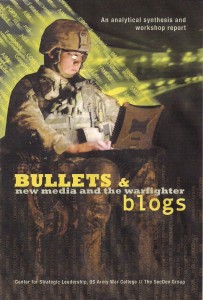
Handbook: Bullets and Blogs Information Operations

Communities of Practice, InfoOps (IO), IO Multinational, IO Sense-Making, Methods & Process, Peace Intelligence
Marcus Aurelius

Invite your attention to attached — contains a couple of interesting observations about Open Source Intelligence (OSINT):

“…open source intelligence — catapulting it to primary place for new adversaries and increasingly for the U.S. military — and also rapid organizational learning and assembly of capabilities…”  [page 9]

“…There are strong indications that Hezbollah made significant use of OSINT — gathering valuable intelligence from Israeli press and news broadcasts as well as websites.  Reports suggest that Hezbollah used Israeli press reports to plot the location of its rocket strikes in Israel and may have used Google Earth to help re-calibrate the accuracy of its fire….”  [page 56]

Continue reading “Handbook: Bullets and Blogs Information Operations”

Worth a Look: Sign-Up Today to Be Part of Human Transformation Project

Worth A Look
Tom Atlee

This is not a new organization. It is a new goal for every organization.

Signup to stay informed or help out…

The first phase of Four Years Go will roll out in Feb 2010.

Below the Fold:  complete explicatory email from Tom Atlee, America's seer for co-intelligence and revolutionary activism.

Skip letter (bad idea–multiple links below) and go directly to Four Years to Go

Continue reading “Worth a Look: Sign-Up Today to Be Part of Human Transformation Project”

Search: management connect the dots

Searches
Robert Steele

Personal from Robert Steele.  Although this search yields some links, we'd like to do a little better for you.  Here are a few observations:

1)  If you are only working with 20% of the relevant information, you cannot connect dots that lie outside that 20%.  We live in a complex globalized environment in which everything is connected, and if you cannot do all information in all languages all the time, while also managing human intelligence to leverage all humans, all minds, all the time, you are toast.  The US Government generally, and the US Intelligence Community  specifically, are still back in the 1950's to 1970's in terms of mind-set, isolation from reality and open sources, and so on.

2)  The top-down unilateral command and control communciations, computing, and intelligence (C4I) infrastructure is so severely handicapped as to be largely worthless in terms of estimate intelligence, warning, or rapid reaction.  Haiti is a classic example of how badly the US Government performs when it cannot connect to reality on the ground–the hard rains come in May, the USA has wasted 30 days by focusing on the evacuation of Americans rather than the stabilization and reconstruction of Haiti–what this means is that in April and May the US Coast Guard may well be over-whelmed with a boat exodus–because at the strategic level, our command authority could “command” individual boats and flights, but it could not “connect” to reality and see the obvious: fix Haiti, or watch them swarm toward US shores.  We invaded Haiti once before to stop a boatlift, it seems we learned nothing from that experience.

Continue reading “Search: management connect the dots”

noble gold