Worth a Look: Economic Intelligence for the Public

Collaboration Zones, Communities of Practice, Ethics, Key Players, Policies, Worth A Look

Chris Martinsen's Free Crash Course on Economics

# Chapter Duration Translations
Introduction (on this page, above) 1:47 Español, Français
1 Three Beliefs 1:46 Español, Français
2 The Three “E”s 1:38 Español, Français
3 Exponential Growth 6:20 Español, Français
4 Compounding is the Problem 3:06 Español, Français
5 Growth vs. Prosperity 3:40 Español, Français
6 What is Money? 5:55 Español, Français
7 Money Creation 4:19 Español, Français
8 The Fed – Money Creation 7:13 Español, Français
9 A Brief History of US Money 7:14 Español, Français
10 Inflation 11:48 Español, Français
11 How Much Is A Trillion? 3:28 Español, Français
12 Debt 12:32 Español, Français
13 A National Failure To Save 12:06 Español, Français
14 Assets & Demographics 13:41 Español, Français
15 Bubbles 14:10 Español, Français
16 Fuzzy Numbers 15:52 Español, Français
17a Part A: Peak Oil 17:52 Español, Français
17b Part B: Energy Budgeting 12:15 Español, Français
17c Part C: Energy And The Economy 7:05 Español, Français
18 Environmental Data 16:22 Español, Français
19 Future Shock 8:02 Español, Français
20 What Should I Do? 19:48 Español, Français

Tip of the Hat to pinecarr, who provided this comment at  Book: INTELLIGENCE FOR EARTH–Chapter 7 Loaded.

Retired Reader states “Identifying what he [Robert D. Steele] conceives as the ten major threats to humanity as the bases for designing a global intelligence system is exactly the way to begin.” I couldn’t agree more.

Given that, and as someone who greatly admires your ability to digest huge amounts of information in your pursuit of truth, I would like to bring “The Crash Course”, by Dr. Chris Martenson, to your attention. It is available free on-line..

I think Chris’s 5 year search for the truth -relating to interacting problems in the economy, energy, and environment- complements your search for larger truths, just starting from a different perspective. I also think the knowledge he conveys may contribute additional insights for your assessment of the top threats to humanity.

For an independent review of the Crash Course by the Huffington Post, see “The Perfect Crash Course on the Economy”.

EXTRACT from Huffington Post (a great review) on the author's three core points:

“The first is that the next twenty years are going to be completely unlike the last twenty years. Second, I believe that its possible that the pace and/or scope of change could overwhelm the ability of our key social and support institutions to adapt. Third, I believe we do not lack any technology or understanding necessary to build ourselves a better future.”
Journal: Financial Intelligence for the Public

03 Economy, 11 Society, Commercial Intelligence, Communities of Practice, Ethics

Chuck Spinney

Stiglitz’s 5 Lessons from 2009

Thursday, 12/31/2009 – 12:01 pm by Joseph Stiglitz

New Deal 2.0

Roosevelt Institute Braintruster and Nobel laureate Joe Stiglitz identifies five lessons we can take away from the financial crisis.

The best that can be said for 2009 is that it could have been worse, that we pulled back from the precipice on which we seemed to be perched in late 2008, and that 2010 will almost surely be better for most countries around the world. The world has also learned some valuable lessons, though at great cost both to current and future prosperity — costs that were unnecessarily high given that we should already have learned them.

The first lesson is that markets are not self-correcting. Indeed, without adequate regulation, they are prone to excess. In 2009, we again saw why Adam Smith’s invisible hand often appeared invisible: it is not there. The bankers’ pursuit of self-interest (greed) did not lead to the well-being of society; it did not even serve their shareholders and bondholders well. It certainly did not serve homeowners who are losing their homes, workers who have lost their jobs, retirees who have seen their retirement funds vanish, or taxpayers who paid hundreds of billions of dollars to bail out the banks.

Continue reading “Journal: Financial Intelligence for the Public”

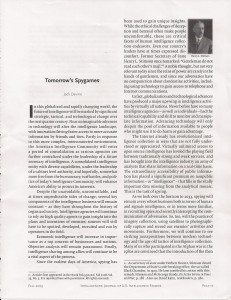
Reference: Jack Devine on Tomorrow’s Spygames

Articles & Chapters, Director of National Intelligence et al (IC)
Jack Devine on Future of Spying

Jack Devine is the finest manager we have ever known, and the only one we know of who has never let a case officer miss a deadline without asking why.  Former Acting Deputy Director of Operations while appointed as ADDO, former head of Latin America Division, he managed the Afghan Task Force whose outcomes are have been tactically and operationally successful and strategically painful.  His signal idea in the above article is a Secretary of Intelligence.  It's not a bad idea, if accompanied by legislation that gives the Secretary the powers that the Director of Naitonal Intelligence (DNI) does not have now, but a better idea would be a Secretary for Education, Intelligence, and Research, with CIA converted into Director of Classified Intelligence, a new Director of Open Source Intelligence, NSA becomes the all-souorce processing center, and the NRO gets folded into NGA at the same time that USGS is absorbed by NGA.  The article also falls prey to the acceptance of glibness by others–cyberwar, for example, is not something we can just throw money at–there are not enough qualified cyber-warriors with US citizenship eligible for clearances to become competent in less than a decade–cyberwar is going to have to be a multinational endeavor, and the Chinese are twenty years ahead of us in both offense and defense.  Reality can be such a pesky creature to deal with….

With a tip of the hat to the Association for Intelligence Officers (AFIO), which provided this in Intelligencer: Journal of U.S. Intelligence Studies (Fall 2009), pages 49-55 (7 pages).  Although AFIO has not opened its doors to all multinational multifunctional intelligence professionals across the eight tribes of intelligence as we expect it to one day, its web site and publications are openly available and we encourage one and all to subscribe.

See also:

2009: Human Intelligence (HUMINT) Trilogy which includes:

Intelligence for the President–AND Everyone Else

+ Fixing the White House and National Intelligence

+ Human Intelligence (HUMINT): All Humans, All Minds, All the Time

Journal: Director of National Intelligence Alleges….

Search: Intelligence Reform

Search: The Future of OSINT [is M4IS2-Multinational]

Search: Intelligence Preparation of the Battlefield

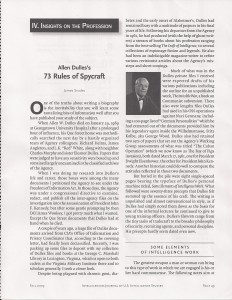
Reference: 73 Rules of Tradecraft (Dulles via Srodes)

Articles & Chapters, Director of National Intelligence et al (IC)
Allen Dulles on Tradecraft

With a tip of the hat to the Association for Intelligence Officers (AFIO), which provided this in Intelligencer: Journal of U.S. Intelligence Studies (Fall 2009), pages 49-55 (7 pages).  Although AFIO has not opened its doors to all multinational multifunctional intelligence professionals across the eight tribes of intelligence as we expect it to one day, its web site and publications are openly available and we encourage one and all to subscribe.

See also:  Review: Allen Dulles–Master of Spies by the same author of the above article, James Srodes.

Journal: US “Not Viewed as Occupiers in Afghanistan.” Really?

08 Wild Cards

McChrystal Sees Victory Ahead In Afghanistan

By Drew Brown, Stars and Stripes

Mideast edition, Saturday, January 2, 2010

“We are not viewed as occupiers now, ” Gen. Stanley McChrystal, commander of the NATO-led International Security Assistance Force, told Stars and Stripes in an interview Friday.

Continue reading “Journal: US “Not Viewed as Occupiers in Afghanistan.” Really?”

Journal: 1979 to 1988 to 1998 to Now–History Matters

History

Full Story Online

The Radical Legacy Of 1979

By Edward. P. Djerejian

If ever one year in recent times was a catalyst for change in the broader Middle East and Muslim world, it was 1979. One ray of bright light in that year of darkness was the signing of the historic Camp David peace treaty between Israel and Egypt. Conversely, three events had dire consequences with which we live today.

First, there was the overthrow of the shah of Iran by the Ayatollah Khomeini. Second, there was the takeover of the Grand Mosque in Mecca, Saudi Arabia, by a group of Islamic extremists. And third, there was the Soviet invasion of Afghanistan.

Each event fostered the forces of radicalization with implications far beyond the region's borders.

Iran becomes a theocracy.

Saudi Arabia embraces the Wahhabis.

The Soviets invade Afghanistan.

Continue reading “Journal: 1979 to 1988 to 1998 to Now–History Matters”

Graphic: UN Tools & Methods (Walter Dorn) Updated

Advanced Cyber/IO, Collection, Multinational Plus
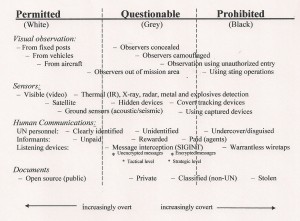
Updated UN Tools & Methods

The above first appeared in “The Cloak and the Blue Beret: Limitations on Intelligence in UN Peacekeeping, chapter 19 in PEACEKEEPING INTELLIGENCE: Emerging Concepts for the Future.  His earlier article “Intelligence and Peacekeeping: The UN Operation in the Congo, 1960-1964remains the single best exposition of how to use intelligence as the foundation for successful peacekeeping.

Dr. Dorn updated the above for the forthcoming Oxford Handbook on National Security Intelligence (Loch Johnson, Ed., March 2010 release) and shared the updated version above via electronic mail.

noble gold