Very inspiring talk, i listened in silence to him and that doesn’t happen often.
As an ex VN soldier i fully support the generals opinion.
Even after losing his own son in Afghanistan he still firmly believes in his ideals and knows how to express them on a way that is understandable and inspiring to allot of people, i can only say general van Uhm made me proud to be Dutch today, and proud i served in the Dutch armed forces.
Such is the self-referencing nonsense produced in contemporary American political discourse shaped by a perpetual election cycle that disconnects debate from the real world and stifles rational governance, but keeps the masses entertained and distracted, much like the circuses did for the Roman masses in the waning days of the Empire. With American politicians are arguing endlessly how great a victory we achieved in Iraq, a natural question remains unasked: What does the rest of the world — particularly the Arab world — thinks of our ‘success'?
Attached, FYI, are two thoughtful alternative points of view on this question.
The first headline is from Rami Khouri's. He is a columnist for the Lebanese Daily Star and is syndicated by the prestigious Agence-Global. The second headline is from Patrick Cockburn's, writing in the Independent [UK]. He is one of the most well informed western reporters now writing about the Middle East.
The United States under President George W. Bush drew on a deep well of nonsense, lies and fantasy when it entered Iraq in 2003. President Barack Obama continued this bipartisan American tradition when he said Monday that the departure of American forces from Iraq left behind a country that can be a model for other aspiring democracies. On the other side of the Arab world on the same day, the Tunisian people elected a new president, providing a more credible example of how Arabs can aspire to become democratic without foreign armies destroying their national fabric. Read more.
World View: For all its military might, the US has failed to get its way in Afghanistan and Iraq, severely denting the prestige of the world's only superpower
Phi Beta Iota: Mr. Cockburn's article contains one major assumption, to wit that the US Government will not attack Iran nor condone an Israeli attack on Iran. We disagree. Now more than ever, Israel is bent on attacking Iran and drawing the US in–the deployment of US/NATO troops all around Syria, the plans for major NATO air operations ostensibly against Syria (long billed, falsely, as an Iranian puppet state) all point to precisely the opposite: a cresendo joint US-Israel mega-attack on Iran and Syria together.
In summary: US took ten years to make an issue of two Pakistani fertilizer factories that are the primary source for all Improvised Explosive Devices (IED) killing and maiming in AF. Taliban gets what it wants in AF school programs, Iran makes progress in AF, SY and on the side with Saudi Arabia.
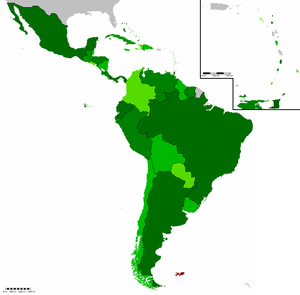
TheCommunity of Latin American and Caribbean States (Spanish: Comunidad de Estados Latinoamericanos y Caribeños, CELAC, Portuguese: Comunidade de Estados Latino-Americanos e Caribenhos, French: Communauté des États Latino-Américains et Caribéens, Dutch: Gemeenschap van de Latijns-Amerikaanse en Caribische landen) is the tentative name[1] of a regional bloc of Latin American and Caribbean nations created on February 23, 2010, at the Rio Group–Caribbean CommunityUnity Summit held in Playa del Carmen, Quintana Roo, Mexico.[2][3] It consists of all sovereign countries in the Americas, except for Canada, France, the Netherlands and the United States. British and Danish dependencies in the Americas are also not represented in CELAC.
CELAC is an example of a decade-long push for deeper integration within the Americas.[4] CELAC is being created to deepen Latin American integration and to reduce the once overwhelming influence of the United States on the politics and economics of Latin America, and is seen as an alternative to the Organization of American States (OAS), the regional body organized largely by Washington in 1948, ostensibly as a countermeasure to potential Soviet influence in the region.[4][5][6]
The arguments for attacking Iran are crazy, like those for attacking Iraq in response to 9-11. But that does not mean such an attack by the American and/or the Israelis will not occur.
Indeed, I think the political pressure for such an attack is increasing. My reasons for saying this are as follows:
On 11 October, Patrick Seale wrote a very important essay, Will Israel Bomb Iran. Seale described secret internal deliberations in the Israeli government over the twin questions of (1) how short a time window existed for Israel to launch a sneak attack on Iran and (2) how to suck in the United States into supporting such an attack, even if an Israeli attack was launched without US approval or if the US was kept in ignorance beforehand? Seale, who is extremely well connected and very knowledgeable on the Middle Eastern affairs, also reported the Americans knew of the Israeli discussions, and the idea of Israeli decision makers thinking their window of opportunity was closing was causing alarm in Washington.
The US military is under threat in its own country as homegrown Islamic extremists, including “radicalized troops,” are treating military installations here as prime targets, US officials warned Congress Wednesday.
The below report by Patrick Cockburn, one of the best reporters now covering the Middle East, describes the growing tensions in Iraq over the question of sharing its oil wealth among its constituent regions. Although his report is important in its own right, its contents become even more ominous when they viewed in a larger historical context:
The long view of history is likely to record the greatest ‘sins' of Iraq, Iran, and Libya prompting interventions by the West have been related to the control of oil — not nuclear weapons; not any communist leanings during the Cold War; not support of worldwide terrorism.
Each country committed the unforgivable sin of being governed at one time by nationalistic leaders who believed the oil under each country belonged to that country and should be controlled by the government of that country — therefore, these leaders had to be removed:
Iran – Mohammed Mosaddegh, a popularly elected Prime Minister of Iran and social reformer, removed by a CIA/MI6 coup in August 1953.
Iraq – Saddam Hussein, a murderous neo-Stalinist dictator and social reformer (e.g., major achievements in women's rights and education), removed by military force in 2003.
Libya – Muammar Qaddafy, a quirky tribal dictator and social reformer (e.g., major achievements in women's rights and education) removed by military force in 2011.
Click on Image to Enlarge
One short-term common denominator in these imposed regime changes was that the nationalist leader was replaced by a more compliant government that agreed to an opening of that country's oil fields to exploitation by privately owned western oil companies.
While history does not repeat itself, memories of the past condition events in the future. Over the longer term, perceived wrongs are not forgotten, and such interventions can provoke blowbacks, which in turn provoke counteractions that enmesh the intervener in a welter of increasingly complicated conflicts. In the case of Iran, for example, the 1953 coup eventually backfired in 1979, when Reza Shah Pahlavi was overthrown by the Islamic revolution led by the Ayatollah Khomeini. Khomeini then established a regime retook control of Iran's oil fields, among other things. But the Iranian game is not over, and the historical pattern of move and countermove is in play, with the nationalist (Islamic) regime of Iran again in the West's crosshairs, allegedly because of its nuclear ambitions and support of international terror. Nevertheless, the glittering temptations of re-privatizing Persian oilfields are lurking in the background, attracting the private oil capitalists of the West like flies to honey.
Finish long comment from Spinney, plus reference, plus See Also.