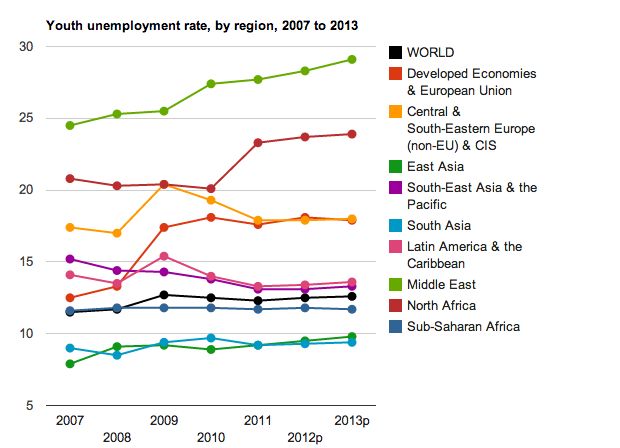
Graphic: Youth Unemployment by Region — Worst Ever
03 Economy, 11 Society, Civil Society, Commerce, Government
The truth at any cost lowers all other costs — curated by former US spy Robert David Steele.

Being read in Europe.
Former FBI Agent Confirms the Surveillance State Is Real
Truthdig, 4 May 2013
A former FBI counterterrorism agent acknowledged this week on CNN that every telephone conversation that takes place on American soil “is being captured as we speak.”
Continue reading “Berto Jongman: USA is a Surveillance State Turned Against Itself”

Huh?
Guantanamo Attorney Found Dead in Apparent Suicide
Jason Leopold
Truthout, 1 May 2013
An attorney who represented prisoners detained at Guantanamo Bay was found dead last week in what sources said was a suicide.
Andy P. Hart, 38, a federal public defender in Toledo, Ohio, apparently died of a self-inflicted gunshot wound. Hart left behind a suicide note and a thumb drive, believed to contain his case files. It is unknown where Hart died, what the suicide note said or whether an autopsy was performed.
Hart’s death comes amid escalating chaos that has engulfed Guantanamo over the past three months—from a mass hunger strike to military commissions and renewed pressure on the White House to shut down the prison facility. Hart was one of three-dozen Guantanamo attorneys who signed a letter in March urging Secretary of Defense Chuck Hagel to take immediate action and bring about an end to the hunger strike.
Because Hart was a federal employee working on sensitive legal issues the FBI was contacted about his death. It is unknown if the agency has been investigating the circumstances surrounding his death.
Neither the FBI nor local law enforcement officials in Toledo, Ohio returned calls for comment. A phone number listed for Hart was disconnected Wednesday.

List only — read article for elaboration.
Ten civilization-shaping trends for 2013 that are driving us into social and spiritual crisis
Mike Adams
Natural News, 1 May 2013
#1) The rise of human engineered genetics
#2) Reality escapism via gaming, social networks and computer-human interface devices such as Google Glass, VR helmets
#3) The demonization of normalcy
#4) The rise of “omission journalism”
#5) The “Idiocracy” effect of self-selected procreation that multiplies the number of people least qualified to advance humanity
#6) The censorship and criminalization of knowledge
#7) Selective dehumanization: The abandonment of any value for the life of a newborn child or any adult who disagrees with you
#8) The “theaterization” of narratives for political gain (false flags)
#9) The end of privacy: Government tracking and cross-referencing of every uttered word, email, web page visit, photos and electronic communications
#10) Rewriting of history

The Pope Called One of the Foundations of the Global Capitalism System ‘Slavery'
Pope Francis on Wednesday condemned as “slave labour” the conditions for hundreds of workers killed in a factory collapse in Bangladesh and urged political leaders to fight unemployment in a sweeping critique of “selfish profit”.
The pope said he had been particularly struck by a headline saying workers at the factory near Dhaka were being paid just 38 euros ($50) a month.
“This is called slave labour!” the pope was quoted by Vatican radio as saying in his homily at a private mass in his residence to mark May Day.
More than 400 workers have been confirmed dead and scores are missing in the collapse, which occurred in a suburb of the capital Dhaka last week in the country's worst-ever industrial disaster.
“Today in the world this slavery is being committed against something beautiful that God has given us — the capacity to create, to work, to have dignity,” the pope said at the mass.
Christopher King has worked in residential and corporate real estate in various capacities for the past twelve years, clearing title, filing zoning applications and reviewing wireless tower contracts. He and his associates are now teaming to provide video coverage of America's imploding Mortgage market. All images video and text subject to copyright.
Wednesday, May 1, 2013

Naturally Judge Norman became the Judge on the case. One must wonder why Lee picked Norman instead of, say, Judge King who found foreclosure mill attorney Thomas P. Dore to have violated several ethics rules. It was the second such determination that Dore has faced in connection with foreclosure cases in the past 3 years, for use of false documents and signatures.
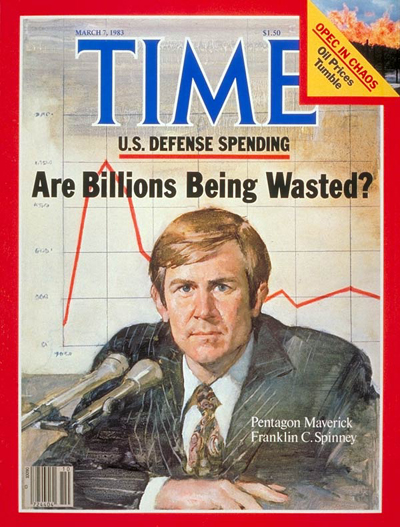
In the attached essay, my very good friend Mike Lofgren raises the question of whether defense spending is good for the economy. This is a current issue because the threat of defense budget reduction is being countered by arguments asserting that these reductions will push the economy into recession. More generally, the political addiction to defense spending has been a major contributor to our nation's economic decline and our political stagnation — i.e., what I have called Americas Defense Dependency, the subject of an essay I wrote last November for Counterpunch. Mike comes at these issues from a different albeit complimentary and equally important angle.
Readers interested in learning more about this important subject will find the work of the late Professor Seymour Melman of Columbia University to be particularly edifying. In his prescient book, Profits Without Production (Knopf, 1983), Melman explained how the growing militarization of our economy was one of the central causes of the decline in America’s manufacturing competitiveness. This decline started in the 1970s, but Melman showed how it grew out of seeds planted by the permanent military mobilization of a huge defense industry in the 1950s.
Chuck Spinney
Marina di Ragusa, Sicilia

Michael S. Lofgren, Huffington Post, Posted: 04/30/2013 12:06 pm
The author is a Former Congressional Staffer and author of The Party is Over: How Republicans Went Crazy, Democrats Became Useless, and the Middle Class Got Shafted
The 1960s comedy show Laugh-In included an occasional sketch in which co-host Dan Rowan played a comic general whose tag-line was “war is good for business!” In an ironic echo of that skit, an April 27 Washington Post story delivers the same message: “A steep slowdown in defense spending tied to the end of the wars in Iraq and Afghanistan is undercutting the country's economic recovery, new government data released Friday revealed.” An 11.5-percent annual drop in Pentagon spending resulted in slower growth in the gross domestic product (GDP) during the first quarter of 2013 than economists expected.
So did the dozen years of war, with all the deaths, destruction, and expense they entailed, have the perverse silver lining of being good for the economy? Most mainstream economists — who, like cynics, know the price of everything and the value of nothing — would answer in the affirmative.
Gross domestic product, which they tend to treat as a surrogate for economic well-being, is only a tote board of all spending that occurs in an economy. Statistics like GDP are arbitrary, subject to incomplete data, and can mislead us about underlying economic conditions. A dollar spent on a cancer cure has the same worth to the GDP as a dollar spent to bribe an Afghan drug lord. This convention can reach absurd lengths, such as massive hurricane damage possibly increasing the GDP: money must be spent just to get conditions back to the way they were, but it counts it as “growth.”
Based on my almost three decades on Capitol Hill, most of them involved in defense budgeting, I can say authoritatively that military spending evokes an almost mystical reverence among many members of Congress. A $325-billion defense program like the F-35, however technically flawed, typically engenders less floor debate than relatively miniscule domestic programs such as the Corporation for Public Broadcasting.
Continue reading “Chuck Spinney & Mike Lofgren: Is War Good for the Economy?”
