What sets this movie apart, in my view, are the nuanced facial expressions and the deep sincerity that the two main actors bring to the screen. I certainly regard the actor playing the hero of this film, the adopted son, to be in line for best supporting actor, or the other way around. Every time I watch this movie I find something I missed before, and I simply do not tire of that pleasure.
It troubles me that a movie as rich as this, telling a true story that is representative of what can be the best of America in a single individual doing the right thing for the right reasons, seems to bring little minds out of the crevices where they have been hiding. This is not a Christian movie, an anti-Christian movie, a bi-racial movie, or anything else. It is an American Story in the grandest possible manner. In no way does that excuse the continuing segregation and abuse of people of color, the really rotten education system for all, the two-party tyranny, the corruption of the US government at all levels–but in one small very real time and space, one family–one mother–got it right.
Pure Fun with Great Visuals–a Fantasy Film to be Sure
March 29, 2010
Meryl Streep, Steve Martin, Alec Baldwin
Guatemala seems to be the place where Academy Award pre-release DVDs find a home and are replicated in the thousands, then sold for a few dollars if not less–I have never bought one, just borrowed from those who have. I am reminded of the VHS underground marketplace in Panama in the 1980's.
Alec Baldwin really surprised me–he rose to the occasion and turns in one of his best performances as a supporting actor to Meryl Streep, with Steve Allen coming in as third fiddle but the ultimate victor.
I take quite seriously the severe critic that complains this is a white super-suburban fantasy film, and this is absolute true. Having said that, I never-the-less recommend this film very strongly as engaging, with very strong visuals, and a total pleasure across the board.
I had real reservations about this DVD based on the write-up, but Meg Ryan carried it over as I was picking out three DVDs to keep me company on an editing marathon.
BE PATIENT with the beginning. Despite Meg Ryan (doing very well playing a stressed out robot lawyer), I almost lost patience and moved on.
On balance the movie is fun, provokes thought, and it has an absolutely killer ending that makes the whole thing totally worth watching from beginning to end, and leaves me chuckling with appreciation for Meg Ryan the actress and Meg Ryan the character as played in the film.
Riveting, Gifted Reporting, Deeply Depressing, Call to Arms, May 18, 2008
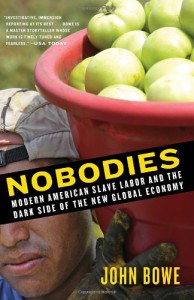
John Bowe
This is a spectacular piece of work with many gifted turns of phrase. The author has done his homework, and melds economic facts and philosophical reflections in a worthy manner. The author opens with a challenge: how should a free people respond to slavery, i.e. should they knowingly buy products and services that are rooted in slavery?
I ordered this book on the strength of the author's appearance on CSPAN BookTV, and this is one of those instances where I think that listening to him talk about the book first is hugely beneficial to appreciating the book. The author, in person (on CSPAN), is funny, intelligent, informative, a really excellent presenter of facts in a coherent manner.
Supreme Court Justice Brandeis is cited in this book: “You can have great concentration of wealth in the hands of a few or you can have democracy. You can't have both.” While the author documents slavery, at least 27 million world-wide (not counting the prison-slave population) with 800 million not enslaved but utterly poor going hungry each day, 33 million of them in the USA, his book is a socio-economic ideo-cultural treatise on “whither globalization.” His bottom line is clear: if we allow slave labor and sweatshop conditions to undercut each of our homeland industries, we are toast.
The author does something quite special with this book. I am deeply impressed. Since the 1970's I have understood the conflict between multinational corporations and governments, the trade-offs between profits and social value, but it is only recently that my reading has brought forth the sharp battle that will define the 21st Century: the battle between Collective Intelligence (one for all, all for one) and Corruption at all levels of government and business.
The meme “true cost” is the ideological battle line. Also known as the triple bottom line (economic, social, and environmental), it is my view that the ability of my generation to promulgate True Cost information in the next ten years is going to determine what kind of future our children have. The author provides numbers, and I am gripped by the 40 cents paid to the slave laborer for a bucket of tomatos, versus the $12.00 plus paid to the farmer or “organizer/enforcer.” The author is eloquent in describing how slave wages have not risen in thirty years, while all else has….
This book is deep, richly textured, a tremendously informative and socially-valuable offering.
Here are a few highlights that stayed with me:
1) US Census statistics are so “delusional and deceptive” that Wall Street investors no longer use them–they commission their own studies.
2) The conditions of slavery and poverty and abuse are so deeply entrenched, and imposed on individual held in isolation from society and the rule of law–when the law is willing to be enforced–that they might as well be on another planet, a slave planet.
3) FBI Special Agents get very high marks for being able to master law enforcement in an illegal immigration environment, but the author speaks of “institutional malfeasance” in how often the FBI transfers people. I have long felt that we need to turn government inside out–we need to mass Latin American specialists across government, military, law enforcement, etc, and we need to start putting people into 10 year tours.
4) It is clear we need a “white hat” side of the Immigration and Naturalization Service (INS), I envision something in which all information they might collect in investigating human rights and other labor violations is firewalled from illigal immigrant status.
5) 911 operators are virtually helpless in responding to foreign langugage calls. I have been saying for years that we need to have an international implementation using Telelanguage.com.
6) The author surprises me with his optimism, his expectation that we can achieve a profound change in attitude across our population, completely boycotting all products and services whose “true cost” include slave labor.
I want to end this laudatory review by pointing readers toward the World Index of Social and Environmental Responsibility, the Interra Project, the World Cafe, and the Earth Intelligence Network.
Below I list a few other books that support this one. The first book documented the commoditization of human labor as the beginning of commercialized evil. The rest are increasingly positive about all of us coming together to overcome power and information asymmetries. “Put enough eyes on it, no bug is invisible. That's us: intelligence officers to the poor and the disenfranchised, who in being lifted from slavery, will create infinite revolutionary wealth. We can do this.
Brilliantly Conceived and Executed, Totally Absorbing, July 5, 2008
Helmut K. Anheier
Half the book is text and half superb illustrations and charts.
The publisher has failed to provide a table of contents, the easiest way to make it instantly clear to any prospective purchaser that this book is quite unusual in its scope and weight.
This is the first book in a series, the next two will focus on culture and economy, and then on culture and politics.
Close to 50 contributors, and a process of conferences in advance of the book's preparation, assure the quality and diversity of this offering.
Chapters 1-6 are introductory, each by different authors or pairs of authors, focusing on approaches and developments in the cultural dimension of conflicts and tensions.
Chapters 7-13 discuss different regional realities, including China and how the US cultural wars went global (no focus on the global class war in this book).
Chapters 14-17 discuss tensions; chapters 18 & 19 values, and chapters 20-22 migration into respectively, the USA, Argentina, and Malaysia.
Chapters 23-27 introduce the concept of culture as a tool for preventing and resolving conflict and are followed by a massive resource section, the cultural indicators suite.
My fly-leaf notes from the text half of the book:
+ Globalization can weaken social agencies and impose suffering on minorities
+ PERCEPTION of fairness or unfairness a major factor
+ Cultural entrepreneurs (e.g. Islamic clerics or American ministers) can hijack culture for their own ends (e.g. influence or wealth)
+ State fragmentation or shrinking reduces social safety nets
+ Globalization seen differently by varied groups
+ Lack of solid data on culture and conflict
+ Culture now transnational and subnational
+ Globalization equals competing world views in contact and collision
+ Culture moves globally as knowledge, artifacts or goods, and people in migration
+ Four general cultural protagonist groups:
– Davos Culture
– Faculty Club
– McWorld
– Religious revival
+ Globalization and global threats not being adequately addressed at global scale (e.g. the UN and Red Cross are not cutting it)
+ Identity politics can become conflictual–religion amplifies social differences
+ Huntington is anti-thesis to this book, a cliché
+ Worldview more useful term than civilization
+ Cultural conflicts are manufactured
+ Cultural heritage is a collective memory
+ When ethnic immigrant unemployment if 3 to 4 times that of natives, this invites conflict
+ Civil wars on rise and ethno-nationalist up to 90% from 25% in 1935
+ “Cultural practice” is a new set of competencies for dealing with the reality of conflict among groups
+ Theater can be used to role play and articulate repressed anger
+ Memory wars waiting to erupt
+ Cultural imperialism furthers immoral capitalism
+ Culture can help reconcile differences but cannot compensate for lack of water, food, shelter, security
+ Resistance strategies of Canada, Malaysia, and Kazakhstan reviewed
+ Fascinating chapter on Singapore fails to mention four official national languages: English, Mandarin, Malay, and Hindi
+ European model emphasizes somewhat imperfectly:
– Jobs and growth
– Economic policies
– Flexible labor
– Knowledge economies
– Investment in education
– Human rights
– Ecological issues
– Immigration
– Aging population
– Public reform
+ Fourth world: immigrants with no rights or recognition
+ China has seen rise of nationalism, anti-Americanism, cultural conservatives
+ On balance China's leadership has successfully managed Chinese capitalism and cultural shifts
+ USA in confusion, experiencing a 4th great awakening since 1975
+ Fault lines are North versus South, Arabs versus West, Religion versus Identity Politics, Europe versus USA
+ Mediating or cross-cultural “concord” organizations are needed:
– Logic of collective investment
– Promote overarching values
– Balance bridging and bonding
– Establish rules of engagement
– Recognize and reward investment
– Prevent proselytizing
– Acknowledge and receive legitimacy
– Avoid “gotcha”
– Accept incomplete understanding or less than full acceptance
– Support single-community endeavors
– Develop leaders
+ Citizen radio in Colombia helped (I think of multi-media Internet and cell phone broad and narrowcasting
My word limit prevents me from doing this book full justice. I hope someone else will provide a good overview and review of the second half of the book where the indicators are developed. While similar to Banks & Textor in the 1970's, and to many of the “State of ….” Graphical and Visual Atlases, I found this book to be completely engrossing and extremely worthwhile. Worth every penny. A signal contribution.
Best in Class Overview–Follow On Volume Warranted, July 23, 2008
Duke Center for Integrative Medicine
Below I list links to two other “alternative” or natural medicine books, and above I post a slide that I created as I contemplate a new book on Health Intelligence.
Unlike the other two books, this book is an overview book that integrates both conventional and “alternative” or natural medicine as commonly developed by both the Chinese (more structured, easier to access and exploit) and the Indian (more verbal and not as documented).
For this book to come out of Duke University (the “Harvard” of the South, but a powerhouse in its own right) is easily worth a fifth star, as Duke appears to be, along with the University of Washington, one of a tiny handful of institutions that is committed to balancing a very unreliable, wasteful, and often deceptive “conventional” medicine program (big phrama and lots of elective surguries that are not evidence-based), with natural cures including lifestyle and behavior or preference patterns that have been proven over centuries in China and India, but deliberately repressed, censored, subverted and scorned by the American Medical Association, which exists largely to protect a very badly broken medical “practice” that is closer to witch doctoring than it is to evidence-based holistic health.
I am very pleased to see that the publisher and Amazon have made it possible to “look inside” this excellent book, so my normal remediation is not necessary. This book is a “class act” in every possible sense of the word, from content to organization to presentation to glosary and index. It is true that “encyclopedia” may not be completely appropriate, “overview” might be a better term, but I have to give all those associated with this book real credit for taking the giant leap forward in integrating Part I, a Catalog of Health Conditions with Part II, Complementary & Alternative Therapies.
The book earns one of its stars for its emphasis on Prevention. I fear that more critical reviewers are missing the paradigm-shift in the forest due to their micro-focus on a specific condition about which they have deep knowledge. I regard this book as a true pioneering endeavor, one with huge credibility, and one extremely meritorious and worthy of follow-up.
The volume I would really like to see next from Duke would examine the true costs to society, and the true costs to heal (with an emphasis on the cost of prevention and the cost of natural cures), for each of the diseases covered in volume one. If we can articulate, in cold hard proven numbers, the costs, the common sense of the public will take us to the next leve.
Superb Example Should be Applied to All Topics, July 24, 2008
Joni Seager
This is one of three atlases I am reviewing today, but instead of reviewing the twelve or so in my library, a couple of which I did long ago, I am creating a list of atlases as substantive visualization of inquality and relative status.
This specific atlas on women is divided into seven parts:
+ Women in the World
+ Families
+ Brithrights
+ Body Politics
+ Work
+ To Have and Have Not
+ Power
+ World Tables
General comment: I remove one star from all atlases I am reviewing for the same generic reasons:
1) Each volume lacks an overview, in the case of women, “the difference women make.” You will not find in this volume the fact that the single best investment for any charitable or foreign assistance dollar is in the education of a woman–from that follows all else that is good in society.
2) Each volume lacks a website where one can rapidly “see” changes for any given chart, or compare and contrast different charts. These atlases, regardless of publisher, are “state of the art” visualization for the INDUSTRIAL era, not the information era.
3) The publishers are not keeping the publications up to date. This one, for example, by Penguin, is copyrighted 2003. All of these need ANNUAL updates as well as a live interactive website where women can interact, add data, and generally create new value from an end-user perspective.
Wish list: that the publishers come together and agree to work together to create a series of atlases on the ten threats and twelve core policy areas, that I list below for convenience.
Twelve policies (of my own making, after studying the Mandates for Leadership from the last 4-5 presidential campaigns in USA):
+ Agriculture
+ Diplomacy
+ Economy
+ Education
+ Energy
+ Family
+ Health
+ Immigation/Emigration
+ Justice
+ Security
+ Society
+ Water
Concluding comment: Peter Drucker said, writing in Forbes ASAP on 28 August 1998, that we have spent 50 years on the T in IT, and now need to spend 50 years on the I in IT. Visualization such as this book provided, but interactive and connected to both “true costs” and to real-world budgets at all levels of governance across all organizations (government, corporate, non-profit).

 Phenomenal on all fronts, April 26, 2010


 Killer Ending, Meg Ryan Carries It Off