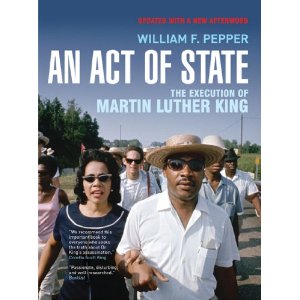
Review: An Act of State–The Execution of Martin Luther King, New and Updated Edition

5 Star, Crime (Government)
Amazon Page
Amazon Page

Compelling Story of US Government Role in Death of Martin Luther King,

May 4, 2008

William F. Pepper

Edit of 8 May 08: Reverend Wright preaches in the negative, but this does not mean he is wrong, only inflamatory. Senator Obama's first instinct was correct: he can no more deny those who walked with us than we can the truth. In renouncing Reverend Wright, Senator Obama demonstrated his subordination to “the system,” the same subordination that swallowed Colin Powell, who confused loyalty with integrity.

John 8:32 Ye shall know the truth, and the truth shall make you free.

The updated book is better than the original because it includes a post 9-11 Afterword.

So many people are going to consider this book to be a provocation, a conspiracy theory, revisionist, etc. I will start with three compelling reasons to take this seriously:

1. The author is a recognized barrister in England and lawyer in the US. His reputation is impeccable, and he is respected by heads of state and of international organizations concerned with human rights.

2. The author brought a civil suit in which it took the jury less than one hour of deliberation after all the facts had been laid out, to find for the plaintiffs (the King family survivors) and agree that the US Government was complicit in his murder.

3. The evidence of US Government complicity in crimes against humanity as well as high crimes and misdemeanors of all sorts, is now over-whelming within the non-fiction literature. Cover-ups are the norm.

Here are my flyleaf notes:

+ King was leading a coalition of peace and civil rights in 1967, one that expanded to address economic injustice and the rights of indigenous people's everywhere, but especially in Viet-Nam. This “new politics,” like the third party politics of today, was so threatening to the Mafia, to banks and corporations, and to the US political and FBI leadership committed to “because we say so, right or wrong,” that he was ordered killed.

+ The author tells us that by 1970 King's moral authority was directly challenging the moral bankruptcy of the American “state,” which King aptly described as “the greatest purveyor of violence on Earth.” See my review of The Fifty-Year Wound: How America's Cold War Victory Has Shaped Our World and also Legacy of Ashes: The History of the CIA

+ Unlike others who accepted the government's fictional account at face value, the author actually interviewed James Earl Ray in prison, and over time clearly established both Ray's veracity, and additional evidence.

+ The FBI burglarized Martin Luther King over 20 times.

+ Less than one month after the John F. Kennedy assassination (he was warned and discounted the warning delivered by his brother), the FBI made Martin Luther King its top target, focusing on “neutralizing King as an effective leader.” The cover-up is exposed in Someone Would Have Talked: The Assassination of President John F. Kennedy and the Conspiracy to Mislead History.

+ At least two funded “hits” on King were discovered, but the one that succeeded involved Frank Liberto, a Mafia boss in the food business, who evidently forgave a major debt from Lloyd Jowers who served as the on-site cut-out for the weapon but did not do the shooting himself. Links are discussed between the FBI, the Mafia, and local police.

+ The local police pulled back all assigned security, took black officers off watch, and evidently arranged to have King moved from a protected inner courtyard room to an upper room directly in the line of sight from the bushes where the shooter was planning to be.

+ 30 years seems to be the magic time period that must pass before individuals sworn to secrecy to protect political malfeasance realize they should ease their consciences before death.

+ The book includes an appendix that shows the many times the Department of Justice willfully lied or omitted evidence in its own investigation.

+ The author presented nine areas to a court that found for the plaintiff; they are listed on page 108:

01 the background to the assassination
02 the local conspiracy
03 the crime scene
04 the murder weapon
05 Raul (the handler)
06 the broader conspiracy
07 the cover up–its scope and activities
08 the defendant's prior admissions
09 damages

The King family sought damages of just $100. Far more important to them was the verdict of the jury: the US Government, and particularly the FBI and US Army counterintelligence elements acting against US citizens on US soil, were complicit in the murder (assassination) of Martin Luther King.

The author places King is direct opposition to the materialism and the secularization of life to include a loss of morality in US foreign policy. Specifically mentioned in this book are King's objection to US Government support for dictators. See my review of Breaking the Real Axis of Evil: How to Oust the World's Last Dictators by 2025.

The author states that he could not have obtained a trial date, much less a verdict, without the full engagement of the King family. Their participation was of inestimable value, he says. He then goes on to describe how the media, which did not attend the trial, slandered (broadcast) and libeled (print) the family and the memory of Martin Luther King. [This is the same media that refused to run $100,000 cash in advance information advertisements against the elective war on Iraq.]

The author specifically warns of the discreet movement in 2007 of the Violent Radicalization Act allowing the White House to redirect the National Guard from any state to any other state, and believes that there is now an explicit fear among “the elite” of impending and complete system collapse and a public rebellion of consequence.

I have a note from the book, that Martin Luther King was branded a traitor. So also was General Tony Zinni, USMC (Ret), the most recently retired Commander in Chief of the U.S. Central Command, and the single most knowledgeable authority at the time on Iraq, Iran, the Middle East, the Pakistan wild card, and Afghanistan. My bottom line: we are lied to; the “experts” are not expert and pander for access–it is time we assert the collective intelligence of We the People.

Completely unexpected to me, but relevant in the context of other books I have been reading, is the author's outline of how King and all that he stood for called into question the entire-military industrial complex and the misdirection of most of our money toward waging war. See my review of War is a Racket: The Antiwar Classic by America's Most Decorated Soldier and of the DVD Why We Fight.

The last page of the body of the book, page 288, has this quote that I marked:

“Martin King firmly believed that non-violent civil disobedience was the best strategy to obtain justice. There is little doubt in my mind that massive non-violent civil disobedience has the potential to shut down the nation, and compel substantive social, economic, political, and cultural change, leading to the reconstruction of the Republic with a focus on the needs of people rather than capital. His dream lives on in each of us who internalized it.”

See these two books for a taste of our potential:
Spoiling for a Fight: Third-Party Politics in America
Collective Intelligence: Creating a Prosperous World at Peace

Why the two party system is organized crime at its best:
Running on Empty: How the Democratic and Republican Parties Are Bankrupting Our Future and What Americans Can Do About It

Why Senator Barack Obama is not the one (and today he Uncle Tom'ed himself–Reverend Wright's concerns are firmly founded on non-fiction):
Obama – The Postmodern Coup: Making of a Manchurian Candidate

To fulfill the dream, we need a third party with no experts, just us.

Vote on Review

Review: Blue Collar Ministry–Facing Economic and Social Realities of Working People

5 Star, Culture, DVD - Light, Democracy, Peace, Poverty, & Middle Class, Priorities, Values, Ethics, Sustainable Evolution

Blue CollarRecommended by Micah Sifry, Final Review–McCain Benefits, May 3, 2008

Tex Sample

Micah Sifry in Spoiling for a Fight: Third-Party Politics in America recommends this book. This book is a seminal reference, a vital, urgent reading for anyone who wishes to do the right thing for our massive blue collar population that has been betrayed by both parties (see Running on Empty: How the Democratic and Republican Parties Are Bankrupting Our Future and What Americans Can Do About It.

Here are highlights from my fly-leaf notes:

+ Our society has structured inequality built in at all levels, and the blue collar and working poor populations will NEVER climb out of their pit unless we minister to them in an active manner.

+ The focus of the blue collar worker is the neighborhood, and a web of favors given and received, favors that define not just a community, but a covenant of community. See Off the Books for more on this.

+ Our “culture” has managed to make every individual that is structurally repressed feel guilty for not being able to rise above their circumstances because our churches and our state preach freedom of opportunity, but the REALITY is that the upper class web of connections trumps lower class striving every time.

+ The deindustrialization and deskilling of the economy (Bill Clinton's signal mistake, apart from being inept at getting single-payer health care where the working class would be the principal beneficiary) has deepened the disadvantages of race and gender in America.

+ The author does a superb job–truly a scholarly and responsible job–of properly reviewing applicable literatures and offering proper citation in text, not just endnotes, of a rich buffet of practical and intellectual contributions by others.

+ He discusses five types of blue collar groups:

– Blue Collar Winners, a threatened species
– Blue Collar Respectables, want family, school, and church to be in harmony, conformists, a morality of repression, lowered social norms make it harder to be “respectable,” and there is no social mobility
– Blue Collar Survivors, trapped like inmates, a daily struggle to stay even with life in the face of multiple challenges
– Blue Collar Hard Living, heavy drinking, marital instability, toughness, political alienation, rootlessness, present time orientation, strong sense of individualism

The author's greatest contribution is his full exploration of how a pastor in a blue collar neighborhood cannot think of themselves as being on the pinnacle of a pyramidal organization between the community and God, but rather as a member at the base, part of a web of giving and love, dignity and local empowerment. This book should be required reading for EVERY pastor of ANY faith. It should also be required reading for every Precinct Captain for any political party, ideally a third party such as the Libertarians or Greens. This book is a handbook for connecting, empowering, and enriching at the local level.

The author concludes that the “ward heeler” is the best model, an individual that is constantly moving throughout the community, touching each person and especially the many that do not come to church, offering favors with love, investing in each individual. I am MOVED by this book. This is pastoral reference A, and it is touching in its understanding while illuminating in its scholarship.

Citing Andrew Greeley the author notes that ethnic politics is not about ideas, but rather about intuitive brokering among a broad diversity of intersecting interests. He goes on to cite the three weaknesses of ethnic politics: it depends on the group being structured; it overlooks small but explosive groups; and it fails to engage the intellectuals.

This is where I experience two huge epiphanies (Republican word for Aha!):

1. At the blue collar level, the author tells us, patriotism is not just a given, it is an EXISTENTIAL deeply rooted part of being. This helps me understand why Reverend Wright's intemperate (but accurate) depiction of the USA and the crimes done “in our name” would cause anger among the white blue collar population. America right or wrong is a tangible value.

2. At the national level, any candidate who would lead America must trisect three groups: money, brains, and brawn. I do not see any candidate, although John McCain appeals to me if he can avoid Leiberman or Rice as a Vice President (I would recommend to him the protagonists in The Average American: The Extraordinary Search for the Nation's Most Ordinary Citizen, that is doing that. All three of the candidates are doing platitudes to the public with secret handshakes behind closed doors with the money people, and all three are completely neglecting the intellectual substance: we are hated or distrusted around the world; we are doing nothing to eradicate the ten high level threats to humanity; we are bankrupt as a Nation (financially, morally, culturally, and intellectually), and “there is no plan.”

Read my reviews of the following for additional perspective on how we have betrayed the lower two thirds of the population:
The Working Poor: Invisible in America
Off the Books: The Underground Economy of the Urban Poor

I read this book while trying to see if a third party candidacy is still viable. In that context:

1) I have written off Obama. His rejection of Reverend Wright is the final nail in his political coffin this time around, he has become, as one Reverend of color put it, the “House Negro.” See Obama – The Postmodern Coup: Making of a Manchurian Candidate.

2) Bloomberg (see my review of Bloomberg by Bloomberg) needs to understand the difference between transpartisan ship and the two-party organized crime and spoils system, and then he needs to put his integrity on the line and go for the full enchilada.

Other reform books that have impressed me:
The Revolution: A Manifesto
Don't Start the Revolution Without Me!
Society's Breakthrough!: Releasing Essential Wisdom and Virtue in All the People

Review: Spoiling for a Fight–Third-Party Politics in America

5 Star, Democracy, Politics

SpoilingBeyond Five Stars–a Foundation Stone for Third Party Bid in 2008, May 3, 2008

Micah L. Sifry

I am not giving up on fielding a third-party team in 2008. All three of those running are part of the two party organized crime spoils system, and to mock 41, “this will not stand.”

This book is beyond five stars for its relevance, timeliness, and detail. It has gripped me all morning, and the level of detail including specific names, is phenomenal.

Although the author does not cover the 27 secessionist movements (but does cover the Vermont Progressive Party) and I could find no mention of the The Cultural Creatives: How 50 Million People Are Changing the World, I am totally impressed by the structure, the discipline, the detail. I started with the index and that alone persuaded me this was a phenomenal book worthy of every voter's attention.

The book was published in 2003, to early for the author to be following Reuniting America and its transpartisaship meme, or the World Index of Social and Environmental Responsibility (WISER) described in Blessed Unrest: How the Largest Social Movement in History Is Restoring Grace, Justice, and Beauty to the World but I can say with certainty that this author, who he knows and what he knows, is an essential contributor to appreciative inquiry and deliberative democracy.

I have a number of notes, and unlike many books, there is a lot in here that I simply did not know (I did not pay much attention in classes until I earned my MPA because it mattered).

+ Abe Lincoln was a third party candidate for president. The author is well-spo0ken and compelling in condemning the Supreme Court for several decisions that institutionalize the two-party spoils system, both within the states where Hawaii was allowed to ban write-in votes, in other states where the states are allowed to exclude all third parties from all debates

+ Although the author does not provide a policy framework, there is a great deal of compelling detail about how Jesse Ventura combined fiscal conservative and social liberal values in a centrist independent common sense platform that attracted the votes of the working class (the author notes that this class is bigger than most imagine, while the middle class is now smaller than most imagine).

+ Although I have read Don't Start the Revolution Without Me this book is in many ways better on policy details and personalities, and an ideal companions to everything written by Jesse Ventura, by Ron Paul (e.g. The Revolution: A Manifesto). I also recommend Our Undemocratic Constitution: Where the Constitution Goes Wrong (And How We the People Can Correct It) and The Thirteen American Arguments: Enduring Debates That Define and Inspire Our Country.

+ Four constituencies elected Jesse Ventura: women, moderate Republicans, blue collar suburbanites, and alienated 20-30 somethings. To this the author adds “unlikely voters” and says the polls always miss them but they make the difference for third party or independent candidates and are twice as likely to branch off from either of the two criminal parties. [I won't belabor this latter point, just see Running on Empty: How the Democratic and Republican Parties Are Bankrupting Our Future and What Americans Can Do About It.

+ The author teaches us that Americans certainly do want more choice (as well as honesty in politics) but third parties have a way to go.

+ 9-11 did not change the fundamentals, but did end public complacency and did start public engagement.

+ This book is especially strong and useful on why Ralph Nader won and why Ralph Nader did not undermine Al Gore, it was actually the other way around. Crashing the Party: Taking on the Corporate Government in an Age of Surrender is still a must read, but this author has given us a more concise and able ennumeration of all the reasons Gore lost, and he ends that section toward the end of the book by pointing out that Pat Buchanan took more states and more votes away from Bush 43 than Nader did from Gore.

+ Across the book the author outlines how states are deliberately disenfranchising all who would seek to run for office or vote as independents, but toward the end of the book he points out how Greens are winning half the elections they go for at the local level in some states.

+ I am personally inspired by this book to believe that on the 4th of July we need a third party transpartisan team with a balanced budget that also demands Electoral Reform prior to November 2008. We cannot led any of the three presidential contenders get away with the myth that this election means anything at all without debates open to all third party candidates, and voting on week-ends or holidays with instant run-offs to re-enfranchise the The Working Poor: Invisible in America.

+ The author enrages with his calm discussion of how voter registration is rigged to disenfranchise the working poor, and later in the book he observes that the true schism in America is between top and bottom, not left and right. See also The Global Class War: How America's Bipartisan Elite Lost Our Future – and What It Will Take to Win It Back.

+ This book is a mother lode of useful data in a coherent structure. My notes cannot do it justice.

+ On a positive note, while the book ends by saying third parties have a long way to go, the author notes across the book that the two-party spoils system is self-destructing and reform is largely inevitable. I agree.

+ We learn that Ralph Nader and Jesse Ventura are both of the view that any third party must attract people who can “raise hours, not just money.” Their logic is interesting, but with all the billionaires out there, and with Michael Bloomberg now strangely silent, I have to wonder if he has not been sidelined by the Trilateral Commission and the Councils on Foreign Relations in New York and Chicago, who now own Senator Obama lock, stock, and barrel (see Obama – The Postmodern Coup: Making of a Manchurian Candidate. He is an engaged young man of promise, but if he cannot lead conversations that matter and inspire citizen wisdom councils instead of listening to the Dr. Strangeloves (Bzezinski) and acolytes, then he is not worthy of governing and will be a repeat of Jimmy Carter, a gerbil on a wheel.

+ This book inspires me to think that a meme can be created between the League of Women Voters and WISER, “Our Deal or No Deal.” It should be possible to restore the League of Women Voters at every level, especially if we can finance legal challenges to every corporate donation to any entity that refuses to respect the need for transpartisanship and open source politics.

+ The author does a super job on how Ross Perot self-destructed and then Pat Buchanan more or less hosed the Reform Party into oblivion (after first wiping out their treasury to pay old debts, something we learn not from this author, but in Jesse Ventura's book.

+ Greens are not going to go away. I recommend everyone look for Paul Ray's “New Political Compass,” but there are green values that I do believe will carry the day within the decade:

– Ecological wisdom
– Personal and social responsibility
– Grass-roots democracy
– Nonviolence
– Respect for diversity
– Postpatriarchal values
– Decontralization (some would call this home rule, state and local officials are having to ignore federal laws paid for by special interests that specify CEILINGS on state and local standards instead of floors)
– Community economics (I am also very excited by the Interra Project for community credit cards, and the emergence of open money and no money economies)
– Global responsibility
– Future focus (what the Native Americans would call Seventh Generation thinking, a concept captured very well in Stewart Brand's Clock Of The Long Now: Time And Responsibility: The Ideas Behind The World's Slowest Computer.

+ I am completely blown away by the author's concise accounting of how the US Supreme Court has legitimized state exclusion of third parties. That is totally unacceptable and yet another reason for term limits on the Supremes.

+ The book ends with an overview of third parties (117 of them listed in the Encyclopedia of Third Parties in America, which is grotesquely overpriced but probably a useful candidate for a pass around shared purchase.

+ The bottom line in this book is that four national parties are viable: Green, Libertarian, the New Party and the Labor Party. The book was written too soon to see Reuniting America (110 million strong) and the Bloomberg phenomenon in New York which I note with concern may have been squelched by bigger multi-billionaires who want the two party system to remain “as is.” None of the three candidates in 2008 are true reformers, my vote right now is for Jesse Ventura with The Average American: The Extraordinary Search for the Nation's Most Ordinary Citizen as Vice President and Tom Atlee and Jim Rough and Paul Hawken and Juanita Brown and many others leading a national Wisdom Council at every level on the ten high-level threats to humanity and the twelve policies from Agriculture to Water that must be harmonized. I will be blunt: the “advisors” are disconnected from reality and vastly more dangeous to our future than any common sense appreciative open policy process might be.

+ The author concludes that Minnesota's Independence Party, Vermont's Progressive Party, and New York's Working Families Party are models that can inform any emergent national campaign.

Review: Design and Landscape for People–New Approaches to Renewal

4 Star, Culture, DVD - Light, Education (General), Nature, Diet, Memetics, Design

DesignNot what I was hoping for–between eclectic and kludgy, May 2, 2008

Clare Cumberlidge

This book was a disappointment for me. As one who has appreciated Small Is Beautiful, 25th Anniversary Edition: Economics As If People Mattered: 25 Years Later . . . With Commentaries and Human Scale I was not expecting so much fine print and examples, even through grouped into the following five categories, struck me as kludgy:

Utility
Citizenship
Rural
Identity
Urban

My notes:

+ Imagination alone can work miracles in the absence of resources.

+ Worlds of planning, commerce, culture, technology, and politics are disconnected BUT the authors see a massive shift emergent toward participatory culture. I am reminded of Paul Hawkin's Blessed Unrest: How the Largest Social Movement in History Is Restoring Grace, Justice, and Beauty to the World and Collective Intelligence: Creating a Prosperous World at Peace.

+ There are a lot of buzzwords among the fine print, such as creative engagement, adaptive transformation, etcetera. This is where I begin to think this has crossed the line toward kludge.

+ I am *very* impressed with the small section that focuses on children play power, connecting a merry-go-round to pump water to a gravity storage container.

+ Page 17: What many of these strategies shared was the principle of putting information clearly in the public domain and drawing togetyher a debate between a public, political and professional audience to unlock different perspectives and produce different solutions. I am reminded of Jim Rough's brilliant work Society's Breakthrough!: Releasing Essential Wisdom and Virtue in All the People

+ Art in public spaces inspires new forms of social networks. Rivers can have “Save My River Chapters” all along its path, I am reminded of the Salmon Nation the future-oriented denizens of Eco-topia have put into place.

The book does downhill from there, in part because the small print is annoying, in part because while the photos are truly beautiful, this book does not convey what the Germans call “the feeling in the fingertips.”

I am however very impressed toward the end when the book talks about OASIS (Open Accessible Space Information System) and the discussion the authors offer of how training children and citizens to map their neighborhoods at the sapling level in unleashing enormous stores of energy. I am especially impressed by a map on page 158 that shows “Desireable Places to Plant a Tree.” THIS IS PERFECT. Now imagine a Global Range of Gifts table at the sapling and ceramic refrigerator level for the whole planet, so the 80% of the individuals that do not do planned giving can give a sapling or a cell phone or a month's worth of medicine. I this coming and pray it will arrive sooner.

The book re-engaged me at the end where there is a superb discussion of how we should plan neighborhoods with running water so that the poor can upgrade as they improve their condition, rather than vacating. Grow wealth locally.

This book is offered at a very fair price and on that basis am taking it up to four stars instead of three. If you love this topic, this is book by two people who care, offered by a publisher who has the integrity to price it affordably.

I read this book with A Civilization of Love: What Every Catholic Can Do to Transform the World and The Porto Alegre Alternative: Direct Democracy in Action (IIRE (International Institute for Resear) and in a fascinating way all three hung together–Civilization of Love ends by pointing out that the future Church is going to comprised of young urban poor; and the Porto Alegre book, an edited work, ends compellingly by saying that we should not have to choose between statism and the market, it is possible to put everyone's eyes on the whole of the budget, and dramatically redirect how our tax dollars are spent. I agree, but not in 2008. That just became another lost epoch. See my review of Obama – The Postmodern Coup: Making of a Manchurian Candidate and of course Running on Empty: How the Democratic and Republican Parties Are Bankrupting Our Future and What Americans Can Do About It.

With my last remaining link, I recommend All Rise: Somebodies, Nobodies, and the Politics of Dignity (BK Currents)

.

Review: The Porto Alegre Alternative–Direct Democracy in Action

5 Star, Country/Regional, Culture, DVD - Light, Democracy

Puerto AllegreImportant Book with Deep Insights, May 2, 2008

Iain Bruce

I read this book along with Design and Landscape for People: New Approaches to Renewal and A Civilization of Love: What Every Catholic Can Do to Transform the World and in an odd sort of way they hang together.

I am stunned that it has not been reviewed by anyone else. This is a first class edited work, easy to understand, with very important lessons.

Here's what I got out of this book:

+ Progressives facing ambiguity have lost sight of the objectives

+ Participatory budgeting is completely different from consultative budgeting, and should eventually be joined by participatory planning.

+ Progressives are not likely to succeed any time soon (UNLESS we can mount a mass movement with teeth–Blessed Unrest: How the Largest Social Movement in History Is Restoring Grace, Justice, and Beauty to the World. We are all trapped in a strait-jacket of existing legal, constitutional and fiscal frameworks. I agree. Both Jean-Francouis Nouble and Jim Rough speak to the pyramidal organization (top down command and control) and its struggle to avoid being displaced by the circle organization. See their work in Collective Intelligence: Creating a Prosperous World at Peace which is also free online as a PDF of the whole book in or individual chapters as documents easy bound together for more selective study.

+ The bottom line on this book is that the Brazilian state chose to ignore the lessons of Porto Alegre, and chose to neglect its population while agreeing to externally imposed conditions that have ultimately made Brazil weaker than stronger. I cannot judge–that's the message I got.

+ The World Social Forum keeps coming up as I scan the horizon for early warning.

+ Local governments are going to become at least as important as national governments as they strive to deal with very large scale challenges characteristic of urban areas with large concentrations of both the poor and the young.

The book ends on a note in favor of socialism which leaves me uncomfortable. I believe that moral capitalism, combined with honest participatory government, strikes a better balance. Corruption, though, is the killer.

If you are interested in this area, I recommend this book as a very high value reading, and one that could merit several returns.

Other books I favor:
The Tao of Democracy: Using Co-Intelligence to Create a World That Works for All
The World Cafe: Shaping Our Futures Through Conversations That Matter
Society's Breakthrough!: Releasing Essential Wisdom and Virtue in All the People
All Rise: Somebodies, Nobodies, and the Politics of Dignity (BK Currents)
One from Many: VISA and the Rise of Chaordic Organization
The Wealth of Networks: How Social Production Transforms Markets and Freedom

Review: A Civilization of Love–What Every Catholic Can Do to Transform the World

4 Star, Culture, DVD - Light, Religion & Politics of Religion

LoveBy a Catholic for Catholics, May 2, 2008

Carl Anderson

Edit of 3 May 08: Just finished Who Speaks For Islam?: What a Billion Muslims Really Think and one point that jumped out at me was that the Pope heard from 100 Muslim scholars about basic mistakes in his reconciliation speech. We do NOT understand one another, and any civilization of love is going to have to start there, alone with tolerance.

This is a real gem. The author is learned, balanced, and other than managing to not recognize all the other religions in the world, has written an excellent testament for those of any faith who wish to follow in Gandhi's path, in Bonhoffer's path.

I am reminded of a Shi'ite that asked a question of me at the last Hackers on Planet Earth, he told me that Shi'ites in Saudi Arabia who seek to get government jobs, have to answer questions that put them into hell. We cannot go that route. Reconciliation at the community level, one man one bullet at the Dying to Win Logic of Suicide level.

The author provides reflective questions or suggestion actions for reflection at the end of each chapter, and these make the book worthy of more than one reading.

I like the other reviews so after a handful of notes I am going to do my duty by adding links.

+ Knights of Columbus an insurance business that is also committed to charity and unity

+ Vocation to love is the only power up to the tasks facing us. Here I want to link to The Unconquerable World: Power, Nonviolence, and the Will of the People and A Power Governments Cannot Suppress

+ Human self-knowledge is not possible in the fullest sense without recognizing or receiving Christ. Here I would point to The Faiths of the Founding Fathers.

+ Popes have recognized that reconciliation is essential but from where I sit, the Catholic hierarchy in particular wants to have it boths ways: secret blood money from the Mafia, and Holier Than Thou on the pulpit.

+ The author explores the moral view of human dignity and I am totally with him. I like this book. As blatantly Catholic as it is, this is a thoughtful author who has done his homework can can hold his own with anyone.

Other books I recommend:
The Lessons of History
Fog Facts: Searching for Truth in the Land of Spin
The Cheating Culture: Why More Americans Are Doing Wrong to Get Ahead
Web of Deceit: The History of Western Complicity in Iraq, from Churchill to Kennedy to George W. Bush
Obama – The Postmodern Coup: Making of a Manchurian Candidate
Society's Breakthrough!: Releasing Essential Wisdom and Virtue in All the People

Am loading a few images from Earth Intelligence Network. There is plenty of money for peace and prosperity, we just have to eradicate government and Wall street and prison-medical industry corruption first.

Review: Earth–The Sequel–The Race to Reinvent Energy and Stop Global Warming

5 Star, Environment (Solutions), Future, Survival & Sustainment, Water, Energy, Oil, Scarcity

Earth SequelDouble Spaced Very Useful Tour of the Energy Horizon, May 2, 2008

Miriam Horn

I like this book and recommend it for students of any age from high school to the geriatric crowd that I represent. It has a super index but no mention of Lester Brown or Herman Daly, but that is offset by back cover recomendations from E. O. Wilson, Mark Lewis, and Michael Bloomberg.

Highlights from my fly leaf notes:

+ 1977 Clean Air was a command and control one size fits all that did not pass the market test

+ Lead author and others with the Environmental Defense Fund were instrumental in getting the 1990 Clear Air Act passed.

+ Making clean air a commodity makes the environment a profit center

+ Although there is no mention of Paul Hawkin's “true cost” meme, Hawkins does get listed in the index twice, see his Blessed Unrest: How the Largest Social Movement in History Is Restoring Grace, Justice, and Beauty to the World; the author mentions the urgency of accounting for the cost of pollution.

+ USA must cut its emissions by 80%

+ The author is fully aware that Acts of God are in fact Acts of Man. Another book, I cannot remember which, tells us that changes to the planet that used to take 10,000 years now take three. Not only do we need real time science, but we also need The Precautionary Principle: A Critical Appraisal

+ Clean energy is described by one sources as “the mother of all markets.”

+ The author considers the energy markets to be completely “rigged” and notes that grain based ethanol, which I have called idiocy on more than one occasion, exists because of lobbying from Archer Daniels Midland among others.

+ In 2005 solar power grew by 45%.

+ Solar is distributed power, storage is a major obstacle.

+ The author clearly excited by Silicon Valley nano-tech, and also cautious about what we do not know when it is destabilized.

+ The solar energy industry is shooting for the Home Depot marketplace, stuff so simple I could install it. The author also tells us that banks are starting to get into power purchase agreements that will finance clean energy the way a home or car might be mortgaged. Home depot level will also mean graceful degradation and no “crash” or energy equivalent of Bill Gate's “blue screen of death”.

+ Concentrating the sun is another promising approach. The author tells us that solar energy is six times more land efficient than wind energy.

+ Cuba is sitting on a sugar cane gold mine, biofuels with zero emissions are on the way from sugar modification.

+ Algae is covered, as well as bacteria.

+ Ocean power is also making headway, and is consistent, predictable, and has a high energy density.

+ Earth thermal includes hot water that comes with oil, previously considered a nusiance.

+ Coal is getting a make-over, and biomimicry is helping. It must get a make-over because it is an essential part of the mid-term power solution.

+ Sequestration is working and will work long enough to matter.

+ Regenerative reserves (e.g. the Amazon) are an essential part of the future. More more on this see the lovely and informative Climate Change and Biodiversity

+ Manure is turning into a major league energy source (when it's not contaminating our spinach, there is a whole land under surface water use deal here that we just do not understand.

+ Energy efficiency, hybrid cars, and smarter land use (compacting towns and cities to increase efficiency of public transportation) are part of the solution.

+ All parties will spend $10 trillion over the next thirty years to achieve clean energy.

See Other books I recommend:
Plan B 3.0: Mobilizing to Save Civilization, Third Edition
Ecological Economics: Principles And Applications
The Future of Life
The Mighty Acts of God
The Republican War on Science
Biomimicry: Innovation Inspired by Nature
Green Chemistry and the Ten Commandments of Sustainability, 2nd ed

This is a fine book. See also the WIRED Magazine Cover Story from 2000, it came out the same month Dick Cheney was meeting secretly with Enron and Exxon executives.

noble gold