The documentary ‘Thinking Cities' deals with one of the most dramatic societal trends happening today: urbanization. The world population is expected to soar to more than 9 billion people by 2050, with roughly 70 percent living in cities. At the same time, Information Communications Technology (ICT) is extending its reach.
Focus is on the science of cities. Cities concentrate everything, both good and bad. ICT pervasiveness is the game changer. ICT is like water, but carries intelligence. Mayors — not Governors, Prime Minsters, or Presidents — are the center of gravity for achieving 21st Century hybrid governance. Urban Mechanics and Participatory Urbanism are emerging. Apps now available for citizens to report anything from potholes on, while optimizing city respopnsiveness to those reports in the aggregate. This is not just about efficiency, it is about rebuilding trust with the citizens. At the same time the new approach enables bottom-up resilience — solar collected at the house level feeding the grid, for example.
Background on why the public must take back control of the communications infrastructure while providing universal free access to all. Background on guifi.net in Spain and Kansas City FreeNet. Discourse on Network Governance. “It Must Be Done” summary and credo by Isaac Wilder. Conclusion includes “Not an End but a New Beginning by Jeff Michka and Comments from Dave Hughes.
Importance for Self-Determination. Introduction onf “Do It Ourselves” as antidote to tyranny of the corporate state, enabling free and open networks. History of guifi.net growing to 4,000 nodes. How guifi.net runs at scale — challenges secular power. LocalRet as a learning experience. The ecology of guifi.net. The operation and governance of guifi.net. Promoting fiber optics. AlterMundi in Argentina. Kansas City Renaissance. Fedeation of French Data Networks (FFDN). Ecuador commits to an open commons-based knowledge society.
The Internet as an agent of local empowerment. i2cat and Living Labs. Entire cities as citizen laboratories. Emerging innovation ecosystems require a change in attitude on the part of city government. Appendix on i2cat projects in 2011. A guifinet – i2cat collaboration scenario. Seizing one's local economy from the bottom up in Oakland, California.
MuSIASEM is an open framework able to take into account the economic, environmental, social, cultural, technical and political dimensions in an integrated analysis, accounting for different flows such as monetary, energy, waste or water. As a result, ultimately we can get “congruent” relations among the different set of variables.
The results of the MuSIASEM are sets of georreferenced vectorial indicators that are easy to understand, and this is one of the strengths of the method. But it is build on strong and heavy theoretical blocks. Here we summarize its roots.
Complex System Theory
From CST, MuSIASEM has taken concepts that are useful to deal with the definition of the societies as part of a broader hierarchical system and with the different levels of it that are relevant for the analysis of the sustainability.
Hierarchical levels of a Socio-Ecosystem. By Cristina Madrid.
Under the CST perspective, the Societal Metabolism is a notion used to characterize the processes of energy and material transformation in a society that are necessary for its continued existence, sustainability or Autopoiesis. In order to maintain this, those transformations cannot overpass the thresholds posed by the Ecosystem Metabolism. Both, societies and ecosystems are levels of a Hierarchical System. In them, there are relations that have to be maintained within and among the levels, including the relations that control the biophysical transformations, or metabolic patterns. The metabolic patterns of the social level of a hierarchy depend on its internal and external relations. They pose internal and external constraints to the autopoesis of the system.
Bioeconomics
From Bioeconomics, MuSIASEM has used the flow-fund model of Georgescu-Roegen. With it, MuSIASEM is able to deal with the degrees of complexity given by the different meanings a resource has in each of the levels of analysis and by the relation between them.
In MuSIASEM, flow is a semantically open definition for elements that come into or out of the relevant system level during the analytical representation. They give information about what the system level(s) does to maintain itself. Fund is a definition used for those elements that remain there during the complete time of the representation. They are the components of the system that must be maintained.
“It is now six weeks since I arrived in Ecuador as part of an international team of researchers and activists that are working with the government to radically transform the nation’s economic model.
John Restakis
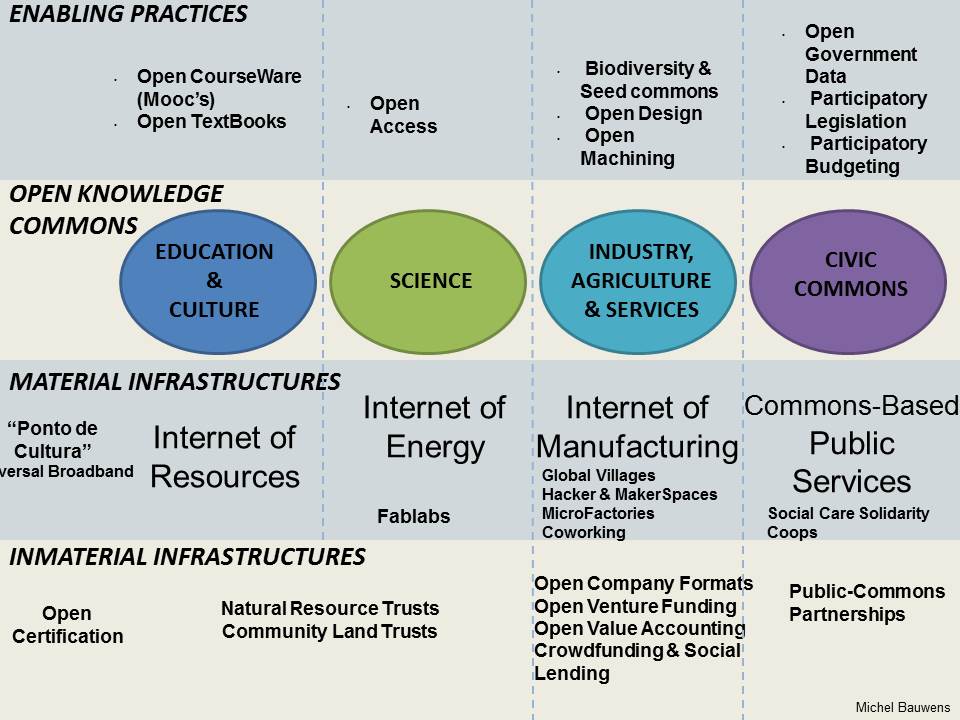
In what may be one of the most innovative change programs in Latin America, the administration of Rafael Correa is proposing to transition from a neo-liberal, free market economic model to what they are calling a social knowledge economy based on a combination of commons-based economics and the promotion of open knowledge systems. It’s heady stuff and the project is placing Ecuador at the forefront of global efforts to advance human knowledge as a commons and to apply this knowledge to the creation of a new economic model based on the commons, co-operative models of production, open-source systems of sharing, and free access to information.
Internet Society New York Chapter President David Solomonoff interviews Isaac Wilder and Marcus Eagan of the Free Network Foundation at the FreedomBox Hackfest at Columbia Law School NYC on Feb 18 2012