IO Newsletter V 14 N 1

IO Newsletter
0Shares

IO-Newsletter-JPEG-300x225 PDF (49 Pages): ARSTRAT_IO_Newsletter_v14_no_01

In this issue:

1.      How to Fight Cyber War? Estonia Shows The Way
2.      Utilizing Social Media during Major Events
3.      Google Launches Project Shield Cybersecurity Initiative for ‘Free Expression'
4.      U.S.-Style Personal Data Gathering Is Spreading Worldwide
5.      How They Think: PME in the Modern PLA
6.      CNO Says Navy Needs Ground Forces' Help On Cyber, Electronic Warfare
7.      The Nairobi Attack and Al-Shabab's Media Strategy
8.      South Korea Says North Korea Developing Electromagnetic Pulse Weapons
9.      Saudi Experts Boost Their Skills in Electronic Warfare
10.     Fighting On the Cyber Battlefield: Weak States and Nonstate Actors Pose Threats
11.     US Governmental Information Operations and Strategic Communications: A Discredited Tool or User Failure? Implications for Future Conflict
12.     US Senators Warn On Huawei Deal with South Korea
13.     Cyberspace Warriors Graduate With Army's Newest Military Occupational Specialty
14.     China Spins New Lesson from Soviet Union's Fall
15.     Drawing Lessons from Zimbabwe's War of Liberation: Efficacious Use of Propaganda and Violence
16.     Cyber Power in the Gulf
17.     Inside the Ring: China targets Global Hawk drone
18.     Army Reserve Units Earn Top Places
19.     SOCOM Web Initiative on Senate Chopping Block

Chuck Spinney: Climate Warming Bottom Line + Global Warming @ PBI

Earth Intelligence
0Shares
Chuck Spinney
Chuck Spinney

The central fact is that there exists great uncertainty about the long-term dynamics of the global climate system.  This fact, however, is not reflected in the partisan positions of either side in the highly-charged political debate over climate change.

The recently published IPCC report (AR5) raised a host of questions relating to how AR5 dealt with changes in the its ECS/TSR estimates from those of preceding report (AR4).  Attached below is a very informative, critical analysis of these questions.  It was prepared by Nic Lewis, an independent climate scientist, based in the UK, and a well known but respected skeptic of the consensus position.

The Lewis analysis was prepared in response to questions asked by  UK House of Commons Energy and Climate Change Committee.  While a Parliamentary request is a political request, Lewis's response in grounded in science and is apolitical.  His reasoning and assumptions of open to critical examination by anyone who chooses to do so.  If Lewis is correct, his is a devastating critique of the state of art understanding of sensitivity question — which I reiterate, is at the heart of the entire debate of mankind's effect on the global climate.

Continue reading “Chuck Spinney: Climate Warming Bottom Line + Global Warming @ PBI”

Patrick Tucker: ESRI Mapping the Future with Big Data + Big Data @ PBI

Design, Economics/True Cost, Geospatial, Governance
0Shares
Patrick Tucker
Patrick Tucker

Mapping the Future with Big Data

A little-known California company called Esri offers a “Facebook for Maps” that promises to change the way we interact with our environment, predict behavior, and make decisions in the decades ahead.

Click on Image to Enlarge

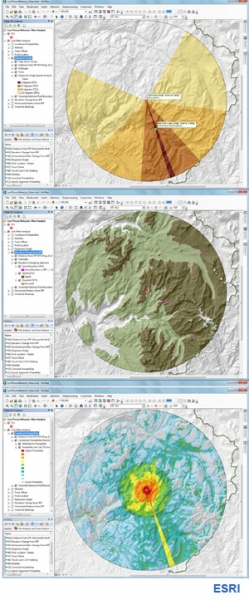
The setting is central California’s Yosemite National Park. A hiker, let’s call him Steve Clark, has gone missing on one of the trails. As the head park ranger, your job is to lead a search-and-rescue mission to find him. All you have to go on is the point where he was last seen, your training, and a computer; from this, you have to predict the behavior of a lost hiker. Sunset is approaching, and in some parts of the park the temperature will be below freezing in a matter of hours. What do you do?

Click on Image to Enlarge

Many experienced hikers know that the recommended course of action when lost is to follow a stream downhill and this will eventually lead to civilization. But you can’t assume that Steve Clark is aware of this, or that he’s even seen the Discovery Channel. He might elect to stay put, or, if he has a cell phone, he might be moving uphill to find a signal. You also don’t know if he’s injured. A person with a sprained ankle is less likely to walk up, but he may not move down, either.

You go to your computer and open ArcGIS.com. A computer map of Yosemite that you’ve made and uploaded appears on the screen. Let’s say you also have access to a “big data” database of records from 30,000 lost hiker search-and-rescue missions and you can query this database with key words.

You soon learn that 66% of lost hikers are found within two miles of the spot last seen. You impose a ring over your map reflecting this two-mile perimeter. You then learn that 52% of lost hikers are found downhill, only 32% go up, and 16% keep walking at the same elevation. You impose an elevation layer on the area with all the land above the last point seen shaded one color and the land beneath it shaded another. You can even impose a new lens depicting tree and plant cover and open fields, and one depicting linear objects like trails, roads, power lines, and streams, knowing that the vast majority of lost hikers follow some sort of linear marker to avoid going in circles.

Read full article.

Phi Beta Iota: ESRI code is proprietary and they do not play well with others. They either have to change both of those conditions, or be replaced by CrisisMappers at scale. The future is open.  This is not negotiable.

See Also:

Big Data @ Phi Beta Iota

Open Source Everything (List & Book)

Berto Jongman: Bits, Bytes, & Stuff

Commercial Intelligence, Cultural Intelligence, Earth Intelligence, Peace Intelligence
0Shares
Berto Jongman
Berto Jongman

ANALYSIS: Methodology to Analyze Future Security Threats (3): Scenarios as an Organic Living System

BOOK: Evaluation Methodologies for Aid in Conflict

BOOK: Global Intellectual History

BOOK: Governing the World: The History of an Idea, 1815 to the Present

CYBER: BIOS Malware Can Destroy Any Computer

Continue reading “Berto Jongman: Bits, Bytes, & Stuff”

Jean Lievens: Denise Cheng at Harvard Business Review on Peer Economy Transformation of Work

Crowd-Sourcing, Design, Economics/True Cost, Innovation, P2P / Panarchy
0Shares
Jean Lievens
Jean Lievens

The Peer Economy Will Transform Work (or at Least How We Think of It)

Denise Cheng

You can’t avoid peer-to-peer marketplaces. For transportation and housing, look no further than Uber, Lyft, and Airbnb. Skillshare and TaskRabbit are tackling education and task completion. Etsy and Shapeways have created handmade and fabrication marketplaces. They all facilitate integration into the economy without the need to secure employment from a large company.

Instead, the growing peer economy enables people to monetize skills and assets they already have. Vendors and providers on these platforms choose when to work, what to do and where to do it, sidestepping traditional constraints of geography and scheduling. Investors, advocacy groups and companies tout its apparent advantages, including a greater sense of solidarity through peer-to-peer commerce and reduction in carbon footprint through access to products and services instead of ownership.

. . . . . . .

Peer economy providers are also vulnerable but with a crucial factor that makes all the difference: They are a visible workforce, able to make these collective interests heard.

Read full post.

Patrick Meier: Best 15 Blogs of the Year from iRevolution [Big Data, Crisis Mapping, Disaster Response, Truth, Trust, Twitter]

Cloud, Crowd-Sourcing, Data, Design, Geospatial, Governance, Innovation, P2P / Panarchy, Resilience
0Shares
Patrick Meier
Patrick Meier

The Best of iRevolution in 2013

iRevolution crossed the 1 million hits mark in 2013, so big thanks to iRevolution readers for spending time here during the past 12 months. This year also saw close to 150 new blog posts published on iRevolution. Here is a short selection of the Top 15 iRevolution posts of 2013:

Continue reading “Patrick Meier: Best 15 Blogs of the Year from iRevolution [Big Data, Crisis Mapping, Disaster Response, Truth, Trust, Twitter]”

Stephen E. Arnold: Microsoft Bing – Tits Up, No Milk + Microsoft @ PBI

Commerce, Idiocy, Ineptitude, IO Impotency
0Shares
Stephen E. Arnold
Stephen E. Arnold

Whither the Bing Thing in 2014?

I found the data in the “2013 Bing Infographic” surprising. I continue to think of Bing as a search and retrieval system. I don’t use the system directly. I prefer to run queries on metasearch systems that use Bing as one source of content. The reason for my indirect access is that I don’t want distractions, social media content, and videos. In case you, gentle reader, have forgotten, I prefer to read. I read more rapidly than I can watch a video unfold in real time. I understand that some people find videos just the best possible way to locate information. I don’t.

The infographic has a number of data points. Let’s look at three in the context of locating a white paper, information about a person of interest, and a fact.

Continue reading “Stephen E. Arnold: Microsoft Bing – Tits Up, No Milk + Microsoft @ PBI”