
Avoiding Armageddon: America, India, and Pakistan to the Brink and Back
British Foreign Fighters in Syria
Infrastructure Vulnerabilities
Iraq Death Toll Based on Intelligence Lie(s)

The truth at any cost lowers all other costs — curated by former US spy Robert David Steele.
Lawrence Freedman
5.0 out of 5 stars Extraordinary Effort, Surprise Turn, One Gap, October 16, 2013
FINAL REVIEW
The original review and its links remain valid. The book is misrepresented as a history of military strategy – despite flyleaf comments about the book also covering business strategy, the fullness of the book is not properly presented to the public.
Had this book included Herman Daly and the entire underlying foundation of true cost economics, perhaps augmented by holistic analytics, and had the book focused on win-win and non-zero strategies in its conclusion, it would easily have moved into my six-star (top ten percent) category. As it is the book is assuredly at the top of the five star group.
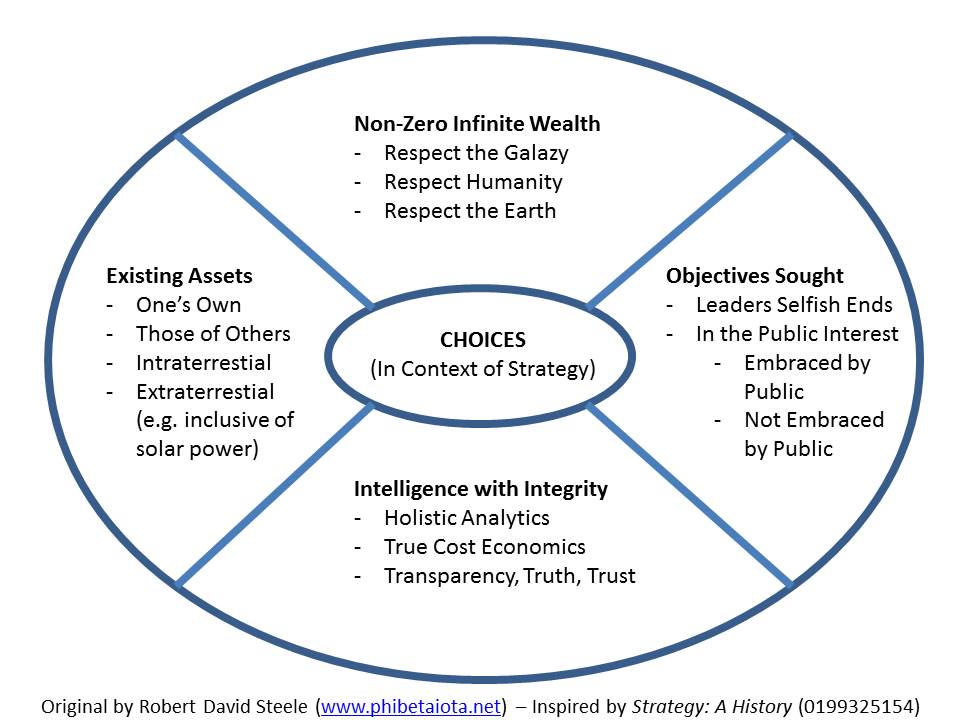
The author touches briefly on a core point where we converge: he states in passing that “victory” is a military concept while “peace” is a political concept. Across the book he addresses persistent conflicts as those whose underlying disputes are never fully resolved, with peace and prosperity made ever less likely by the persistence of rulers striving to optimize their self-interest rather than the public interest. Exactly! Strategy without integrity is not strategy, it is systemic looting.
October 30, 2013 — October 31, 2013
The Edward Snowden affair, and the willingness of the US government to violate the privacy of internet communications on a gigantic scale in the interests of national security, have propelled internet technologies to the center of our political, and civic concerns. There is growing concern about the threat to the privacy of the citizen posed by the unauthorized accumulation of internet-based information by private businesses for their own uses.
This conference will look at the role of the internet both as a vehicle of political and cultural dissent and, in the hands of the state, as a weapon of repression and control.

The final days of empire give ample employment and power to the feckless, the insane and the idiotic. These politicians and court propagandists, hired to be the public faces on the sinking ship, mask the real work of the crew, which is systematically robbing the passengers as the vessel goes down. The mandarins of power stand in the wheelhouse barking ridiculous orders and seeing how fast they can gun the engines. They fight like children over the ship’s wheel as the vessel heads full speed into a giant ice field. They wander the decks giving pompous speeches. They shout that the SS America is the greatest ship ever built. They insist that it has the most advanced technology and embodies the highest virtues. And then, with abrupt and unexpected fury, down we will go into the frigid waters.
The last days of empire are carnivals of folly. We are in the midst of our own, plunging forward as our leaders court willful economic and environmental self-destruction. Sumer and Rome went down like this. So did the Ottoman and Austro-Hungarian empires. Men and women of stunning mediocrity and depravity led the monarchies of Europe and Russia on the eve of World War I. And America has, in its own decline, offered up its share of weaklings, dolts and morons to steer it to destruction. A nation that was still rooted in reality would never glorify charlatans such as Sen. Ted Cruz, House Speaker John Boehner and former Speaker Newt Gingrich as they pollute the airwaves. If we had any idea what was really happening to us we would have turned in fury against Barack Obama, whose signature legacy will be utter capitulation to the demands of Wall Street, the fossil fuel industry, the military-industrial complex and the security and surveillance state. We would have rallied behind those few, such as Ralph Nader, who denounced a monetary system based on gambling and the endless printing of money and condemned the willful wrecking of the ecosystem. We would have mutinied. We would have turned the ship back.
Continue reading “Chris Hedges: The Folly of Empire and Obama's Legacy”

Disaster-affected communities are increasingly becoming “digital” communities. That is, they increasingly use mobile technology & social media to communicate during crises. I often refer to this user-generated content as Big (Crisis) Data. Humanitarian crisis computing seeks to rapidly identify informative, actionable and credible content in this growing stack of real-time information. The challenge is akin to finding the proverbial needle in the haystack since the vast majority of reports posted on social media is often not relevant for humanitarian response. This is largely a result of the demand versus supply problem described here.
. . . . . . . . .
The smaller the micro-stack, the easier the tasks and the faster that they can be carried out by a greater number of volunteers. For example, instead of having 10 people classify 10,000 tweets based on the Cluster System, microtasking makes it very easy for 1,000 people to classify 10 tweets each. The former would take hours while the latter mere minutes. In response to the recent earthquake in Pakistan, some 100 volunteers used MicroMappers to classify 30,000+ tweets in about 30 hours, for example.
Read full post with utterly brilliant photographs that make all this clear.

By PARAG KHANNA
New York Times, October 12, 2013
SINGAPORE — EVERY five years, the United States National Intelligence Council, which advises the director of the Central Intelligence Agency, publishes a report forecasting the long-term implications of global trends. Earlier this year it released its latest report, “Alternative Worlds,” which included scenarios for how the world would look a generation from now.
One scenario, “Nonstate World,” imagined a planet in which urbanization, technology and capital accumulation had brought about a landscape where governments had given up on real reforms and had subcontracted many responsibilities to outside parties, which then set up enclaves operating under their own laws.
The imagined date for the report’s scenarios is 2030, but at least for “Nonstate World,” it might as well be 2010: though most of us might not realize it, “nonstate world” describes much of how global society already operates. This isn’t to say that states have disappeared, or will. But they are becoming just one form of governance among many.
A quick scan across the world reveals that where growth and innovation have been most successful, a hybrid public-private, domestic-foreign nexus lies beneath the miracle. These aren’t states; they’re “para-states” — or, in one common parlance, “special economic zones.”
