In Washington Dulles airport I noticed a large advertisement. I'd seen it before and not paid attention. (No doubt that's why they saturate public space with the things.) It showed a woman's face with the words: “A car crash in California almost took her leg. A bomb blast in Iraq helped save it.” It directed one to a website: orthoinfo.org/dominique
I'm against car crashes in California. I'm in favor of saving Dominique's leg. But at the website what we find is a claim that her leg was saved because her orthopaedic surgeon had experience in Iraq. And I don't mean in the Iraqi hospitals that existed before we destroyed that country. I mean he had experience in the destruction process.
“Thank you, Dr. Paul Girard. How lucky was I to have an orthopaedic surgeon with wartime experience and special insights on how to treat an injury like mine?” Thus writes Dominique, whose partner James comments on the doctor: “His experience as a wartime orthopaedic surgeon in Iraq gave him a special familiarity with traumatic limb injuries.” How would James know this? Presumably the doctor, whose own comments don't mention the war, told him. Or someone ghost wrote the website.
The orthoinfo.org website was created by three societies of orthopaedic surgeons that clearly know which side of the mutilated troop their bread is buttered on. (Orthopaedic comes through French from the Greek for boneheaded.)
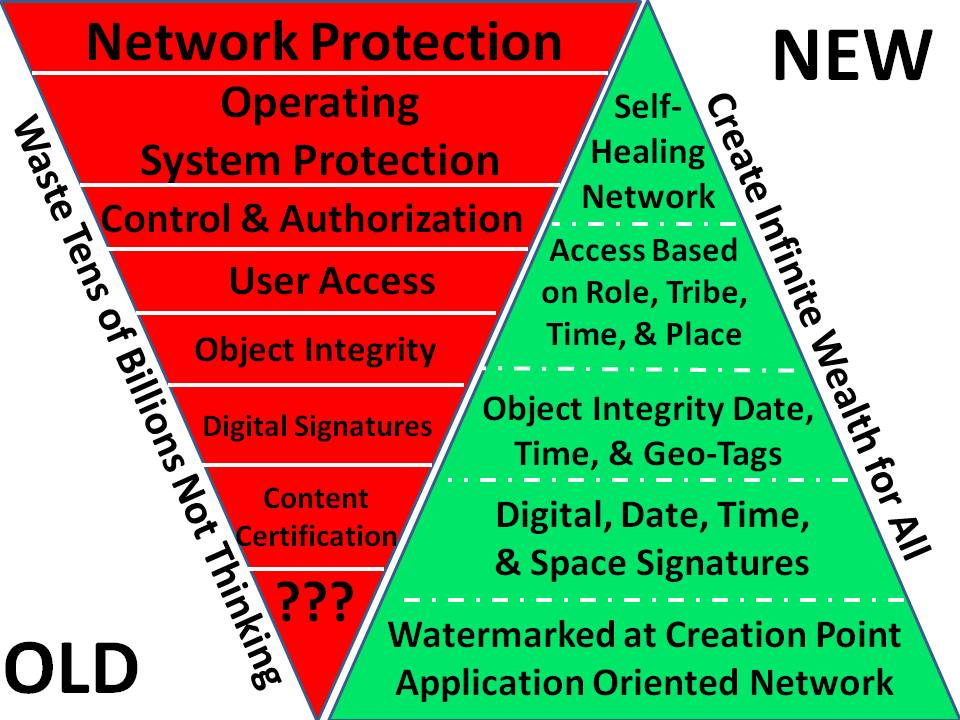
Robert Garigue (RIP) remains one of the giants of 21st Century cyber-security. He was 20 years ahead of his time, and most have still not caught up with him. Below is his cloud list, but we have also selected a few items to showcase. Trust on the edges, not centralized butts in seats, is the heart of security.
Here is the single coolest slide that he and Robert Steele created together. We strongly recommend every single thing he has ever published, when he died in his sleep at the age of 50, we did what we could to gather up his work and showcase it here in memory and in perpetuity.
See (Selective):
Gunnar Peterson on Robert Garigue’s Last Briefing [Note: this is the one briefing that best captures the idiocy across the US cyber-system — still pretending to build Maginot Lines and still absolutely utterly with a clue at the code level.]
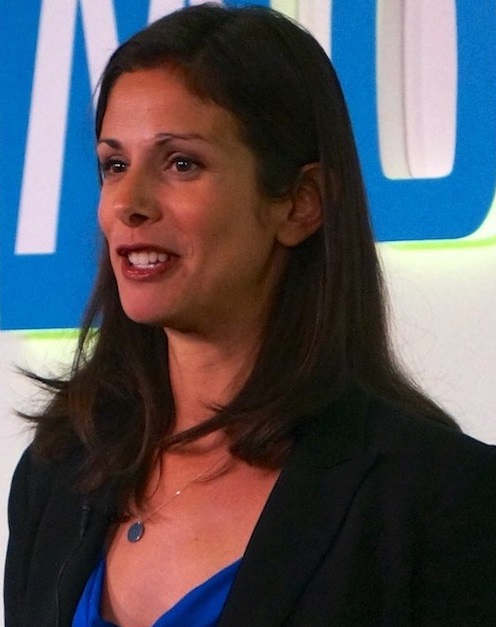
Rachel Botsman advocated the advantage of reputation capital at Wired Money in London yesterday. She noted that an economy based on reputation is incredibly empowering, and will take us away from a financial world “based largely on faceless transactions and moving us to an age built on humanness that we [have] lost.” The reputation economy has already begun to take effect—Airbnb user Kate Kendall used Airbnb reviews to secure an apartment lease.
Rachel Botsman
A reputation-based system will take time to establish, but has the potential to revolutionize the financial sector. This type of credibility adds “context, cause and character” to currently anonymous transactions. “How we treat people and how we behave will ultimately drive our world,” Botsman says.
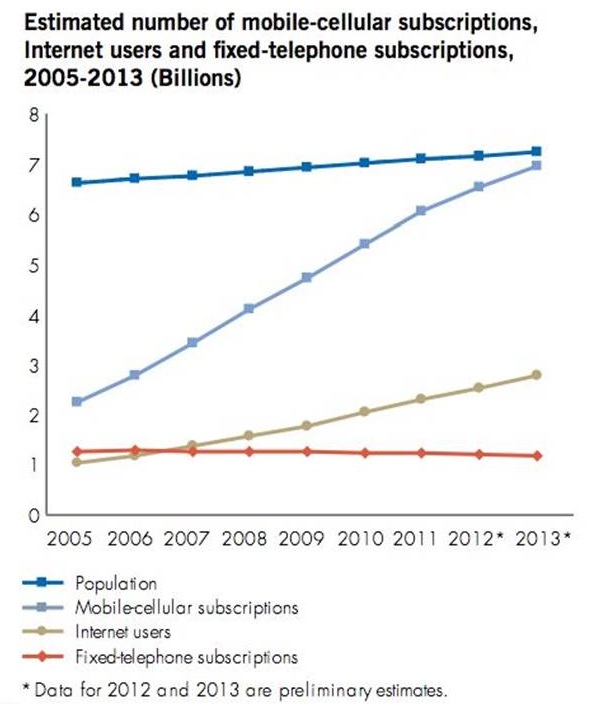
Yes, you’re seeing that right, there are almost as many cell phone subscriptions as there are people. It’s an astounding statistic considering that the number of cell phone subscriptions was only a fraction of the population in 2005. Now, the U.N. projects that there will be 6.8 billion cell phone subscriptions while our total population is just over 7 billion. However, subscription growth rates have fallen to their lowest level in the last year. Still, that puts global penetration of cell phones at 96 percent, 89 percent in developing countries. And it’s developing countries which account for over 77 percent of the world’s cell phone subscriptions and, increasingly, those phones are smartphones.
While cell phone use is impressive, we can’t overlook how quickly more people around the world are connecting to the Internet. There are now about 2.7 billion people using the Internet, up from around one billion in 2005. But while that number is growing, there are regional differences in who is connected and who isn’t. For example, 77 percent of the developed world is connected, while sub-Saharan Africa has the lowest rate with less than 20 percent of the population using the Internet, though Itnernet access is on the rise there.
I recently caught up with Gilal Lotan during a hackathon in New York and was reminded of his good work during Sandy, the largest Atlantic hurricane on record. Amongst other analytics, Gilal created a dynamic map of tweets referring to power outages. “This begins on the evening October 28th as people mostly joke about the prospect of potentially losing power. As the storm evolves, the tone turns much more serious. The darker a region on the map, the more aggregate Tweets about power loss that were seen for that region.” The animated map is captured in the video below.
. . . . . .
In sum, creating live maps of geo-tagged tweets is only a first step. Base-maps should be rapidly developed and overlaid with other datasets such as population and income distribution. Of course, these datasets are not always available acessing historical Twitter data can also be a challenge. The latter explains why Big Data Philanthropy for Disaster Response is so key.
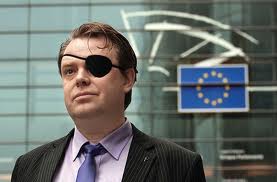
As the NSA and other spooks continue to spy on the world's communications, we ask: who watches them? Is it a secret court under a secret law? Is Edward Snowden really a traitor or a champion of government accountability? Are we already living in George Orwell's 1984? To mull over these issues, Oksana is joined by Rick Falkvinge, Swedish Pirate Party founder and internet freedom activist.