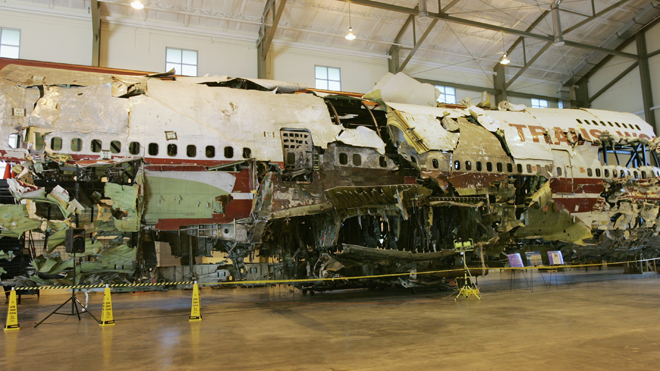
A group of whistleblowers, including a number of aviation experts, have come forward in a new documentary to claim that the official explanation for the crash of TWA Flight 800 was wrong and a gas tank explosion did not bring down the flight off the coast of Long Island 17 years ago.
However, the six whistleblowers, all part of the original investigation team, stopped short of saying the plane was shot down.
Click on Image to Enlarge
Flight 800, a Boeing 747, had just taken off from JFK airport with 230 people aboard on July 17, 1996 enroute to Paris when it exploded and crashed off the coast of nearby East Moriches, Long Island, killing everyone on the plane.
“..This team of investigators who actually handled the wreckage and victims’ bodies, prove that the officially proposed fuel-air explosion did not cause the crash,” reads a statement by the producers of the film, which will debut on cable network EPIX next month. “They also provide radar and forensic evidence proving that one or more ordinance explosions outside the aircraft caused the crash.” However, the statement said they did not speculate about the source or sources of any ordinance explosions.
That’s the number of calls that 75-year old social justice leader Anna Hazare received from people across India who supported his efforts to fight corruption. Two weeks earlier, he had invited India to join his movement by making “missed calls” to a local number. Missed calls, known as beeping or flashing, are calls that are intentionally dropped after ringing. The advantage of making missed call is that neither the caller or recipient is charged. This tactic is particularly common in emerging economies to avoid paying for air time or SMS. To build on this pioneering work, Anna and his team are developing a mobile petition tool called Crowdring, which turns a free “missed call” into a signature on a petition.
The Guardian UK reports that the US and other militaries are preparing for major domestic disorder stimulated by climate, energy, and economic crises. NSA surveillance is part of that. This shoring up of power-over from the top calls for our rapid development of power-with from below.
The report below from the Guardian UK describes accelerating government and military planning for major civil unrest caused by climate change, energy shocks, and economic crises. The recently highlighted NSA surveillance – with its engagement of both government and corporate players – is a part of this. Another part, highlighted here, is the domestic use of the military.
I see this as an example of the power-over forces attempting to maintain control – articulated by them as “government stability” and “domestic order” – as crises and technological developments undermine the capacities of centralized rule and management, as covered by my recent review of THE END OF POWER.
Structure hit, suicide bomber success, another suicide bomber at the hospital handling casualties, and then a unit of unknown size storms the hospital in an attack lasting hours? I first noticed the Balochistan independence movement about six months ago. The action that gets reported has thus far been in Pakistan.
The structure hit was indeed the Balochistan Liberation Army, striking a symbolic target with no loss of life.The suicide bombings and armed assault were not at all related. … So I had some good background, some good maps, but this one conceptual error throws the whole piece off kilter. Rather than editing it in place, I felt a clean update was best.
Oil producers are subject to an effect know as the Export Land Model. Basically, oil fuels internal growth and when production declines exports decline even more swiftly, as producers steer production into uses at home. Egypt, Syria, and Yemen have all featured heavily here and they are first up in the ominously titled How Oil Exporters Reach Financial Collapse.
The ethnic and sectarian divides in Syria are fueling their civil war, and they have a long history of intervention in the affairs of Lebanon. These maps show with increasing focus the ethnic and religious groups that inhabit the region.
For those of you that don't know, the US doesn't spend much time/energy/effort on military strategy and theory. They do spend money on political scientists and engineers to provide a substitute. Regardless, this deficit means the US continually falls victim to strategic errors due to stale military theory.
The big one we recently fell victim to?
The US unilaterally launched an arms race in autonomous weapons (for more on this read my article; Pandora Smiled).
NOTE: In fact, in all of the work I've done for the national security system (CIA, NSA, DoD, JCS, DNI, etc.), I've never run across a true military theorist. They don't exist in the 2 m plus person bureaucracy, despite trillions in spending based on those theories. Go figure?!? It's like building a Large Hadron Collidor without a physicist.
Well, that arms race is starting to bite us back, but not in the way our lazy national security strategists expected. There's a pretty good article in Vanity Fair about cyberwarfare and Iran by Michael Joseph Gross that details how.
It starts with a nice kick at the start, like Brave New War (on its fifth printing), but for cyberware:
The data on three-quarters of the machines on the main computer network of Saudi aramco had been destroyed. Hackers who identified themselves as Islamic and called themselves the Cutting Sword of Justice executed a full wipe of the hard drives of 30,000 aramco personal computers. For good measure, as a kind of calling card, the hackers lit up the screen of each machine they wiped with a single image, of an American flag on fire.
As you can see, if you like my stuff, it's worth the click to read the entire thing. Here's one of the payoffs:
In the U.S., the escalating bug-and-exploit trade has created a strange relationship between government and industry. The U.S. government now spends significant amounts of time and money developing or acquiring the ability to exploit weaknesses in the products of some of America’s own leading technology companies, such as Apple, Google, and Microsoft. In other words: to sabotage American enemies, the U.S. is, in a sense, sabotaging its own companies.
Here's another one from a bug developer:
“You don’t have to be a nation-state to do this,” he says. “You just have to be really smart.”
BTW: the lead graphic is close to an article I did for Wired in 2007, When Bots Attack. From the Vanity Fair article:
It reminded me of this graphic from my Wired article that I thought you would enjoy: