Robin Good: Best 13 Curation Tools for Education and Learning

Crowd-Sourcing, Culture, Education
0Shares
Robin Good
Robin Good

If you are interested in taking curation onboard in your learning or teaching program, here is a collection of the best web curation tools and services specifically designed for the education world. Whether you need to pull together a collection of relevant books and reading resources for your next class, or want to push your students to collaborate on creating relevant information collections on specific topics, here are over the best tools that can be used for this task. *Curation Tools for Education and Learning* P.S.: Please, feel free to suggest new and additional relevant tools that should be added to this collection in the comments at the original post, “Curation Tools.”

Academicpub – Personalize and customize books and documents with this patented publishing and compilation platform.

Adobe Acrobat – Collect and organize different types of documents, presentations and video into a professional portfolio

Adobe Acrobat Professional XI – Collect and organize different types of documents, presentations and video into a professional portfolio.

Avoca – The Avoca Learning platform is a web service which facilitates the finding, collection and organizing of vetted learning resources from dozens of the leading educational sites. The platform already offers over 20,000 resources from over 35 leading education sites. In the near future new educational resources in the fields of of Language Arts/Reading, and History/Social Studies will be added.

Bindworx – revolutionary new service, potentially allowing anyone to assemble a truly personalized new book by mixing and matching other published works, is 100% the way it is being described. On paper, Bindworx offers you the opportunity to buy content from existing published books and eBooks, by specifically picking out a page, a chapter or an entire section and pulling it together into your own custom (e)book.

Curatr – Curatr builds online courses from any digital content, which we refer to as learning objects. Learning objects can be anything that works on the web – from a video to an interactive diagram, a PDF to a webpage.

Edcanvas – EdCanvas is a web service which allows you to search, find, clip and collect any kind of content, from text to video clips and to organize it into visual boards for educational and learning purposes. Differently than Pinterest, EdCanvas is specifically targeted at the education world and at schools and teachers, and it makes possible not just to collect “images” from web pages, but to collect and organize whichever content elements you want, including full web pages.

Educlipper – EduClipper is a new educational curation platform allowing both teachers and students to clip just about any type of content from the web and to organize it into topic-specific clipboards. Clipboards can be made “private” or public depending on your needs and both their individual content items as well as any full clipboard can be easily shared on all major social networks.

Learnist – Learnist is a new pinboard where users can organize their learning materials. It resembles Pinterest except that Learnist is just for sharing learning resources.

Libguides – Offers a perfect environment to create/curate collections of relevant resources on a specific learning topic. The link points to a good curated example page authored by Joyce Valenza and Deb Kachel focuses on showcasing an extended curated selection of content references, video clips, PDFs, tools lists on the topic of digital content curation in education. Lots of useful resources and references, and some good examples of curation at work in different educatonal projects.

Livebinders – Allows you to create folders containing collections of relevant resources and links on a specific topic.

McGraw-Hill Create – Allows you to curate customized textbooks on any topic by selecting and picking individual chapters, pages or excerpts from already published books.

Mentormob – Allows you to create annotated playlists of websites on a specific topic/theme

RELATED:

Robin Good: Content Curation Visualized (More Links)

Berto Jongman: Scientists Decide to Create Replacement Human, Ignore High-Level Threats to Humanity

Academia, Commerce, Cultural Intelligence, Earth Intelligence, Ethics
0Shares
Berto Jongman
Berto Jongman

Blind science?  Or unethical science?

2045: A New Era for Humanity

Institute for Ethics & Emerging Technologies, 4 June 2013

In February of 2012 the first Global Future 2045 Congress was held in Moscow. There, over 50 world leading scientists from multiple disciplines met to develop a strategy for the future development of humankind. One of the main goals of the Congress was to construct a global network of scientists to further research on the development of cybernetic technology, with the ultimate goal of transferring a human’s individual consciousness to an artificial carrier.

Continue reading “Berto Jongman: Scientists Decide to Create Replacement Human, Ignore High-Level Threats to Humanity”

Berto Jongman: NASA Raises Threat Level on Space Storms — Could Black Out US East Coast from 16 Days to 2 Years — They Neglect to Mention Option That Avoids All Damage

Earth Intelligence
0Shares
Berto Jongman
Berto Jongman

Space Storm Could Black Out US East Coast for Two Years – Expert

WASHINGTON, June 4 (by Karin Zeitvogel for RIA Novosti) – Severe space “weather” can knock out satellite communications and GPS systems, expose space tourists and astronauts to dangerous levels of radiation, and even cause massive blackouts on Earth that could last up to two years, scientists and NASA officials warned at a conference here on Tuesday.

A sun storm on the scale of one that happened in 1859, which was recorded by British brewer and amateur astronomer Richard Carrington, would potentially have sweeping consequences on huge population clusters in the United States, experts at the Space Weather Enterprise Forum said.

“The United States population that is at risk of an extended power outage from a Carrington-level storm is between 20-40 million, with an outage duration of possibly 16 days to one to two years,” said Kathryn Sullivan, the first woman to walk in space and now the acting administrator of the National Oceanic and Atmospheric Administration (NOAA), which hosted Tuesday’s conference.

Continue reading “Berto Jongman: NASA Raises Threat Level on Space Storms — Could Black Out US East Coast from 16 Days to 2 Years — They Neglect to Mention Option That Avoids All Damage”

Mini-Me: Next Corporate Revolution Will Be Power to the Peons — Bureaucracy is Now Officially Toxic

Collective Intelligence, Commercial Intelligence, Cultural Intelligence
0Shares
Who?  Mini-Me?
Who? Mini-Me?

Huh?

The next corporate revolution will be power to the peons

‘Bureaucracy has to die,' says business consultant at CITE Conference (see video below)

Computerworld – SAN FRANCISCO — Microsoft, Hewlett-Packard, Dell and Intel have something in common: They all came late to the mobile revolution.

Why? Because they're companies where management is top-down and responsibility for innovation and change is concentrated among executives with strict bureaucratic control over workers.

That's got to change, Gary Hamel, a consultant and management educator at the London School of Business, said at the CITE Conference and Exhibition here this week. And he was not alone in his belief that the next revolution in corporate America won't be technological, it'll be social.

Businesses are on the cusp of a leadership revolution because millennials moving into the workforce are “the most authority-phobic” generation in history, Hamel said.

“Now, we have a generation with a completely different set of expectations — and probably the most core expectation they have is that if you're a leader, it's only because people are wiling to follow,” he said. “The real problem we're up against is not technology, it's that management DNA in companies…. When you concentrate the responsibility for innovation at the top, you're holding your capacity to change hostage. It disempowers the little people.”

Continue reading “Mini-Me: Next Corporate Revolution Will Be Power to the Peons — Bureaucracy is Now Officially Toxic”

FIRE SALE: 60% Off! Intelligence and IO Books on Sale by the Box

Knowledge
0Shares
Click on Image to Enlarge

The following books are on sale by the box at 40% of retail — 60% off.  Enterprising  individuals could reasonably expect to profit by buying a box and then selling the books at $20 each.  Or offices could buy on the credit card (arrange for invoice and payment via email to robert.david.steele.vivas [at] gmail [dot] com), distribute and if desired, have a follow-up Skype session with Robert Steele.  Going away, trying to empty the storage room before departure.  Boxes are generally 20 books to the box, or 16 books in some cases of larger books.

Steele, Robert David (2000).  ON INTELLIGENCE: Spies and Secrecy in an Open World.  Fairfax, VA: Armed Forces Communications and Electronics Association.

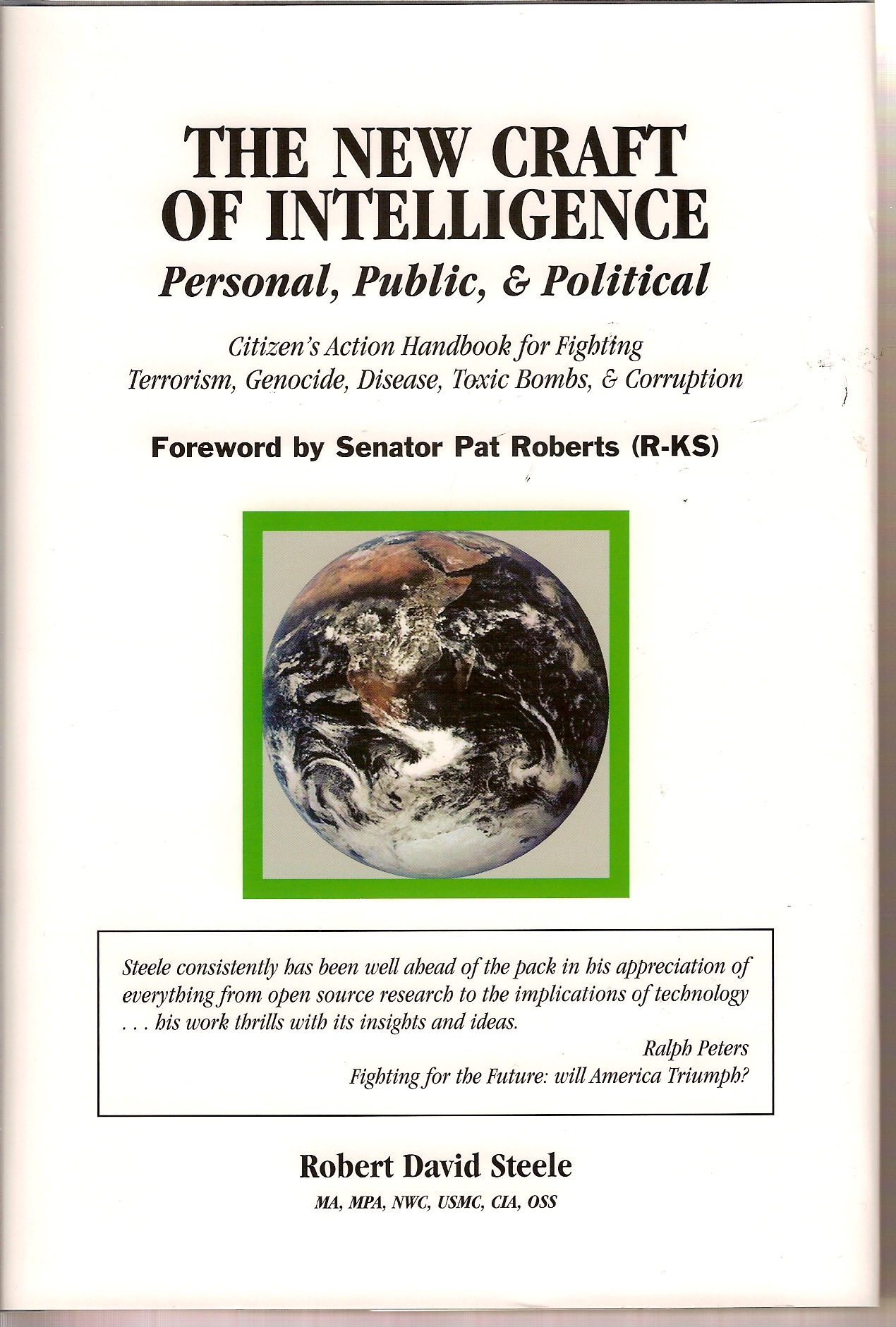
Steele, Robert David (2002).  THE NEW CRAFT OF INTELLIGENCE: Personal, Public, & Political.  Oakton, VA: OSS International Press.

Steele, Robert David (2006).  INFORMATION OPERATIONS: All Information in All Languages All the Time.  Oakton, VA: OSS International Press.

Steele, Robert David (2006).  THE SMART NATION ACT: Public Intelligence in the Public Interest.  Oakton, VA: OSS International Press.

Steele, Robert David (2010).  INTELLIGENCE FOR EARTH: Clarity, Diversity, Integrity & Sustainability.  Oakton, VA: Earth Intelligence Network.

Reinhold Muufstfasta: Cannabis in Alchemical Literature: Green Lion, Philosopher’s Stone

Offbeat Fun
0Shares
Reinhold Muufstfasta'

A compilation of historical reflections on cannabis in alchemical literature.

– – – – – – – – – – –

Three things suffice for the work: a white smoke, which is water; a green Lion, which is the ore of Hermes, and a fetid water… The stone, known from the chapters of books, is white smoke and water.

Michael Maier
Atalanta Fugiens

Of this self-same body, which is the matter of the Stone, three things are chiefly said; that it is a green Lion, a stinking Gum, and a white Fume. Having twelve pounds of Green Lion thus brought into gum, thou mayst believe…

St. Dunstan (pseudo)
Philosophia Maturata

Continue reading “Reinhold Muufstfasta: Cannabis in Alchemical Literature: Green Lion, Philosopher's Stone”

Patrick Meier: Data Mining Wikipedia in Real Time for Disaster Response [or Any Current Event]

Crowd-Sourcing, Data, Geospatial, Governance, Innovation, P2P / Panarchy, Resilience
0Shares
Patrick Meier
Patrick Meier

Data Mining Wikipedia in Real Time for Disaster Response

My colleague Fernando Diaz has continued working on an interesting Wikipedia project since he first discussed the idea with me last year. Since Wikipedia is increasingly used to crowdsource live reports on breaking news such as sudden-onset humanitarian crisis and disasters, why not mine these pages for structured information relevant to humanitarian response professionals?

In computing-speak, Sequential Update Summarization is a task that generates useful, new and timely sentence-length updates about a developing event such as a disaster. In contrast, Value Tracking tracks the value of important event-related attributes such as fatalities and financial impact. Fernando and his colleagues will be using both approaches to mine and analyze Wikipedia pages in real time. Other attributes worth tracking include injuries, number of displaced individuals, infrastructure damage and perhaps disease outbreaks. Pictures of the disaster uploaded to a given Wikipedia page may also be of interest to humanitarians, along with meta-data such as the number of edits made to a page per minute or hour and the number of unique editors.

Click on Image to Enlarge

Fernando and his colleagues have recently launched this tech challenge to apply these two advanced computing techniques to disaster response based on crowdsourced Wikipedia articles. The challenge is part of the Text Retrieval Conference (TREC), which is being held in Maryland this November. As part of this applied research and prototyping challenge, Fernando et al. plan to use the resulting summarization and value tracking from Wikipedia to verify related  crisis information shared on social media. Needless to say, I’m really excited about the potential. So Fernando and I are exploring ways to ensure that the results of this challenge are appropriately transferred to the humanitarian community. Stay tuned for updates. 

See also: Web App Tracks Breaking News Using Wikipedia Edits [Link]