Jean Lievins: The Economist Rocks, Sharing Economy Highlighted

03 Economy, 11 Society, Collective Intelligence, Commercial Intelligence
0Shares
Jean Lievens
Jean Lievens

Economist: Sharing Economy

All Eyes on the Sharing Economy

Collaborative consumption: Technology makes it easier for people to rent items to each other. But as it grows, the “sharing economy” is hitting roadblocks

By The Economist, March 9 2013.

WHY pay through the nose for something when you can rent it more cheaply from a stranger online? That is the principle behind a range of online services that enable people to share cars, accommodation, bicycles, household appliances and other items, connecting owners of underused assets with others willing to pay to use them. Dozens of firms such as Airbnb, which lets people rent out their spare rooms, or RelayRides, which allows other people to rent your car, act as matchmakers, allocating resources where they are needed and taking a small cut in return.

Read full article.

Phi Beta Iota:  The Economist is the first mainstream media source to open up to the emergent possibilities.  There are three major changes being facilitated by the Internet and the related applications, generally those that are NOT proprietary, NOT owned by a major corporation, and NOT predatory:

01  Collaborative Sharing  of products, services, and places

02  True history of products, services, and places (e.g. “my fish today”)

03  True cost of products, services, and behaviros.

It is the last one that is awaiting a major breakthrough that combines the open source crisis making and global diaspora translation and posting, with the still missing heavy lifting of research such as was done for a single cotton T-shirt.

See Also:

Graphic: True Cost of a Cotton T-Shirt

SchwartzReport: For Price of Iraq War, Half of the US Could Be on Renewable Energy Now

05 Energy, Corruption, Government, Military, Peace Intelligence
0Shares

schwartz reportI believe that historians will look back on the era that began with Reagan, and reached its peak during the administration of the second Bush, and his evil wizard, Cheney, and mark that as the beginning of the decline of America. We traded prosperity, and greatness, for the tainted pottage of elective war, and the privatization of our social order to the be! nefit of the few and to the cost of the many. Here is an example of what I mean.

For the Price of the Iraq War, U.S. Could Power Half of the Country With Renewable Energy
David Roberts – Grist

Phi Beta Iota:  It is much, much worse than this, especially when considering the human cost of all nations.  It has long been established that peace and prosperity can be had for one third of what we spend on war — the key difference is that war is profitable for banks in unethically extraordinary ways, while peace and prosperity are profitable for the 99% in relatively mundane ways.  The only good news is that Generation Truth is rising, and will use open information and open deliberation to put the relics of the Industrial Era away.

See Also:

Graphic: Medard Gabel’s Cost of Peace versus War

Berto Jongman: World Citizens’ Truth Network Begins?

Architecture, Crowd-Sourcing, Innovation, P2P / Panarchy
0Shares
Berto Jongman
Berto Jongman

How might we gather information from hard-to-access areas to prevent mass violence against civilians?

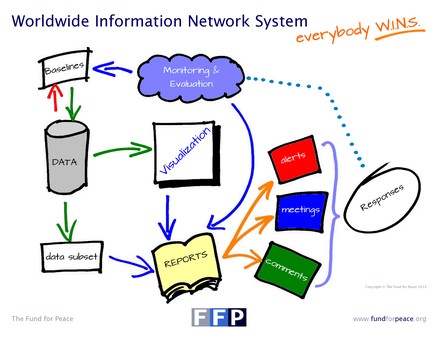
Worldwide Information Network System

A web-based, open platform for actors in all sectors to share, visualize, and analyze data related to the underlying conditions of conflict that exist in areas prone to violence and mass atrocities globally to inform policy and enable action.

Click on Image to Enlarge

Atrocity prevention is about more than collecting and presenting data about conflict risk and opportunities for peacebuilding in an eye-catching and clever way. We also need to present data in a way that simultaneously entices and helps facilitate exchanges among networks of actors who don't usually talk to one another. All sectors must be creatively engaged and working together to effectively confront the challenges that make up the underlying conditions of conflict. These social, economic, political, and security issues are all interrelated. Absent the big picture, solving one problem in isolation may just exacerbate another.

Continue reading “Berto Jongman: World Citizens' Truth Network Begins?”

DefDog: The Coming Catastrophe in the USA

11 Society, Corruption, Government, Idiocy, Ineptitude
0Shares
DefDog
DefDog

Someone smarter than me wrote this in an email.  Scary stuff, seems to be right on target.

– – – – – – –

The freight train bearing down on us is the Millennials – 80 million strong, 15% unemployment, that's 6 million 18 to 34 males who are fucked. How many have hardcore urban combat experience from Iraq or open country insurgency skills from AfPak?

Oklahoma City & D.C. Sniper came from 38 days of ground combat during Desert Storm. Now we get TBI guys who've done three tours and get screwed out of benefits with a PDO discharge because the VA doesn't want to deal? Ticking bomb, size XXXXL, and it's all around us.

So when does it flip from an edgy theory into a “holy shit how do we stop THAT?” Can't say for sure, but it'll be like trying to un-tornado a house once it gets moving …

Phi Beta Iota:  The truth at any cost lowers all other costs.

See Also:

Graphic: Preconditions of Revolution in the USA Today

Tom Atlee: 17 April 2013 Democracy, Peace, & the Iriquois Teleconference

Crowd-Sourcing, Culture, Governance, P2P / Panarchy, Politics
0Shares
Tom Atlee
Tom Atlee

Dear friends,

An invitation to speak has brought me back to some roots of my work I haven't revisited in some time – the Iroquois Confederacy and its recognition of the intimate tie between democracy and peace – collective wisdom and collective tranquility.  Peace between people requires their respectful, insight-seeking conversation.  It requires, as Oren Lyons, Faithkeeper of the Turtle Clan of the Onondaga Iroquois tells us, that “we meet and just keep talking until there's nothing left but the obvious truth.”

Lyons also notes – to us self-proclaimed modern people – that “The Earth has all the time in the world.  We don't.”  I strongly recommend his brief, vivid and moving video:
http://vimeo.com/50460060 (note for those who have trouble with online videos: in the lower right it give the option to use Flash or HTML5 video players).

Few Americans or people in other modern “democracies” realize how much our government structures owe to the Iroquois.  We talk about ancient Greece giving us democracy.  True, ancient Athens gave us the idea of “one man one vote” when adopting laws.  But some scholars suggest that the Iroquois gave us our federal system (an alliance of free states under one greater power), the idea of “balance of powers”, and much of our sense of personal privacy and liberty from government interference, as well as the idea of taking turns while speaking in an assembly.
http://www.co-intelligence.org/CIPol_IndiansOrigDemoc.html
http://en.wikipedia.org/wiki/Great_Law_of_Peace

Continue reading “Tom Atlee: 17 April 2013 Democracy, Peace, & the Iriquois Teleconference”

Winslow Wheeler: If OMB Cannot Manage, and DoD Cannot Win Wars or Secure Peace, Who Is to Blame? Sub-Text: Obama “Team” Has No Plan B — They Cannot Even Find Plan A!

Corruption, Government, Idiocy, Ineptitude, Military
0Shares
Winslow Wheeler
Winslow Wheeler

Since the defense budget roll out on Wednesday, April 10, Pentagon budget geeks all over Washington have been popping Ibuprofen trying to unscramble the mess that DOD and OMB have made out of the 2013 and 2014 defense budgets. My take on this dysfunction is explained below.

By the way, I don't blame Secretary Hagel for this junking of budget ethics and smarts; he's too new to the job, but his time for using that as an excuse is fast running out.

Obama's Useless Budget Data.and Improbable Budget Strategy

Defense Secretary Chuck Hagel and Army General Martin Dempsey, chairman of the Joint Chiefs, unveil the Pentagon's 2014 budget request Wednesday.

Budgets are important documents: they are the ultimate expression of policy by a President or Congress.

Budgets are also a useful revelation of the character and competence of those who put them together.

President Obama's budget presentation for the Department of Defense and national security-related activities outside of the Defense Department is useless for understanding what he and Congress have enacted for the current 2013 fiscal year, which ends Sept. 30.

The budget material for 2014 also shows there is no new thinking in the Obama Administration for putting U.S. national security spending on a constructive path. Given the dysfunctional Congress that's getting the new budget, we should expect the worst: delay, chaos and decisions to increase, not control, costs.

Continue reading “Winslow Wheeler: If OMB Cannot Manage, and DoD Cannot Win Wars or Secure Peace, Who Is to Blame? Sub-Text: Obama “Team” Has No Plan B — They Cannot Even Find Plan A!”