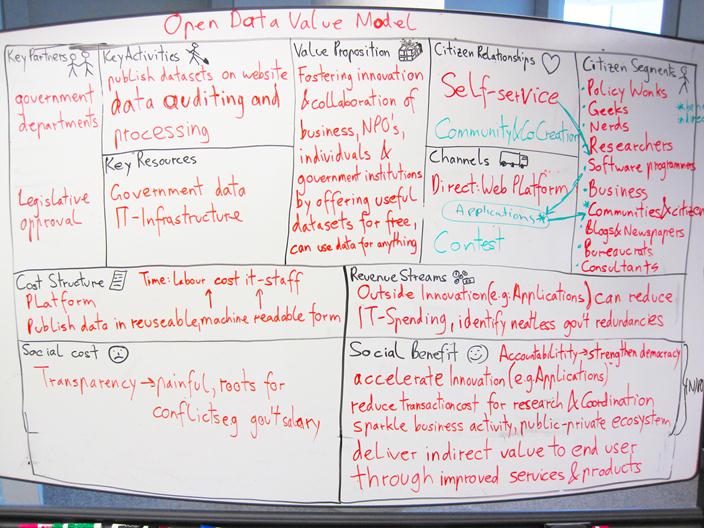
Graphic: Open Data Value Model
Analysis, Balance, Citizen-Centered, Data, Graphics, Processing, Strategy-Holistic Coherence
The truth at any cost lowers all other costs — curated by former US spy Robert David Steele.
 I completely support this. The last place where power still resides with ordinary people lies in the vote. Everything else in our government may increasingly be a charade of retained form underneath of which lies corrupted substance. But the vote still matters because it determines who gets to play. Any compromise in the already tattered social safety net, should result in all those who voted fo! r the compromise being cast out of office.
#ChainedCPI? For Every Social Security Judas, a Primary Challenge
Robert Naiman – truthout
EXTRACT
The moment of truth has arrived. According to press reports, President Obama has openly embraced cutting Social Security and veterans benefits by imposing the “chained CPI” cut on cost of living increases, which is like signing in blood the idea that the federal government's priorities should be owned by the 1% rather than by the 99%. The war in Afghanistan will continue, the boondoggle F-35 “Bankrupter” fighter plane will continue, the $83 billion annual taxpayer subsidy to the “too big to fail” banks will continue, but the earned benefits of America's working families, including disabled veterans and their survivors, will be cut if President Obama has his way.
The only thing that can stop President Obama from cutting Social Security now is Congress. Therefore, the only thing that can stop President Obama from cutting Social Security now is public pressure on Congress to stand up to Obama and say no. The pressure that has been exerted so far was not sufficient to stop President Obama from doing this. Therefore, public pressure against Social Security cuts must significantly escalate.

Chatham House Report
Rob Bailey, April 2013
Report: Managing Famine Risk: Linking Early Warning to Early Action
Executive Summary: Managing Famine Risk: Linking Early Warning to Early Action

Project on Translating Early Warning of Food Crises into Early Action.
Chatham House report: Famine risks are badly managed
BBC News, 5 April 2013
Continue reading “Berto Jongman: Managing Famine Risk – Linking Early Warning to Early Action”

Bitcoin May Be the Global Economy's Last Safe Haven
One of the oddest bits of news to emerge from the economic collapse of Cyprus is a corresponding rise in the value of Bitcoin, the Internet’s favorite, media-friendly, anarchist crypto-currency. In Spain, Google (GOOG) searches for “Bitcoin” and downloads of Bitcoin apps soared. The value of a Bitcoin went up to $78. Someone put out a press release promising a Bitcoin ATM in Cyprus. Far away, in Canada, a man said he’d sell his house for BTC5,362.
Bitcoin was created in 2009 by a pseudonymous hacker who calls him or herself Satoshi Nakamoto (and who might be several people). It’s a form of virtual cash used to buy goods and services online. Even by Web standards, it’s a strange and supergeeky phenomenon. This is what happens when software and networks meet the concept of currency, when you take peer-to-peer networks and advanced cryptography and ask, “How can I make a new economy?”

From Quantitative Easing (QE) to Moral Easing (ME)
a stimulus package to avert moral bankruptcy?
Introduction
Slide towards global moral bankruptcy?
Possibilities in the light of strategic precedents
Moral indulgences?
Moral easing or Qualitative easing?
Ensuring moral authority in practice
Moral indulgence in the current practice of moral authorities
Moral elevation
Pledging, promises and commitments
Declarations, Appeals and Calls for global action
Metaphoric confusion in diagnosis: constipation or diarrhoea?
Enabling moral currency circulation? (Annex)
References

Francesca Gino
4.0 out of 5 stars A Good Book That Could Be Made Better, April 7, 2013
I received this book as a gift and was glad to get it. As a professional intelligence officer I have been fascinated for decades by the mystery of why smart people make stupid decisions — completely apart from outight corruption. This book is most helpful in addressing nine specific contexts within which good decisions gets sidetracked into bad decisions, and I certainly recommend it as a gift for any thinking person, perhaps for a long airplane ride. It does not address my larger focus on “information pathologies”
The book is structured to address three forces impacting on the how of our decisions:
01 Forces from within
02 Forces from our relationships
03 Forces from the outside
The author concludes with a summary of the “nine step program” for not getting sidetracked:

Bad Context: Why nobody, not even Apple, has done mobile right
Your smartphone is dumb. Mine is too. I’ve got an iPhone in my pocket, and a Galaxy S III, and an HTC One, and they’re all stupid. The BlackBerry Z10 in my bag is a clot, and the Lumia 920 isn’t just thick in the hand, it’s just plain thick. Today, on the fortieth birthday of the first cellphone call, the gadget that was supposed to liberate us has turned us into plagued, screen-tapping obsessives, in thrall to every buzz and bleep.
Before you say anything – though I understand you may instantly have raced to the comments section before you even reached the period in my first sentence, desperate to berate me – I’m not a luddite. I love smartphones; I like Android, iOS, Windows Phone, and even have a soft spot for BlackBerry 10 in places. I don’t leave the house without at least one phone in my pocket. It – and its ringing alarm – is the first thing I reach for in the morning; with the exception of the light switch it’s probably the last thing at night.
That devotion, or maybe obsession, doesn’t mean I’m blind to the limitations of what we have today, however. The modern smartphone is faster, lighter, runs longer, has more apps, sensors, radios, and gadgetry than any before it, but all that complexity has only served to pull us in closer, to enmesh us more with the digital world on its terms.
Your phone still, generally, demands you reach for it and proactively consult it. If it has something for you, it’ll beep to let you know, but it’ll generally do that on its own timescale. Many devices have a “do not disturb” mode, which blanks all (or all but the most important) notifications between certain periods, and some can “intelligently” manage alerts depending on what you’re doing at the time, though that tends to amount to little more than bashing calendar entries against the clock and keeping quiet when you’ve remembered to log a meeting taking place.
“Most phones are dumb in how they understand context”
Beyond that, for all their sensors and smarts, most phones are pretty dumb in how they understand context. Right now, they’re portable terminals for the internet, for the most part: a smaller window than our regular browser, or one we view through the medium of function-specific apps. Much of the development we’ve seen from phone software and hardware over the past 3-5 years has been in translating the internet into something that fits onto a smartphone-scale screen.
