1. 10th Annual Army Global Information Operations Conference
2. China's Space Activities Raising U.S. Satellite Security Concerns
3. ‘Red October' Cyber-Attack Found By Russian Researchers
4. Influence Operations and the Internet: A 21st Century Issue
5. When the Network Dies
6. Cyber Operations: Bridging from Concept to Cyber Superiority
7. Army Electronic Warfare Goes On The Offensive: New Tech Awaits Approval
8. Army Manual Highlights Role of “Inform and Influence Activities”
9. DoD Looking to ‘Jump the Gap' Into Adversaries' Closed Networks
10. President Putin orders FSB to protect media sites from cyber attack
Over time I’ve grown more and more suspicious of stories about breakthrough technologies. I always think back to those heady days of EEStor, the guys who were going to make a battery that would revolutionize grid storage and electric cars alike. “EEStor CEO says game-changing energy storage device coming by 2010”! As you may have noticed, 2010 came and went and the game remains unchanged.
All of which is to say, regarding the post to follow: caveat lector. Still, this looks very, very cool.
CleanTechnica has an exclusive on a new solar technology that claims to be able to produce power with a levelized cost of energy (LCOE) of 8¢/kWh. That is mind-boggling, “two-thirds the price of retail electricity and over 3 times cheaper than current solar technology.” If the claim proves to be true (and a lot can happen between prototype and mass manufacturing), it could revolutionize the solar industry.
The company is called V3Solar (formerly Solarphasec) and its product, the Spin Cell, ingeniously solves two big problems facing solar PV. First, most solar panels are flat, which means they miss most of the sunlight most of the time. They only briefly face direct sunlight, unless expensive tracking systems are added. The Spin Cell is a cone.
The conical shape catches the sun over the course of its entire arc through the sky, along every axis. It’s built-in tracking. The second problem: Solar panels produce much more energy if sunlight is concentrated by a lens before it hits the solar cell; however, concentrating the light also creates immense amounts of heat, which means that concentrating solar panels (CPV) require expensive, specialized, heat-resistant solar cell materials. The Spin Cell concentrates sunlight on plain old (cheap) silicon PV, but keeps it cool by spinning it. It’s just so damn clever.
Mali: Update. French airstrikes targeted the fuel depots and desert hideouts of Islamic extremists in northern Mali on Monday. A military spokeswoman said that French forces plan to hand control of Timbuktu to the Malian army this week. Five hundred French soldiers left Timbuktu on Monday, beginning a staged withdrawal.
A group of Touareg rebels said they had captured Islamist leaders Mohamed Moussa Ag Mohamed and Oumeini Ould Baba Akhmed as they fled toward the Algerian border. Ibrahim Ag Assaleh, a spokesman for the MNLA rebels, who seek autonomy for Touareg tribesmen, confirmed the capture of the men, adding, “They have been questioned and sent to Kidal.”
Comment: Press sources reported that the men were important figures in the Islamist administration, charged with enforcing Sharia punishments, including amputations of hands and feet. They apparently are now in French custody.
By Associated Press, Updated: Monday, February 4, 8:11 PM
US CHARGES SEEN AGAINST S&P: The U.S. government is expected to file civil charges against Standard & Poor’s Ratings Services, alleging that it improperly gave high ratings to mortgage debt that later plunged in value and helped fuel the 2008 financial crisis.Read full article.
Congressional hearing Oct 2008 had lots of testimony that rating agencies were selling triple-A ratings on toxic CDOs when both the sellers and the rating agencies knew they weren't worth triple-A. Commentary at the time was that the rating agencies would likely avoid federal prosecution by blackmailing the gov. with threat of gov. rating downgrade.
By now, the term “information economy” has been beaten to death. Now, we may be moving into a new realm one observer calls the “hacker economy.”
That’s the word from Greg Satell, who suggests that we’re evolving beyond the information economy, into something more participative, driven by individuals from the ground up. One of the most often-stated paradigm shifts associated with the information economy was that data is what holds value, and that society’s wealth — and everyone’s work — would be created by moving, storing and trading in this abstract commodity. Manufacturing was someone else’s problem. Perhaps people are rethinking the importance of physical goods production as an integrated part of the economic equation. Satell calls this the “hacker economy.” Maybe not the best term, but here’s how he describes it:
In the hacker economy, “brands become platforms rather than products. An iPhone is valuable not so much for the hardware, but for the apps created by third parties and, increasingly, those third parties are small entities or individuals. The irony here is that the hacker economy is, in a very real sense, fostering a return to the craft economy. … there is a large movement of people using open source technology to create their own products, although many are doing it for fun and enrichment rather than necessity.”
New York Times columnist Tom Friedman coined the term “DIY economy” a couple years back, suggesting that its participants (us) create value by assembling and delivering products and services via online services and networks. Satell adds an additional wrinkle with the emerging maker trend, made possible by 3D printing.
In the process, he suggests, the creation of physical goods — taken out of the equation in the information economy — is back in play. “It is mass production, combined with knowledge and information, which has created such enormous wealth that we can choose our own possibilities.” “DIY” or “hacker” economy” may not be the best terms to describe what is coming: the tantalizing possibility that individuals may have greater and more rewarding roles to play than in past economic shifts — without writing off an entire sector of the workforce.
Getting Complex Projects to Work: Short, Medium and Long-Term
By Neil E. Boyle
The George Washington University
University Seminar on Reflexive Systems
Thursday, February 14, 2013 from 10am – 12pm
Funger Hall, Room 620
2201 G Street NW
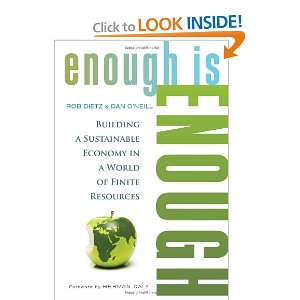
5.0 out of 5 stars Important Milestone, Two Gaps, February 4, 2013
I was educated in the Limits to Growth period–back in the day of telephone couplers–and have also been an ardent follower of Herman Daly's pioneering work in ecological economics as well as complementary work spanning the last several decades, notably by Paul Hawkins among others.
On the one hand this book is very important and not to be ignored, not least because the foreword is written by Herman Daly and there are pages of glowing endorsement from serious people. The book is superbly organized and below I do my summary, as much for my own future recall as for others. First however, two gaps:
01 This book shares one troubling assumption with Limits to Growth — they thought they could micro-manage from the top down and that governments would be the principal actors. The Club of Rome, in choosing to support the Meadows and Randers, explicitly rejected the more affordable and implementable alternative that focused on educating the public with respect to true costs and creating a culture of bottom up conservation instead of a bureaucracy of top-down regulation.
02 The book is perfection incarnate with respect to being the best summary I have seen yet of what are we doing now and what should we be doing, but it skips over the hard part: how to we establish a universal appreciation for whole systems thinking, respect for feedback loops, and acute public awareness of the true cost of every product, service, and behavior? The concept of a steady-state economy is a useful one, but only if one appreciates, as Charles Perrow is at pains to document, that we are our own worst enemies, creating catastrophe at every turn, because we know not what we do or what is done in our name, and allow the hoarding of profit and the externalization of costs to future generations.
Implicit in both of the above, and explicitly not addressed in the book, is the reality that all organizations — be they government or private sector and including non-profit — are corrupt to the bone. Their leaders are focused on what benefits the leaders, not the ctizens, tax-payers, stake-holders, etcetera. I certainly agree with Lawrence Lessig that “the” fatal threat to humanity is CORRUPTION, and I have set for myself the task of further PUBLIC INTELLIGENCE IN THE PUBLIC INTEREST.
I particularly reject the carbon tax, mercury and sulfer are much more dangerous, and the last thing we need is another derivatives scheme. Please note that my praise for the book is denoted by the five star ranking and my strong recommendation that it be bought, read, and shared. By virtue of my need to also focus on what is not in the book, my critical comments may seem inconsistent with the grade but they are not — they augment this excellent work rather than diminish it.
Now to the details.
High-level objectives:
+ New measures and meanings of progress
+ Limits on material and energy consumption, waste production, plus conservation of natural lands
+ A staple population and labor force
+ A more efficient capital stock
+ More durable, repairable products
+ Better pricing including a carbon tax [NO — just make TRUE COST pricing available at point of sale]
+ Shorter work week and more leisure time
+ Reduced inequality
+ Fewer status goods
+ More informative and less deceptive advertising [NO — END all advertising]
+ Better screening of technology [NO — UNLEASH all technologies now locked up for the wrong reasons]
+ More local and less global trade of goods and services [YES — resilience at the local level]
+ Education for life, not just for work [YES, free for life as well]
The authors then go on to discuss eleven things we have too much of, and how to reduce them:
01 Throughput [use only what will renew, create no waste that will not recycle]
02 People [educate the women, make population limitation a national cultural priority]
03 Inequality [set maximum pay differentials, employee owned companies]
04 Debt [end national debt, local currencies, restructure financial institutions]
05 Miscalculation [Human Well-Being as Measure]
06 Unemployment [Full employment policies]
07 Business as Usual [Limit size of corporations]
08 Materialism [Eliminate planned obsolescence, culture of humanity instead of things]
09 Silence [Strengthen academic multi-disciplinary steady-state voice]
10 Unilateralism [Stop being the bully — multinational consensus]
11 Waiting [sustainable scale, fair distribution, efficient allocation, high quality of life]
There are many excellent notes but no bibliography, and the index is a bit light.
The authors take a stab at a “whole system” conclusion, with the following each discussed in a paragraph:
01 Consumption
02 Population
03 Families
04 Community
05 Business
06 Cities
07 Agriculture
08 Nature
09 Energy
10 Money
This is where I identify a third gap in the book. The concept of “free energy” is not in this book, and it should be. Apart from exposing and eradicating corruption in all its forms — in the USA it is corruption, nothing more, that causes the US Government to borrow one trillion dollars a year and waste 50% of three trillion dollars a year each year — we should be doing a global Manhattan Project to create free energy, which in turn creates unlimited clean water. Throw in national call centers, an Autonomous Internet with Freedom Towers everywhere and free cell phones for life for the five billion poor, and you create a prosperous world at peace, a world that works for all.
Governments have failed and are not the answer. There are eight “tribes” of knowledge: academic, civil society, commerce, government, law enforcement, media, military, and non-government/non-profit. We are at the very beginning of an era of hybrid governance that must be enabled by open-source decision-support. That is the center of gravity for creating a prosperous world at peace, a world that works for all, and that is not something the ecological economists have grasped just yet.



 All of which is to say, regarding the post to follow: caveat lector. Still, this looks very, very cool.
 Goodbye ‘information economy’; hello ‘hacker economy’