DefDog: SASC Questions Sanity of Pentagon InfoOps

Corruption, Government, IO Impotency, Military
0Shares
DefDog

The Pentagon may have hit a speed bump in the expansion of its growing worldwide information operations…………

A speed bump for Pentagon’s information ops

The Pentagon may have hit a speed bump in the expansion of its growing worldwide information operations.

The Senate Armed Services Committee has asked Defense Secretary Leon Panetta to assess the effectiveness of a series of news and information Web sites that have been initiated by U.S. Special Operations Command (SOCOM) in recent years in a bid to counter extremist messaging. The so-called “influence Web sites” are maintained by various overseas commands and operated by defense contractors.

For fiscal 2012, SOCOM sought $22.6 million in the Overseas Contingency Operations account — primarily intended to fund the wars in Afghanistan and Iraq — for the initiative.

Congress, over the past few years, has been pressing the Pentagon to justify the hundreds of millions of dollars spent overseas under various headings such as “strategic communications” and “information operations.”

Read full article.

Phi Beta Iota:  No one now serving in the US Government actually has a clue what Information Operations (IO) should be, because no one now serving in the US Government can combine intelligence and integrity to get to holistic analytics with deep “true cost” data.  IO is all information in all languages all the time.  Secret intelligence is 10% of all-source intelligence and all-source intelligence is 10% of IO.  IO includes policy, acquisition, and operations feed-back loops that must be transparent, truthful, and replete with trust–that pretty much eliminates ALL inter-agency and intra-agency information.  We've learned nothing since 1992.

See Also:

2011 Cyber-Command or IO 21 + IO Roots

2011 from 1999: Setting the Stage for Information-Sharing in the 21 st Century (Full Text Online)

2008: Creating a Smart Nation (Full Text Online for Google Translate)

Paul Fernhout: Open Letter to the Intelligence Advanced Programs Research Agency (IARPA)

Search: Steele USMC C4I 1990′s

Steve Denning: Why No Successful Innovation?

Advanced Cyber/IO, Blog Wisdom, Cultural Intelligence, Methods & Process
0Shares
Steve Denning

Why Are There No Successful Innovation Initiatives?

Forbes, 2 December 2011

Just the other day, a colleague asked me whether I could suggest some examples of organizations that have been successful with “innovation initiatives” in a commercial setting?  He said that he had a CEO who wanted to launch an “innovation initiative” that would provide a laboratory for experiments in-house, so that his firm could become known as an idea factory in their sector.

I replied that I didn’t know of any “innovation initiative” that was ultimately successful on a sustained basis. That’s because if an organization is looking at innovation as “an initiative”, and it introduces that initiative into a culture that doesn’t support innovation, then the culture will sooner or later crush the initiative—usually sooner. So you can have temporary “successes” as “initiatives” with a lot of flag waving and hoopla ceremonies and celebrations of victories, but they don’t last.

If the firm wants innovation, which they should, since innovation is an essential ingredient for survival in today’s marketplace, then they need to ask themselves why are they thinking of an innovation as “initiative”. They need to look more deeply at how the organization is being run and think through what would be needed to make innovation a central part of the organization’s culture.

The three phases of the 20th Century organization

In the 20th Century, organizations tended to go through three phases, as sketched by f Robert X. Cringely’s Accidental Empires, by analogy with a military operation.

  • In the first phase, you had startups run by commandos. They were unpredictable and uncontrollable yet remarkably productive.  They worked hard and fast. They succeeded with surprise and teamwork, establishing a beachhead before the enemy is even aware they exist. They pushed the state of the art, ideally providing creative solutions to customer needs and making existing products irrelevant. However most startups fail because they don’t meet customer needs. Sometimes the product was close to meeting customer needs but it wasn’t ideal and had bugs or even major failings that need more work. However commandos were useless of this type of work: they got bored.
  • In the second phase, the infantry moved in, i.e. the obedient workers who followed orders and methodically grew a company from its IPO to market dominance. They exploited the opportunity created by the commandos. They took the prototype, tested it, refined it, made it manufacturable, wrote the manuals, marketed it and ideally produced a profit. This work was governed by rules and procedures—all the stuff that commandos hated. While the commandos make success possible, the infantry makes success happen.
  • In the third phase, the firm was run by police: the bureaucrats and middle managers who defend the entrenched position of an established market leader. The third phase was an occupying force intent on holding territory. A middle manager’s job was to say no to ideas that don’t originate from on high, preferably near the CEO, or which don’t improve the bottom line for the quarter.

In the 20th Century, “management” was seen as the set of bureaucratic practices designed to run the second and third phases. Management comprised hierarchy,  command-and-control, tightly planned work, competition through economies of scale and cost reduction, impersonal top-down communications, all focused on making money for the shareholders.

These management practices were seen as timeless truths of the universe, so obvious that there was scarcely any need to articulate them, let alone re-examine them. They are still pervasive in large organizations, business schools and management textbooks. John Sculley tried to run Apple [AAPL] as a third-wave organization. Most big old mastodons today like GE [GE] or Walmart [WMT] are still third-wave organizations.

This way of managing systematically kills innovative activities in organizations. The phenomenon can be observed in:

knowledge management  ..  lean manufacturing  ..  marketing  ..  teams   ..  even innovation itself

It isn’t just one or area. It’s every area. It isn’t just one organization. It is most of the big organizations.

How traditional management kills innovation

Read full article.

Josh Kilbourn: Catagorizing Unemployed in the USA

03 Economy
0Shares
Joshua Kilbourn

Categorizing the Unemployed by the Impact of the Recession

By Dr. Cliff Zukin, Dr. Carl E. Van Horn, and Charley Stone

Rutgers University Working Paper, 5 December 2011

Words like ‘shameful' and ‘national disgrace' do come to mind.

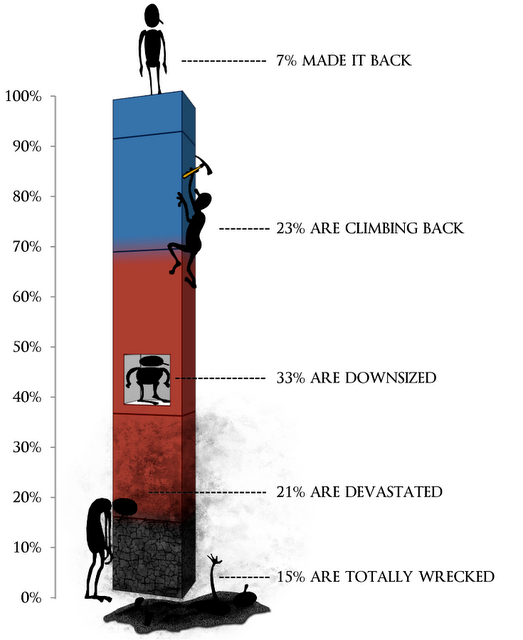
In August 2009, the John J. Heldrich Center for Workforce Development at Rutgers, The State University of New Jersey began following a nationally representative sample of American workers who lost a job during the height of the Great Recession.

Click on Image to Enlarge

The research began with a cross-sectional sample of 1,202 who had said they had lost a job at some point in the preceding 12 months (between August 2008 and 2009). They were resurveyed in March 2010, again in November 2010, and then in August 2011.

A total of 3,972 individual surveys were completed over the two years. Well over half of the original respondents participated in all four waves of the project, meaning they spent, on average, 50 minutes of their time responding to roughly 200 questionnaire items.

This resulting measure combines an assessment of the respondent/family’s current economic status with the magnitude of change in the quality of daily life, with an assessment of whether this change represents a new normal or is a temporary stay in limbo. Combining answers to these three questions result in a typology with five groups, defined as follows:

� Workers who have MADE IT BACK consider themselves in excellent, good, or fair financial shape and have experienced no change in their standard of living due to the recession.

� People ON THEIR WAY BACK have largely experienced a minor change to their standard of living, but say the change is temporary. They also consider themselves in excellent, good, or fair financial shape.

�� Workers who have been DOWNSIZED meet one of three conditions; they have experienced: a minor change that is permanent; a minor change that is temporary, but they are in poor financial shape; or a major change in their standard of living that is temporary and they are in at least fair financial shape.

� Workers classified as DEVASTATED have experienced a major change to their lifestyle due to the recession. They can be either in poor financial shape and think the change is temporary, or in fair financial shape but think this change is permanent.

� Workers that have been TOTALLY WRECKED by this recession have experienced a major change to their lifestyle that is permanent and are in poor financial shape.

Read the rest of this working paper here.

ADMIN: Links Update

Commercial Intelligence
0Shares

LINKS now has two columns, one for Righteous Sites of Note, the other for Professional Sites of Note.

Nominations are sought for both.  In the case of Professional Sites of Note, the avant guarde is observing the death of Competitive Intelligence and the emergence of public intelligence and commercial intelligence as more holistic approaches to the art and science of intelligence as decision-support.  Both public and commercial intelligence have multi-national, multi-agency (or multi-sector) evoluations.

Kristan Wheaton: Intelligence Analytics – Three Sources

Articles & Chapters, Commercial Intelligence, IO Sense-Making, Methods & Process, Movies
0Shares
Kristan Wheaton

VIDEO (8:19)  Applying Scenarios, Wargames and Advanced Intelligence Analytics (Part 1 of 2)

Generic is worthless–focus on real specific threats and opportunities.  Do the collection rather than just speculating without data.  Do not extrapolate from the past — instead intuit and shape the future.

VIDEO (7:12) Applying Scenarios, Wargames and Advanced Intelligence Analytics (Part 2 of 2)

First, study your business model. Then simplify it. Then innovate.

In passing (PDF): The impact of competitive intelligence on products and services innovation in organizations

Competitive Intelligence (CI) is not impacting on innovation.