DefDog: Law Schools Not Teaching How to Lawyer

04 Education, Academia, Cultural Intelligence
0Shares
DefDog

This just doesn't apply to lawyers, but most college grads are ill
prepared to enter the work force….

What They Don’t Teach Law Students: Lawyering

New York Times,  November 19, 2011

EXTRACT:

What they did not get, for all that time and money, was much practical training. Law schools have long emphasized the theoretical over the useful, with classes that are often overstuffed with antiquated distinctions, like the variety of property law in post-feudal England. Professors are rewarded for chin-stroking scholarship, like law review articles with titles like “A Future Foretold: Neo-Aristotelian Praise of Postmodern Legal Theory.”

So, for decades, clients have essentially underwritten the training of new lawyers, paying as much as $300 an hour for the time of associates learning on the job. But the downturn in the economy, and long-running efforts to rethink legal fees, have prompted more and more of those clients to send a simple message to law firms: Teach new hires on your own dime.

“The fundamental issue is that law schools are producing people who are not capable of being counselors,” says Jeffrey W. Carr, the general counsel of FMC Technologies, a Houston company that makes oil drilling equipment. “They are lawyers in the sense that they have law degrees, but they aren’t ready to be a provider of services.”

Read full article.

Phi Beta Iota:  The entire US educational system is hosed.  From college students who graduate with no more capability than high school graduates to half century ago, to “professional” degrees that do not teach how to “do” only how to take tests, the disconnect from reality is huge.   While some intelligence studies have emerged, after the pioneering effort of Mercyhurst under Bob Heibel, they do not actually teach the craft of intelligence or how to do holistic analytics or create workable open source information technology support packages — they simply prepare rounded cogs for the secret intelligence world.

See Also:

Education (General) (128)
Education (Universities) (58)

Josh Kilbourn: Police Pepper Spray Seated Non-Violent Students – Calls for UC Davis Chancellor’s Head

Uncategorized
0Shares
Joshua Kilbourn

UC Davis Chancellor Called to Resign After Police Pepper Spray Students

Kevin Gosztola

FireDogLake, Saturday November 19, 2011

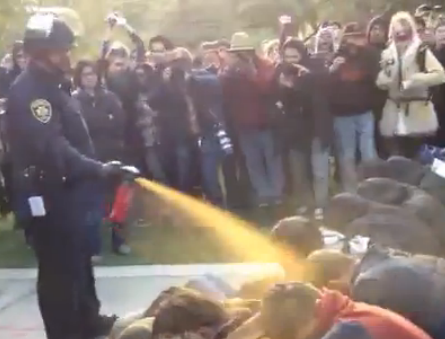
Each and every day some police action infuriates and breathes new life into this movement. Just when you think the movement might go stale and the message of “We are the 99%” will no longer pack the punch that it has had over the last two months, some picture or some video is released showing occupiers or, in this case, students peacefully standing their ground in the face of police violence.

Click on Image to Enlarge

Yesterday, UC Davis students showed solidarity with students at other UC campuses, who are facing tuition increases and have been the victim of police brutality (particularly at UC Berkeley during Occupy Cal protests). The students set up tents on the main quad area of UC Davis. Police were ordered to remove the tents and arrived in riot gear holding batons and tear gas guns. Students sat on the ground in a circle, linked arms and held their ground in the face of a menacing police force.

“Lieutenant of Police” for UC Davis, John Pike, stepped over the line of occupiers sitting on the ground. He pointed a pepper spray canister at the line of students. Then, as if he was watering his lawn, he began spraying the students with orange-colored pepper spray.

Read more, two videos.

DefDog: The Absurdity [Atrocity] of US Police Powers

07 Other Atrocities, Corruption, Counter-Oppression/Counter-Dictatorship Practices, Law Enforcement
0Shares
DefDog

War on Terror and War on Drugs actually a war on individual civil liberties. And for this [and the bloated defense/intelligence pork fest] we borrow one trillion a year?

Police Response to Occupy Wall Street is Absurd

E. D. Kain

Forbes, 19 November 2011

Events like the one in the above video have been far too common in the police response to Occupy protests across the country. I do believe that Occupy Wall Street is at a tipping point, and that it must grow beyond and evolve away from the tent city occupations, but this police response is absurd and excessive.

Arrests exceeding 250 people followed protests in New York City yesterday. All across the country, cops are cracking down on protesters with force. I may be a critic of Occupy Wall Street, but the police are public servants, and public servants have no business treating the public this way.

Read more, watch short video.

John Steiner: Re-embracing Abraham’s Path

Cultural Intelligence, Geospatial, Peace Intelligence
0Shares
John Steiner

In the footsteps and spirit of Abraham

William Ury is on a campaign to mark the path, which will run through several countries of the Middle East, an whose route will follow in the footsteps of the patriarch Abraham.

By Moshe Gilad

HAARETZ.com, 16 November 2011

EXTRACT:

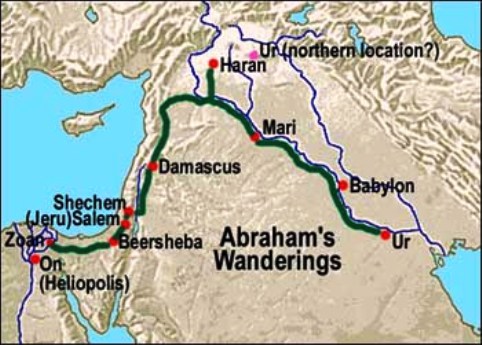
The Abraham Path, which is now being marked, begins in Haran and meanders its way to the city Gaziantep. From there, it continues southward, crosses the border into Syria and wends its way to Aleppo. The path then moves south, passing through Damascus before crossing the border into the kingdom of Jordan and the city Amman. At that point it crosses over to Jericho in the Palestinian Authority, and then to Nablus, Jerusalem and Hebron, where Abraham was buried. Additional offshoots of the path follow Abraham's journeys through Iraq and Israel.

. . . . .

Click on Image to Enlarge

The route is approximately 1,200 kilometers long. The Harvard team is aware that very few people will ever hike its entire length, but in a telephone interview with Haaretz, Ury clarifies that the intent is to create among visitors to the Middle East a profound cultural experience and a familiarization with the local culture, the residents, the landscapes and the regional tradition. “Hospitality is one of the greatest legacies that our culture received from Abraham,” he says, “and when you hike or drive along the path, you feel it every day, in the best possible way.”

A tool for conflict resolution

Ury himself has twice travelled the entire route, from Haran to Hebron, and his travels have left in him a deep impression, he says. His great expertise is conflict and crisis resolution. Development of the Abraham Path is, in his opinion, a tool for resolution of the prolonged crisis in the Middle East.

Read full article.

NIGHTWATCH on European Union, Banks, and PIIGS

03 Economy, 08 Wild Cards, 11 Society, Civil Society, Commerce, Commercial Intelligence, Corruption, Cultural Intelligence, Government, Law Enforcement
0Shares

European Union: Reuters and other news services reported on 18 November that the European Commission will present a study that proposes three options for debt issuance for the Eurozone. The study indicates the European Union intends to exploit the debt crisis to undermine sovereignty in debtor countries, such as the PIIGS – Portugal, Italy, Ireland, Greece and Spain.

• The first law would link the acquisition of emergency loans from current and future bailout funds to the acceptance of economic monitoring by the Commission, which would be more extensive than that for Portugal, Ireland or Greece. If a eurozone member accepts this enhanced surveillance, it could mean the Commission would have an almost permanent presence in the nation.

• The second law would allow the Commission to evaluate draft budgets, suggest changes or draft a new budget. The Commission could also debate the budgets in a national parliament. These changes would not require a change to the EU treaty, which already states that economic policy is a common concern.

• The third law stipulates that budgets must be drafted based on forecasts from independent institutions, such as the Commission or the European Central Bank, rather than government agencies. The Commission will also propose that fiscal rules be written into national laws, preferably a country's constitution.

Comment: If the PIIGS accept these terms, they surrender national sovereignty. It is unlikely that the laws will be approved, but they make clear the intentions of the unelected Eurocrats to govern. Budgetary authority is government authority. The Eurocrats think they know better than the people of the PIIGS.

NIGHTWATCH KGS Home

Phi Beta Iota:  The only thing worse than democracy is everything else, and that everything else assuredly includes European technocrats who have deep conflicts of interest, deep gaps in their knowledge, deep gaps in their integrity, and zero appreciation for the realities that have led to this situation including deep corruption in both government and finance.  In a democracy, if politics and intelligence keep their integrity, there is no conflict and good policy results from good intelligence.  When either or both abandon their integrity, the people get screwed.  The LAST thing any of the weaker countries should do is listen to dictats from external “authorities.”  The re-nationalization of privatized public assets, and the criminal prosecution of all Goldman Sachs and other banking figures that lied to governments over the past decade, are two of the FIRST things each government should do.

See Also:

Journal: Politics & Intelligence–Partners Only When Integrity is Central to Both

NIGHTWATCH on Pakistan-US-Who Knows What

03 India, 05 Iran, 08 Wild Cards, 10 Security, Blog Wisdom
0Shares

Pakistan-US: Special comment. This week, the Pakistani ambassador to the US submitted his resignation for his involvement as a conduit for conveying a politically explosive memorandum from Pakistani President Zardari to Admiral Mullen, when he was US Chairman, Joint Chiefs of Staff. The Washington Post published the text of the memo whose authenticity, on a prima facie basis, is established by the ambassador's request to resign.

Continue reading “NIGHTWATCH on Pakistan-US-Who Knows What”

Patrick Meier: Ushandi Data to Study Micro-Conflict

Cultural Intelligence, Peace Intelligence
0Shares
Patrick Meier

Using Ushahidi Data to Study the Micro-Dynamics of Violent Conflict

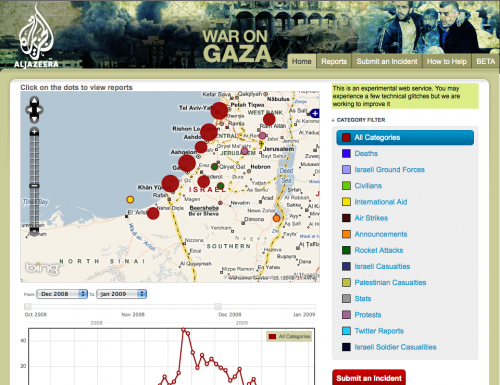
The field of conflict analysis has long been handicapped by the country-year straightjacket. This is beginning to change thanks to the increasing availability of subnational and sub-annual conflict data. In the past, one was limited to macro-level data, such as the number of casualties resulting from conflict in a given county and year. Today, datasets as such as the Armed Conflict Location Event Data (ACLED) provide considerably more temporal and spatial resolution. Another example is this quantitative study: ”The Micro-dynamics of Reciprocity in an Asymmetric Conflict: Hamas, Israel, and the 2008-2009 Gaza Conflict,” authored by by NYU PhD Candidate Thomas Zeitzoff.

Click on Image to Enlarge

I’ve done some work on conflict event-data and reciprocity analysis in the past (such as this study of Afghanistan), but Thomas is really breaking new ground here with the hourly temporal resolution of the conflict analysis, which was made possible by Al-Jazeera’s War on Gaza project which used the Ushahidi platform.

Read Abstract and Key Highlights.