A transpartisan coalition called Green Scissors released a report today showing that $380 billion in savings over five years can be achieved by “curbing wasteful spending that harms the environment.”
WASHINGTON — In what amounts to a fight over who gets to write the history of the Sept. 11 attacks and their aftermath, the Central Intelligence Agency is demanding extensive cuts from the memoir of a former F.B.I. agent who spent years near the center of the battle against Al Qaeda.
. . . . . .
Starting in May, F.B.I. officials reviewed Mr. Soufan’s 600-page manuscript, asking the author for evidence that dozens of names and facts were not classified. Mr. Soufan and Mr. Freedman agreed to change wording or substitute aliases for some names, and on July 12 the bureau told Mr. Soufan its review was complete.
In the meantime, however, the bureau had given the book to the C.I.A. Its reviewers responded this month with 78-page and 103-page faxes listing their cuts.
Taming this torrent into something manageable and highly relevant is increasingly seen as the key for Twitter, YouTube, Facebook, and any other chaotic content network looking to realize monster revenue.
That explains why discovery is the word du jour in tech. It also explains why there's a flurry of activity to build a “discovery engine,” the search engine's smart-ass cousin that tries to answer vague queries (like “funny video”–one of the top searches on YouTube).
Click on Image to Enlarge
Phi Beta Iota: Discovery today sucks, one reason Google is not worth much for serious intelligence (decision-support) endeavors. As Stephen E. Arnold has documented so ably, there are over 75 search engines, each with its own niche, and no one has put them together. Worse, they only tap into the 2% or so that is the surface web, and do not do deep web (for that, dee Deep Web Technologies). Worse, Google shows you what someone else has paid for you to see, not what you actually need or can get for free. The bleeding edge of the mature intelligence world is focused on multinational information-sharing and sense-making, and on human computation, including leveraging the diasporas for crowdsourcing everything from translation to imagery interpretation.
Nouriel “Dr. Doom” Roubini is slamming the run up in the gold market: it's the new subprime bubble only worse. It's leveraged 25-40x not just 5-10x. It's just another example of the global market's central planning directorate in action. Another massive/bad investment by those with all the decision making power. It may also be a good indicator that gold is part and parcel of the old broken economy and not something that should be welcome in the new one we're building.
Phi Beta Iota: George Soros has this exactly right and has pulled out. What can be understood from open sources in addition to the above is that the gold market is chock full of fraud, including gold certificates issued without gold to back them up; and very likely gold diluted with titanium by the Bank of New York under Tim Geithner. There is also the residual matter of the Black Lily covert gold fund, of the gold to be confiscated from Libya before the rebels figure out they're dupes in a major theft, and finally–the wild card–there are rumors circulating in the gold community that a new methods has been found that will more rapidly discover all remaining gold deposits around the earth.
We are incredibly excited to announce an extraordinary lineup of speakers this year, featuring some of the biggest game-changers in Open Hardware history.
Royals dancing in palace corridors have been spotted in Riyadh. The heir to the Libyan throne, Prince al-Senussi, a nephew of King Idriss who was deposed by Muammar Gaddafi and others in a bloodless 1969 military coup, has embarked on a busy self-promotion campaign, saying he's ready to go back to Libya and even “lead the country”.
Nothing in the world would be sweeter for the House of Saud – extremely distasteful of most Arab secular republics – than a friendly, brand new emirate in northern Africa.
The illegal American invasion of Iraq and subsequent occupation was so epochal a catastrophe that it spawned a negative phrase in Arabic, “to Iraqize” or `arqana. Tonight I heard an Alarabiya anchor ask a spokesman for the new government in Libya whether there as a danger of the country being “Iraqized.” He was taken aback and asked her what she meant. Apparently she meant chaos, civil war, no services, etc.
1. No Western infantry or armored units should be stationed in the country.
2. As much as possible of the current bureaucracy, police and army should be retained
3. Establish a strong civilian oversight over police.
4. Avoid being vindictive toward former Qaddafi supporters, and avoid purging all but the top officials from the body politic.
5. Avoid a rush to privatize everything.
6. Consult with Norway about how it is possible for an oil state to remain a democracy.
8. Diversify the economy. The most clever way to do so is to use the petroleum receipts to promote other industries and services. Libya has a high literacy rate and could potentially attract investors to put its population to work in other sectors.
As an intelligence officer, I found myself studying the maps and ultimately noting the following:
a. The Israelites drove out the Cananites, the Philistines (precursors to Palestinians), the Ammonites, the Moabites, and the Edomites. I found myself wanting a book that made the cultures and the history of those “enemy” peoples as clear to one as this book makes the Bible family.
Sykes-Picot Click to Enlarge
b. I also noted the centrality of the Sea of Galilee and the Dead Sea, and the fact that the Philistines (Palestinians) have never really been dislodged from the Joppa to Gaza coastline and beyond to Pelusium; as well as the area south of Gaza.
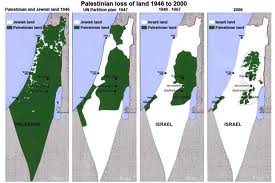
The history of a distinct Palestinian national identity is a disputed issue amongst scholars.[20] According to legal historian Assaf Likhovski, the prevailing view is that Palestinian identity originated in the early decades of the twentieth century.[20] The first widespread use of “Palestinian” as an endonym to refer to the nationalist concept of a Palestinian people by the Arabs of Palestine began prior to the outbreak of World War I[21] The first demand for national independence of the Levant was issued by the Syrian-Palestinian Congress on 21 September 1921
. . . . . .
Genetic analysis and historical accounts suggest that the Muslims of Palestine are largely descendants of Christians and Jews from the southern Levant.[19] Since the time of the Muslim conquests in the 7th century, Palestinians have been predominantly Muslim by religious affiliation and linguistically and culturally Arab.[15] Most Palestinians are Sunni Muslims, but there is a significant Palestinian Christian minority of various Christian denominations, as well as Druze Palestinians and a small Samaritan community. Palestinian Jews made up part of the population of Palestine prior to the creation of the State of Israel, but very few identify as “Palestinian” today.