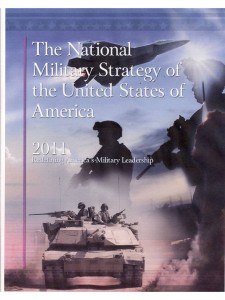
Tip of the Hat to Contributing Editor Marcus Aurelius.
Comments below the line
Continue reading “USA National Military Strategy 2011 + RECAP”

The truth at any cost lowers all other costs — curated by former US spy Robert David Steele.
Tip of the Hat to Contributing Editor Marcus Aurelius.
Comments below the line
Continue reading “USA National Military Strategy 2011 + RECAP”

Self sufficiency appears to be a worthy goal, but it's now impossible if you want to actually get anything done.
All our productivity, leverage and insight comes from being part of a community, not apart from it.
The goal, I think, is to figure out how to become more dependent, not less.
Phi Beta Iota: It is very hard for cultures that define themselves by secrecy rather than accomplishments to accept this. The “eight tribes” of intelligence are the antithesis to unilateral ineffective secret intelligence. This is about complexity, integrity of feedback loops, and harnessing the collective intelligence of the Whole Earth. Autarky [self-sufficiency] is an oxymoron–so is “central” intelligence.
Others, notably Dr. Loch Johnson, de facto dean of the intelligence scholars in the English language, have explored both definitions and concepts for a theory of intelligence. Others, such as Jack Davis, have done much in the area of analytic tradecraft or the “art” of intelligence analysis (to match the “art” in clandestine operations and covert action).
Now the time has come to develop a science of intelligence. The first casualty must of necessity be the obsession with secret sources and methods, secret agencies, and secret clients. Intelligence is about decision-support, plain and simple, and the new science of intelligence will be developed along the lines of the services science developed by Dr. Jim Spohrer of IBM, and others. Dr. Spohrer provided the below in an email exchange today:
(1) “you can have a science of anything, if a community agrees it is important”
(2) “innovations that are based on sciences, not just management and engineering practice, can be advanced more systematically”
(3) “industry cares about innovation acceleration, can academia deliver a science? does the engineering and management exist in practice”
(4) “academia said we can establish a research area to help build the science under the engineering and management practice.”
A round-table is being formed and a new article will result.
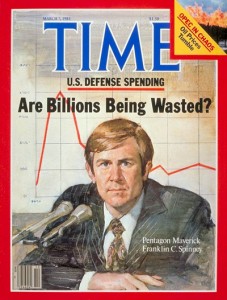
Below are three separate contributions: Spinney on Sprey; Sprey on Boeing; and Seattle Times on Boeing.
CHUCK SPINNEY SOUNDS OFF
President Obama says that restoring America’s competitiveness is one of his top priorities. Yet under his watch, deindustrialization, financialization, and globalization continue without interruption. Many advocates of defense spending argue that spinoffs from the Pentagon's R&D and high tech engineering practices are keys to reinvigorating America’s manufacturing economy. For whatever reasons, Mr. Obama shows no intention of reining in defense spending by anything more than a cosmetic amount, even though the defense budget is higher now that at any time since the end of WWII (after removing the cumulative effect of 60 years of inflation), and despite the fact that the United States is spending about as much on defense as the rest of the world combined.

by jonl on February 7, 2011
With colleagues Pete Lewis, Tony Deifell, Kevin Anderson, Andrew Haeg, and Scott Rosenberg, I’m in a two week conversation about the future of journalism on the WELL. The WELL is the seminal online community; this conversation is in the Inkwell forums, where Bruce Sterling and I have our annual state of the world conversation. Inkwell usually has conversations with authors, but for this conversation we’re trying a panel format.
Here’s my latest contribution to the conversation:

REPORT (PDF 27 Pages)
Identifying and Structuring the Objectives of Terrorists
by Gregory L. Keeney and Detlof von Winterfeldt
Center for Risk and Economic Analysis of Terrorism Events, August 2009
Phi Beta Iota: The report is interesting, and provides a useful methodology for approaching the relationship between intangible values and tangible manifestations, but it has one major flaw: it does not provide for the reality that expelling dictators and the US from the Middle East might be related to actually seeking to create a prosperous Middle East at peace. Because of that flaw, the report also fails to point out that the best strategy against Al Qaeda is NOT to try to hunt down individual Al Qaeda members, but rather to pull out of the Middle East, stop supporting dictators (and Israel) and begin waging peace at one third the cost of war. One should not throw stones when one lives in a glass house. The USA today is a glass house on a sand foundation.
