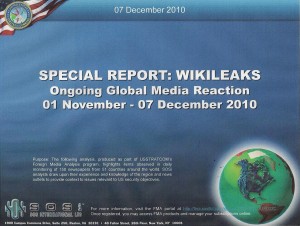
Phi Beta Iota: 78 pages representing the “state of the art” in DoD OSINT, remarkably pedestrian, not at all what one would expect after years of multi-million dollar expenditures by STRATCOM. The “priorities” on the very last page are particularly relevatory with respect to what is and is not being done by STRATCOM, pupportedly on behalf of DoD world-wide.
I am sick to my stomach with “progressive” and “liberal” leaders hurling the insult of “hypocrites!” at the rich.
“Hypocrite” is a word used by men in suits and ties. “Hypocrite” is even used by people who think this Obama deal on the extension of unemployment benefits is one dandy mitigating factor, in the injustice of it all.
What about our Christian (etc.) Brothers and Sisters—the “99ers”–the American human beings who have reached the 99-week limit, and are now ruthlessly spit into poverty. Millions of them, thousands every day.
“Hypocrites” is a word that is used by rich people and Progressives who think that poor people are statistics. Too bad, we can’t take care of these devastated American souls… “After all,” many of employed think secretly or not, “They should go get a job.”
Do you understand this simple fucking fact—there used to be three men on a garbage truck. Two threw in the garbage and one drove. Now there’s a driver with an expensive, giant, robotic, steel, throwing arm. Those other two guys are out of work, and, now, out of luck. Tough nuggies.
What happened to the garbage men has happened to millions of people. It is called structural unemployment. Industry got more and more efficient with better machines and cheaper labor (from wherever). The structure of how we make things has changed. We use fewer citizens and more machines. We need educated people, not public high school drop-outs. Fuck ‘em.
If you're reading this, it's probably because literature matters to you, because you agree with the Peruvian writer Mario Vargas Llosa that literature is “one of the common denominators of human experience through which human beings may recognize themselves and converse with each other, no matter how different their professions, their life plans, their geographical and cultural locations, their personal circumstances.”
Yet here in the United States, we seem to be conversing mostly with ourselves. Even among those of us who love to read, we are largely cut off from the great dialogue that connects so much of the world (and missing some damn good books) due to the fact that less than three percent of what's published in this country is translated from other languages.
Three percent is low: in France and Spain, for example, both of which produce prodigious amounts of their own literature, more than half the new books published in a given year are translated from other languages. And even among the small number of foreign-language books that do make it into English in this country, about 300 to 400 titles in an average year, how many do you hear about?
If your main source for book news is mainstream media, the answer is: not many. Nine of the ten books on The New York Times's “Best Books of 2009” list were written by Americans (the tenth was by a Brit), as were nearly all the titles on their year-end list of 100 notable books. And very few of the books reviewed in any major American newspaper come from beyond our borders.
Phi Beta Iota: The author makes an very important point. Read the entire post to see his thoughtfully selected examples of books Americans should be but are not reading.
Tomorrow, Truthout will debut my new column: “Solutions: Making Government Work.” This weekly column will be a platform for myself and others with inside experience to seek solutions to ineffectiveness, waste and ingrained problems within the federal government.
. . . . . . .
I will continue to investigate fraud in the government where I see it, but after so many years of exposes, I wanted to try to move reform in a different way by trying to find solutions to the government problems once they are exposed. Our current government has immense problems that will require big institutional changes and solutions.
. . . . . . .
I believe that it is crucial for the next generation to try to make the government effective and find ways to make it work, or the suffering and cynicism will just continue to grow and plague our national debate and the future success of our country.
Six years ago, while standing inside a Wal-Mart, Cynthia Caron realized that those passing were walking through the entrance and nobody glanced over at the huge wall frame of missing children. She felt perhaps the general population may have become “desensitized” to the “missing child” posters. She also realized that it was rare to see one for a missing adult.
Cynthia began designing unique banners of missing loved ones which are posted on Internet web pages, blogs and forums with the hopes that a missing person will be recognized. Working with various law enforcement agencies across the country, on behalf of the families, and helping to bring awareness via the media, internet and social network groups relieves the frustrations that families endure when a loved one goes missing and enables families to have peace of mind in knowing that all the necessary steps are taking place. Cynthia interacts on a daily basis with law enforcement and a number of families who are seeking missing loved ones. She also guides those members to supportive groups of other families who have the same experiences. Linking families together has proven to be a valuable and supportive tool both emotionally and physically for those beginning the steps of searching for their missing loved one and LostNMissing is with the families every step of the way.
China does not want to “replace” the United States from its dominant role in the world, and the world should not fear China's rise, the country's top diplomat wrote in an essay.
State Councillor Dai Bingguo said that China would not engage in an arms race, as the country's resources were better spent on development and ensuring its people had enough to eat.
“The notion that China wants to replace the United States and dominate the world is a myth,” Dai wrote in the essay carried on the Foreign Ministry's website (www.mfa.gov.cn) late on Monday.
“Politically, we … respect the social systems and development path of the different peoples of the world,” he added.
NIGHTWATCH Comments: Dai's essay has a defensive tone that suggests the international community expects too much of China. If that is the case, the Chinese nurtured those expectations by their world-wide economic offensive, infrastructure projects in central, south and southeast Asia, port developments in the Indian Ocean and aggressive actions to assert Chinese territorial sea claims in East and Southeast Asia. In promising to be a “responsible participant” in the international system Dai is trying to lower expectations. He is disavowing any pretense to leadership with respect to North Korea and Iran, both of whom are Chinese clients and beneficiaries. Chinese actions, arms sales and investments contradict the self-effacing theme. Nonetheless, the modern successor to the Central Kingdom appears to be trying to tutor the rest of the world on how to look on and behave towards China.
Phi Beta Iota: Colin Gray, in Modern Strategy, reminds us that time is the one strategic variable that can not be replaced nor purchased. China understands this, the USA does not. China has made some very serious mistakes, notably with respect to water and energy, but on balance, on a per capita basis, it has been much more intelligent than the USA, and absent a radical change in how the USA is governed, we expect that to continue. Similarly, Brazil, India and Indonesia, the demographic powers of the future, appear to be less corrupt in their strategic leadership, more thoughtful in their operational campaigns, and less likely to self-destruct as the USA is doing.
15 December 2010, 1 pm – Washington, DC – LexisNexis will host its next Open Source Intelligence (OSINT) Round Table on “OSINT 2020: The Future of Open Source Intelligence.”
LexisNexis will host its next Open Source Intelligence (OSINT) Round Table at the National Press Club on December 15, 2010. Doors open at noon, program to begin at 1:00pm. The focus will continue our theme of “OSINT 2020: The Future of Open Source Intelligence” and will explore the evolving role of traditional media and technology in the future.
The program will include keynote remarks by Mr. Douglas J. Naquin, Director of the DNI Open Source Center followed by a “perspectives” discussion with leading experts among our group of distinguished attendees. The discussion will be based on the future of OSINT as a recognized discipline in strategic and tactical national security decision-making.
Panelists will include:
Mr. Chet Lunner, former Deputy Under Secretary of Homeland Security in the Office of Intelligence and Analysis
Ms. Suzanne Spaulding, Principal, Bingham Consulting and Of Counsel, Bingham McCutchen LLP
Mr. Jeff Stein, Washington Post SpyTalk columnist
Mr. Thomas Sanderson, Deputy Director and Senior Fellow at Center for Strategic & International Studies, Transnational Threats Project
The OSINT Round Table was created to make a public space for discussion about the government’s needs for Open Source Intelligence in order to facilitate relationships between government officials and private sector leaders. We seek to foster an increasingly responsive open source intelligence infrastructure that meets the needs of national security decision makers.