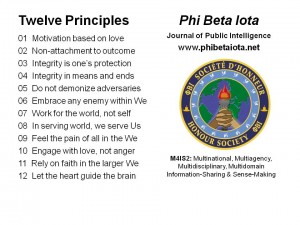
The above is a depiction of the free card that can be printed off and laminated by anyone. Click on the card to reach a printable version with instructions for trimming and lamination. A French version will be posted shortly, and then other languages as they appear. Giving your card away over and over is encouraged.
Will Keepen Describes Twelve Principles
Clicking on the Phi Beta Iota mascot will produce Will Keepen's explanation of his twelve principles as we are applying them to the craft of public intelligence (decision-support) as manifested in the discipline of M4IS2 as incorporated into the membership card. Originally a Swedish military concept, it has been enhanced by Phi Beta Iota and stands for
Phi Beta Iota Public Intelligence Honour Society/e d'Honneur
Phi Beta Iota is an open honour society intended to recognize any individuals or organizations that commit themselves to creating public intelligence in the public interest.
Le Phi Bêta Iota est une société ouverte d'honneur prévue pour identifier tous les individus ou des organismes qui se commettent à créer l'intelligence publique dans l'intérêt public.
At this time Robert David STEELE Vivas is the primary author. Lead authors are invited to volunteer for each of the eight “tribes” of intelligence: government, military, law enforcement, academia, business, media, non-profit and non-governmental, and civil society including labor unions, religions, and citizen councils or advocacy groups.
Actuellement Robert David STEELE Vivas est l'auteur primaire. Des auteurs importants sont invités à offrir pour chacun du ” huit ; tribes” ; de l'intelligence : société de gouvernement, de militaires, de police, de milieu universitaire, de commercial, de médias, sans but lucratif et non gouvernementale, et civile comprenant les syndicats, les religions, et les conseils ou les groupes de pression de citoyen.
The intent of the Society is to publish a Global to Local Journal of Public Intelligence free online to allow for easy tailoring of selections to any of the eight tribes in relation to any issue and/or any location.
L'intention de la société est d'éditer un journal de l'intelligence publique global au local libre en ligne pour tenir compte de concevoir en fonction facile des choix les huit tribus l'unes des par rapport à n'importe quelle issue et/ou à n'importe quel endroit.
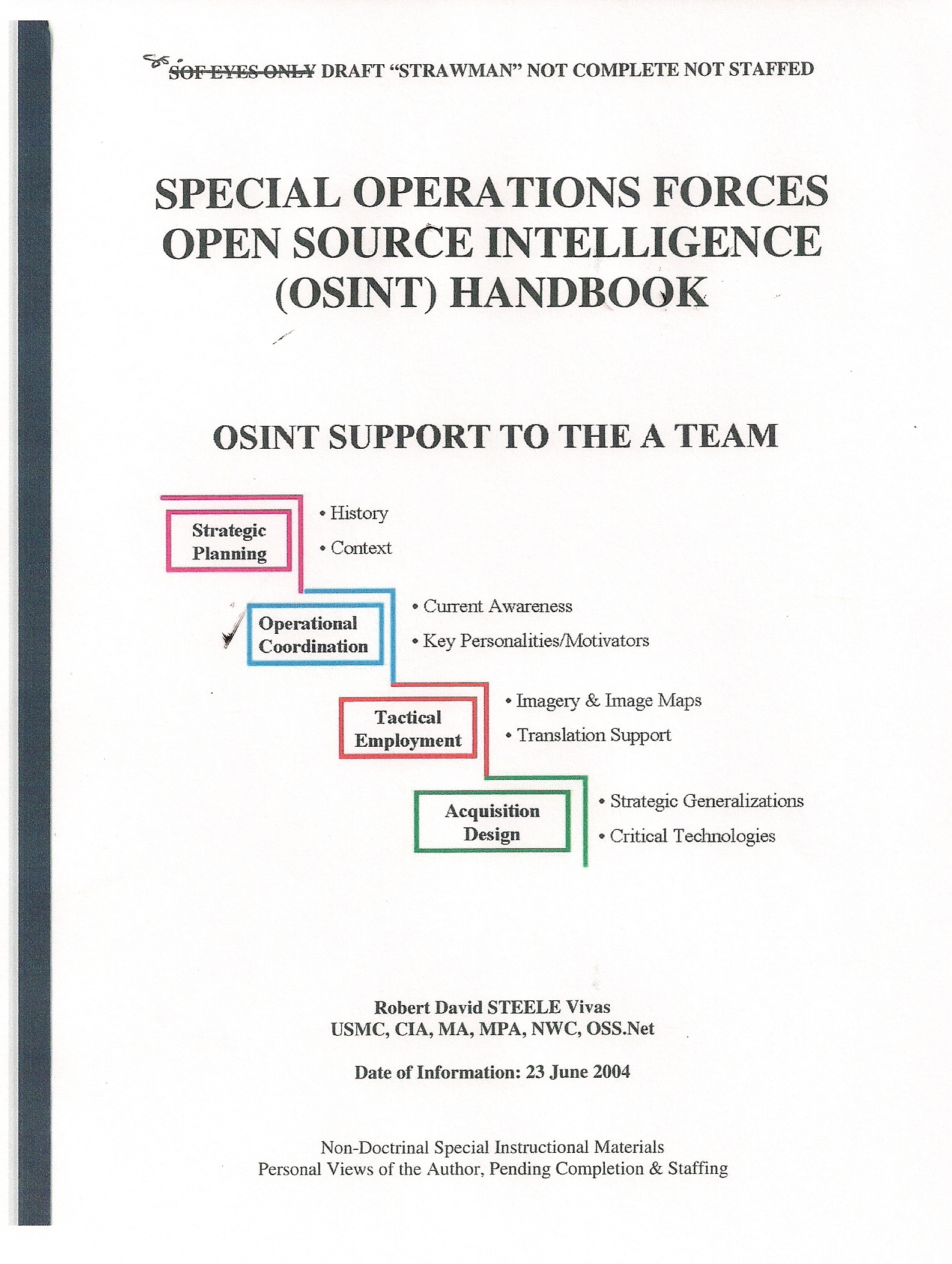
This gem is so valuable to me that when I could not find a copy for sale (this was way back before Amazon made it easy), I made a personal copy.
This is a foundation work for organizational intelligence, which now includes four converging streams: Open Source Intelligence (OSINT), Collective Intelligence, Peace Intelligence, and Commercial Intelligence.
I would like very much to see this re-published, and would be glad to contribute a preface from a commercial point of view while Mark Tovey, editor of the forthcoming book on Collective Intelligence: Creating a Prosperous World at Peace, does the academic preface.
This is a “must have” reference for anyone thinking about group IQ, smart mobs, smart nations, smart corporations, etcetera.
A few key points, with many others not itemized:
01 Explores how knowledge shapes (or does not shape) policy in both governent and industry
02 Information converted into intelligence integrates clear, timely, reliable, valid, adequate, and wide-ranging.
03 Intelligence failures stem in part from hierarchy (which conceals and misinterprets), specialization, rivalry, and other institutional dysfuntionalities.
04 There remains a great shortage of generalists able to select, discriminate, and integrate.
05 Information technology elevates the hard variables, represses the soft variables
06 Those at the top are out of touch; good judgment is rare, decisions are not fully informed nor deliberative.
This book joins my list of books I will never buy, read, nor recommend, because the publisher is charging three times what the book is worth. As a publisher myself, I am happy to inform prospective buyers that this book cost a penny a page to print. You do the math. Authors get 15%, Amazon gets 40%, the rest after actual cost deducation is pure profit.
This publisher is part of the problem, not part of the solution. This book should not cost more than $35. I would buy it at that price and probably find it quite valuable.
Authors are encouraged to demand in advance, in writing, a commitment on affordable pricing. The alternative is to post your book on the Internet as a PDF with a Creative Commons non-commercial license, which is what I do for all the books that I publish (at the same time that they are offered on Amazon at affordable prices to cover costs.
I will buy this book if and when it gets down to $37.50 or so, which is where it should be. The authors should protest this grotesquely expensive profiteering and handicapping of knowledge by posting the book online as a free PDF document.
This book should be selling for no more than $39.95. I'd like to buy it, but not at this price. As a publisher I can tell you it costs a penny a page to publish a book like this. I am adding this book to my list of books I would buy and review if they were more reasonably priced.