Jack Nicholson is as good as it gets for crazy in love with life, and Morgan Freeman is as good as it gets for smart, thoughtful, and good to the core.
This movie is one that I got, skimmed through, dismissed, and then sat down and watched all the way through.
It is NOT a depressing movie, nor is it a “joy” movie. It is a lovely mix of suffering, love, fulfillment, discovery, and reconciliation.
Web 1.0 Mindset Waving Web 2.0 Methods, June 29, 2008
Ted Hart
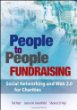
I've given this book four stars because if you want to leverage Web 2.0 methods to garner more money for your Web 1.0 “what we think best” programs, then this is the book for you.
In terms of actually creating empowered social networks where the non-profit is a facilitatator, connecting real people with micro-cash to real people with micro-needs, this book is so far back in time as to be next to useless.
Argh! This is the last gasp of the United Way/Red Cross “rip off as many as possible” so we can have our first class tickets and lifestyle and practice trickle down tax-free programs that “we the elite” decide.
There are web sites devoted to micro-connecting and micro-giving, I recommend that individuals avoid giving to any organization that does not offer open books and a complete menu of opportunities to earmark your gift for a specific need from a specific person or household. The animal and child chartities are a bit ahead of the game here, but even this can be disintermediated eventually.
I am reminded of two famous views:
“Criticize by Creating” from Machiavelo, adopted by the Flow Project.
Instead of trying to fix old systems, create new ones that displace them (paraphrase) from Buckminster Fuller.
I must disclose that recently Earth Intelligence Network sent 65 copies of its first book (the last one listed below, also free online) along with a letter of inquiry to the top foundations puporting to be addressing the ten high-level threats to humanity. We received back exactly two serious responses, six postcards blowing us off, and nothing at all from all the others. This has persuaded me that most so-called national foundations are nothing more than tax dodges and golden parachutes for a select few, and it is time we subject them to the same “open books” scrutiny that we plan for corporations and for government at all levels.
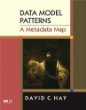
I've given this book four stars because it represents the very best thinking among those who believe it is possible to create integrative comprehensive relational databases in advance of receiving the data.
I served on the Information Handling Committee of the US Intelligence Community, and was a founding member of the Advanced Information Processing and Analysis Steering Group. I have spent the last twenty years thinking about all information in all languages all the time.
I have this book in my library (but just acquired it despite its 2006 publication date) and I have flipped through this book methodically, but cannot claim to have read it. I read the entire index word for word. It is excellent on terms and does not recognize humans.
Although XML is in the index, OWL and SOAP are not. Doug Englebart's Open Hypertextdocument system (OHS) and Pierre Levy's Information Economy Meta Language (IEML) do not appear in this book.
Following are the semantic entries in the index:
+ Semantic Class, 99, 100
+ Semantic Community, 40, 41, 45, 47, 210
+ semantic web, 47
+ semantics, 10, 38
Geospatial and Map (anything) do not appear in the index.
Neither foreign language variations nor multi-media geospatially-related data (the author is correct early on, data is the plural of datum) nor early warning of unanticipated data forms appear to be in this book.
Social networks, collaborative meaning determination, and human in the loop do not appear to be in this book.
I put it down with two thoughts:
1. This is a great book for anyone devoted to Oracle who wants to see Oracle at its very best in a bounded environment, and the author should be consulted by those going beyond such environments; and
2. This book has little to offer to those of us who want to create massive scale and infinitely scalable systems of systems that can cope with all information in all languages all the time, none of it defined in advance.
In the comment, I provide a URL for the best concise definition of the Zachman Framework, the equivalent of the ultra-accurate near-distance arrow just before gunpowder was invented.
Up above I provide my own four quadrants of the knowledge environment–the difference between Nova Spivak, whom I admire immensely, and myself, is that I place much more emphasis on the human factor as well as the sociology and psychology of cultures, tribes, organizations, and nations.
My own books are not technical, but since I have noticed a first negative vote, I will go ahead and link to them for grins. Technology is NOT a substitute for thinking humans. I cannot compare to the author of this book, he is at the top of his relational database game, but I do believe that metadata ultimately boils down to human concepts communicated P2P.
What Humans Knew in 1990's That Secret Mandarins Refused to Hear, June 28, 2008
Ralph Peters
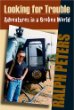
This book is not, as some might expect, a collection of past Op-Eds, but rather an extraordinary retrospective at the 1989-1996 time frame when officers like Ralph (and General Al Gray, myself, and a number of others in the Army and the Marines) were seeing the writing on the wall: the end of big war and the emergence of global instability in every clime and place). Ralph actually walked the ground and had “eyes on.”
I was immediately charmed anew by the poetic writing and the visually elegant turns of phrase. I have in my notes: chuckled, amused, reminded.
This review is going to combine my fly leaf notes with as many short quotes as I can fit in within my 1,000 word allotment.
Notes first:
Deep reading of Tolstoy and others set the stage for *understanding* today's culture and mindset in Russia. Earlier in his life, a subscription gift from an aunt to National Geographic opened his eyes to the rest of the world.
Early on, disdain for how we spend billions on satellites and nothing on officers walking the ground. He notes that overt human intelligence can absorb and articulate what no satellite can provide: “the temper of the people, the taste of the land.”
USSR in 1991 was potholes and rust. In his “walk-about” he gained direct invited access to an MVD commander's office, to all of the local “secret” messages, and had invited “eyes on” the MVD special intelligence communications room.
In the Bosnia-Kosovo run-up, which he and others anticipated, he learned that Europe cannot be trusted to act in unison or decisively in the absence of strong US leadership–France, Germany, and the United Kingdom all revert to their historical animosities, and despite their large standing armies, lack the political will or the deep strategic analytics necessary to use those armies in a coherent manner.
His respect for Armenia is deeply rooted in his on the ground experience among them.
Col Stu Herrington, whose book Traitors Among Us: Inside the Spy Catcher's World I have praised, is strongly praised in this book. He and the author were part of a team that worked with the Russians to address the long-standing concern over Americans being held in the Gulag, and the pages in this book, covering each of the wars from World War II onwards, are a complete surprise and essential reading for anyone interested in POW/MIA accounting.
He blasts the US policy of crop eradication, and his devastating criticism of arm-chair politicians and ivory tower diplomats warms my heart.
Late in the book he focused on Pakistan and I find this chapter especially vital for the public understanding of how the US is destroying its once-close ties to the Pakistani officer corps. The older officers are fully trained by the British or the US. The company and field grade officers are not, and are so delusional about Islam and so ignorant about the rest of the world as to be very dangerous to us.
Throughout the book he laments the lot of women across most Islamic countries (with Indonesia and Malaysia as notable exceptions; I add this from my own knowledge and Ralph's official report to the Marine Corps in the 1990's).
Now the quotes. Page number, then words:
8 On [the Russian and Central Asian] frontiers, humanity is a brotherhood of smugglers.
29 Only its women allowed the Soviet Union to endure as long as it did.
38 …I am convinced there is no Russian word for maintenance.
45 …worry too much about dead facts and too little about their antagonist's delusions.
66 Artist and intelligence challenges similar: an eye for detail and ability to reduce complexity to coherence
73 …no one in the US intelligence community was interested. If the data didn't come from a satellite, it didn't count.
87 What Belgrade lacked … was human dignity.
108 I knew we could overpower [Iraqi] military….I had seen…his officer corps…drunk and whoring.
132 Conquest of Central Asia is a chronicle of…cruelty….Soviets are the champs….[others] tortured human beings. The Soviet Union tortured the earth itself.
141 Bukhara is where Islam turned dark…
146 The Clinton Administration was run by intolerant dreamers… With neither self-critical faculties nor experience of the world …
151 Islam froze by the mid-fifteenth century when science-fearing zealots….
172 And there you have our diplomats. Unwilling to talk to our enemies… Unwilling to learn.
200 Azerbaijan was the first place where I got n inside look at the nastiness of our Saudi “friends.”
204 Everywhere, the Saudis took an interest in human suffering only if it offered them an entry point for missionary activities. And any Muslim who wouldn't sign up for … Wahhabi Puritanism was welcome to die.
218 …the callousness with which our government had treated the family members of our MIAs…
231 [General McCaffrey] wasn't getting an adequate tie-it-all-together picture of the cocaine problem. Not from his staff, and not from the alphabet-soup agencies…
239 You cannot take away the livelihood of the poor [coca crops] unless you have the wherewithal to replace it immediately and enduringly.
244 Found wealth, when immature countries…hit the natural-resources lottery, is uniformly destructive of the souls of men and nations.
251 [Army saw the future coming.] It was impossible, however, to persuade the Clinton White House, the intelligence establishment, or even our own services (except for the Marines) that our enemies, rather than our desires, would shape the future security environment.
319 [Drug Czar] was not allowed to differentiate between hard and soft drugs.
335 [At the Plain of Jars] I saw my country's dark side….we go mad now and then. And when we do, we leave desolation behind.
This is an amazing book and for anyone who is concerned with strategic warning, honest intelligence, strategy, force structure, the need to rebalance the instruments of national power, and the future of humanity, will find this book inspiring.
E Veritate Potens–From Truth, We the People Are Empowered
After postdoctoral research and stints with government, engineering firms, and the National Research Council of Canada, Hassan Masum is now Senior Research Co-ordinator with the McLaughlin-Rotman Center for Global Health in Toronto and a contributor to WorldChanging.com. www.hmasum.com.
Dr. Joseph Markowitz is without question the most qualified Open Source Intelligence (OSINT) pioneer in the ranks of those presently in or retired from U.S. government service. As the only real chief of the Community Open Source Program Office (COSPO) he tried valiently to nurture a program being systematically undermined by both the leadership and the traditional broadcast monitoring service. When he moved on to advise the Defense Science Board, he served America well by helping them fully integrate the need for both defense open source information collection and exploitation, and defense information sharing with non-governmental organizations. His persistent but diplomatic efforts merit our greatest regard.
Professor Levy is Canada Research Chair in Collective Intelligence at the University of Ottawa. The interview took place 12 January 2007 and was shortened somewhat and also updated by Professor Lévy on 10 November 2007.
George Pór is an advisor to leaders in international business and government. Former Senior Research Fellow at INSEAD, currently he is a PrimaVera Research Fellow in Collective Intelligence at Universiteit van Amsterdam

 White, Black, Death, Life, Perfect, June 30, 2008