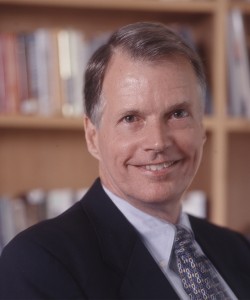
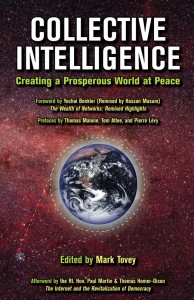
Thomas W. Malone (http://cci.mit.edu/malone/) is the Patrick J. McGovern Professor of Management at the MIT Sloan School of Management. He is also the founder and director of the MIT Center for Collective Intelligence and author of the book The Future of Work. Professor Malone has published over 75 articles, research papers, and book chapters; he is an inventor with 11 patents; and he is the co-editor of three books: Coordination Theory and Collaboration Technology, Inventing the Organizations of the 21st Century, and Organizing Business Knowledge: The MIT Process Handbook. For further information about the Center, please visit: http://cci.mit.edu.
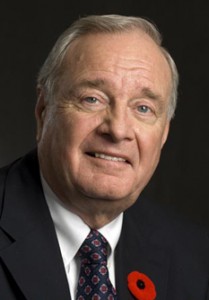
Paul Martin was the 21st Prime Minister of Canada and is the Member of Parliament for LaSalle-Émard in Montreal, Quebec. He was first elected federally in 1988.
Currently Martin co-chairs, with Nobel laureate Wangari Maathai, a $100 million poverty alleviation fund for the Congo Rainforest Basin and is leading a new initiative in Northern Ontario designed to help Aboriginal youth complete high school.
Martin studied philosophy and history at St. Michael's College at the University of Toronto and is a graduate of the University of Toronto Law School. He was called to the bar in Ontario in 1966.
Founder and President of www.TheTransitioner.org, an international research network and think tank of pioneers who are committed to support the emergence of global wisdom driven organizations. Formerly he was one of the co-founders of AOL France and led an assortment of innovative high-tech companies.
Get top http://flowplace.org in a few days and follow the evolution. Also join in http://TheTransitioner.org and create a profile to be part of the global community. On the tech side, go to http://metacurrency.org to understand the philosophy of it. Right now I am finishing an FAQ for the flowplace. Should be online by tonight.
Ellen Naylor, CEO, The Business Intelligence Source
Ellen Naylor has 30 years of sales and marketing experience across many industries. She initiated a competitive intelligence (CI) process at Bell Atlantic (Verizon subsidiary) and conducted financial competitive analysis and economic forecasting at Northwest Airlines. She started her career in sales, first in fine jewelry and later in telecommunications products and services, where her customers were major financial services companies.
5 for Content and Relevance, Zero for Greed Pricing, June 3, 2008
Peter Mika
I am an author and publisher and I would have bought this book today had it been priced more honestly. It costs a penny a page to produce a book, and this book should not be sold for more than $29.95 (which is ten times cost, and also accounts for Amazon only paying 45% of retail to each publisher).
I hope the author reads this and posts the book online as a Creative Commons PDF. I advise all authors to retain original rights to everything they produce, and to always post a searchable savable PDF for the common good. Earth Intelligence publishes hard-copy books on Amazon as a marker, but the real value to all who wich to create a prosperous world at peace lies in our free PDFs that can also be translated into any language at no cost.
Search the web for the title and author of this book and find interesting free stuff. I am adding this book to my list of grotesquely expensive books I would have bought but will not because of the price.
I found this book mildly irritating, until I realized that it was in fact perfect for what it sets out to be, an introduction of Web 2.0 concepts for those who know nothing about the Web, i.e. executives who still dictate memoranda, still budget for print advertising, etcetera. O'Reilly has a superb model for leveraging conferences and publishing books, but O'Reilly should have known better than to publish this book in 2008 without reference to Web 3.0. Wikipedia has a fine overview of Web 3.0, start there, I have put the URL in the comment below.
I found the book bland and disappointing, and found–when discussing Amazon, for example, the book reads more like an advertisement and has no clue on all the stuff Amazon is not doing (see the comment for two URLs), such as microtext for micro-cash, creating global intelligence councils on poverty and every other topic using top authors, and creating local citizen intelligence minutemen who can do real-time observation in the context of Amazon's excellent S3 cloud, which is in my view operating at less than 10% of its potential because Bezos has two things on his mind: outerspace and Kindle.
The end notes and the bibliography are the best part of the book. The index stinks. 7 pages for a 214 page book, should have been at least 14–it was an afterthought and done badly.
Super Book, Fast Read, Relevant to Participatory Democracy, June 3, 2008
Ori Brafman
This is a very fine book, a fast read, and highly relevant to Web 2.0 and all the emergent opportunities to turn our world right side up, restoring power back to all the people. My reading has moved heavily toward cognitive science and “open everything,” and my avowed goal, apart from creating public intelligence in the public interest, is to make “true cost” visible to the public on every product and service, penetrating through the kinds of sway barriers this book describes.
Each chapter is excellent, with a nice teaser diagram. The book is double-spaced with adequate notes and index.
My flyleaf highlights:
+ Diagnosis bias is huge. [The book does not focus enough on how our “experts know more and more about less and less,” but the core point is valid: once their tiny little brain storage reaches a conclusion, they bend everything to fit it. this could also be called paradigm or disciplinary bias.]
+ Hidden currents in the individual and group decision support process include loss aversion, value attribution or negatiion, and a commitment to the wrong s trategy. Holy Cow. Talk about CIA, Microsoft, Google, CISCO, they are all there.
+ NBA draft is mostly guess and speculation [so is most intelligence “analysis” and both groups get away with it because they are not held accountable for getting it wrong.]
+ Labels *matter* and deeply influence outcomes.
+ Visualization *sells* just about anything.
+ Cues and subtle messages are nuanced and complex and omnipresent. I was really engaged by this section.
+ Need to be heard is vital and the more one does that, the more value is created (this is social networking 101, as Web 2.0 starts to go over the cliff so Web 3.0 can rise like a Pheonix.] The authors stress that those offering to listen must *hear* each individual voice.
+ Blockers matter, i.e. there have to be people in the loop who have the courage, the commitment, the *role* of saying no to abuses of authority including rankism. [I think of all our flag officers and Congress Members who refused to challenge the criminal lies of the White House and the abuses of power by the Vice President, all documented now in the open literature. Had Colin Powell resigned and called for a stop, he would be President in 2009, instead of those now running. all flawed in their own way [and each a testiment to how easily we are swayed by a lack of substance on the part of all three–visit Earth Intelligence Network to see the 52 questions none of the candidates can answer, and the 52 “starter” answers for a Citizens Summit to discuss (February 2009 in Chicago, over Lincoln's birthday).