Review: Who Speaks For Islam?–What a Billion Muslims Really Think

4 Star, Religion & Politics of Religion
0Shares

Who SpeaksMuslim 101, Excellent Overview and Starting Point, May 4, 2008

John L. Esposito

This book nose-dived to a three and even a two as I was confronted with what appeared to be a Saudi-USA sponsored propaganda piece that did not properly consider India (largest Muslim population after Indonesia) and that addressed what Muslims thought without being explicit about US misbehavior, what I think of as Dick “Not the Virgin” Cheney's “immaculate conception” of the most amoral, costly, and destructive global war in our history. Bless him–had he not taken the Republic over a cliff and into insolvency, the two thirds of the voters who have tuned out the two party spoils system (“you pay, we'll make it legal to steal”) would not be coming back into 2008 steaming mad and with both feet.

However, I persisted, and ultimately this book settled at a four. What I found was a series of offerings that allow this book to be a very fine “Muslim 101 Lite” for the general public. I totally admire the reviewer that has listed more in-depth works for consideration and have urged him to edit the review to use the Amazon feature that allows links to the pages for each of those books.

I also detect a real disconnect in that the book lists all Muslim countries up front, but the fine print says the survey only covered the 10 predominantly Muslim countries, and that list specifically excludes India, which has the second largest Muslim population after Indonesia, and in my mind that discredits the study by perhaps 20%.

Highlight provided early on by the authors:

+ Muslims do not see West as monolithic (and also see distinctions between Americans, America, US Government, US military, and the bellicose presence of US forces in their countries). I found this also in a Strategic Communication survey across the 27 countries in the US Central Command Area

+ Muslim majority, and especially women, want jobs, development, opportunity, not jihad and certainly not US occupation or corruption

+ Muslim silent majority rejects attacks on civilians (but I would say the book does not do as well as it could on showing that they also feel USA “deserved” 9-11–regardless of let it happen or made it happen allegations). Today the USS Cole belligerents got a free pass and we are reminded that it was Bill Clinton that took Madeline Albright's advice to ignore the attacks on Khobar Towers (Iran), two Embassies (al-Qaeda?) and the USS Cole (al-Qaeda?).

+ Religious moderates are in the majority, consider democracy a FOREIGN concept, and look to find ways to accommodate faith, family, and state without their being exclusive or compartmented. One could even say moderate Muslims are pre-disposed to be holistic!

+ The one thing the West could do to improve relations with Muslims is to show more respect and press for more understanding (in both directions).

+ Majority favor religious law as a source of legislation, but do not want clerics to have a direct role in drafting the constitution (I am reminded of how Israel went too far toward extremism when it yielded to its religious extremists–and of course Israel used the tactic of terrorism against the British to good effect, and ignored Gandhi's observation that “Palestine is to the Palestinians as France is to the French.”)

+ My valuation of this book takes a definite leap upwards as I appreciate three facts that come together:

– Within the limits of prostitution toward those who pay their bills, the Gallup book does a good job–but I have BLAND in one section–of raising hard truths that those in power have no interest in, but could be helpful to voters.

– Each section has little gray boxes worth a look.

– Each section ends with key points summarized.

+ The book ultimately loses one star because it does not cite many books for context and when it does, tends to go with the discredited Fukiyama and the discredited Blair. This is an undergraduate reading that needs several more layers of study, and hence I recommend the other books suggested by an earlier reviewer.

+ I am totally absorbed by the book's account of how the Pope, with the best of intentions and relying on his top “experts,” made many mistakes in his speech attempting to reconcile with Islam, and was so told by over 100 Muslim scholars. This drives home both the limits of experts embedded with any leadership figure, and the importance of multicultural appreciative inquiry. The three candidates for President of the USA today are out of touch with citizens and out of touch with reality because they are giving stump speeches instead of leading nation-wide conversations on the ten high level threats to humanity outlined in A More Secure World: Our Shared Responsibility–Report of the Secretary-General's High-level Panel on Threats, Challenges and Change and the twelve policies that must be recovered from the special interests that hijacked them to steal from the many for the benefit of the few. See also The Global Class War: How America's Bipartisan Elite Lost Our Future – and What It Will Take to Win It Back

+ The book does cite Professor Pape's Dying to Win: The Strategic Logic of Suicide Terrorism and adds primary research to the effect that the radicalized are not poor or illiterate, but rather educated and moderately well-off. This was my own finding in 1976 when I did my first Master's thesis on the prediction of revolution. The book astounds me in noting that while only 7% of the Muslim population is radicalized, this number is NINETY ONE MILLION. The book also documents the plain fact that the primary motivation for suicidal terrorism is almost invariably FOREIGN OCCUPATION.

+ Page 84 lists the Muslim perceptions surveyed has of the USA, we learn that they are:

– Ruthless (68%)

– Scientifically & technologically advanced (68%)

– Aggressive (66%)

– Conceited (65%)

– Morally decadent (64%)

The book does a very good job of addressing how the civil rights conflict is closer to the Muslim-Christian-Jewish conflict, calling this a clash of cultures (to which I would add, a clash of economic corruption and predatory looting versus commonwealth exploitation by, of, and for indigenous peoples) and specifically discounting the clash of civilizations as the model. Readers interested in the whole question of belief systems can find the Technical Preface by Robert Garigue free online or at Information Operations: All Information, All Languages, All the Time.

The book does well at portraying Muslims world-wide as feeling under siege from the USA, and concludes from its primary research that Muslim anger is based on US foreign policy and its effect on their own peace and development. This is not rocket science, but I assure you, Henry Kissinger, Zbigniew Brzezinski, Madeline Albright, Condi Rice, even Strobe Talbott–they are NEVER going to come to grips with the fact that US foreign policy today is lunatic, out of control, costly, and totally out of touch with how to wage peace at one third of the cost of war. See for example Breaking the Real Axis of Evil: How to Oust the World's Last Dictators by 2025

The book ends on a note that suggests that both Muslims and Christians deeply want and need more erespect and understanding at a public diplomacy level, but the book is also quite specific in noting how US public diplomacy (and I would add, Strategic Communication) is completely out of touch with reality. You can no longer manufacture consent or use propaganda to mislead the majority of the world. As Joe Trippi points out, The Revolution Will Not Be Televised: Democracy, the Internet, and the Overthrow of Everything–Trippi is a genius, but I would note that we have moved one step beyond–cell phones, not the Internet, are the primary intellectual, emotional, cultural, and asymmetric warfare tool of choice today, one reason why the National Security Agency is freaking out–they cannot build a computer that weights next to nothing, runs on almost no energy, and can do petaflop calculations per second–the human brain (these are the last three words in Jim Bamford's book, Body of Secrets: Anatomy of the Ultra-Secret National Security Agency. US intelligence is “inside out and upside down” as I explained in Forbes ASAP, and desperately needs a draconian redirection of funding from the %60B we spend on the 4% we can steal, to rebalancing the use of all national powers and especially education, rule of law, and infrastructure here at home, and public diplomacy as well as open source or public intelligence that can exploit all information in all languages all the time.

I liked the details on the survey that are included in the appendix.

On balance, the book does a good job within the constraints of funding, US management, and the need to pander moderately to an Administration that has no regard for reality at the White House level (our flag officers and top civil servants and some political appointees such as the Secretary of Defense have rediscovered their integrity and are fighting a holding action for all of us here at home).

I would like to see two new surveys: one of all the countries they missed, and one of India alone, ideally done in partnership with the government of India. I regard India, Malaysia, and Turkey as well as Indonesia as major success stories, and the US Government does not seem to be ready to recognize that these four countries can and should be major partners in offering peace and development instead of corruption, occupation, and exploitation, to all Muslims everywhere.

Three other books within my limit of ten:
Good Muslim, Bad Muslim: America, the Cold War, and the Roots of Terror
The Looming Tower: Al Qaeda and the Road to 9/11 (Vintage)
Web of Deceit: The History of Western complicity in Iraq, from Churchill to Kennedy to George W. Bush

Review: New Turkish Republic–Turkey As a Pivotal State in the Muslim World

5 Star, Country/Regional, Diplomacy
0Shares
Turkish Republic
Amazon Page

Undergraduate Overview, Superb Price, a Real Value, May 4, 2008

Graham Fuller

I might have made this a four star since it is missing a couple of big pieces, but the overall book is so well presented in summary form, and the publisher has made it so reasonably priced, this would appear to be exactly the kind of book that is ideal for both the undergraduate and the graduate whom might be beginning a more intensive look at Turkey in its new “360 degrees” or Ankara-centric re-emergence as both a regional power and a continental power.

No Turks in, of, and for Turkey are on the credits, which confirms my first impression that this is a superb primer of, by, and for American students, but the US Institute of Peace is the publisher, so I get over it. Still, the book does not address the Muslim world outside the immediate region, and I am immediately irritated by the early depiction of Paul Wolfowitz as a proponent of democracy in Iraq–Wolfowitz lied to Congress and the public, and is no more a proponent of democracy anywhere than I am in favor of making Islam the ruling religion in America.

Having said that, the author's commitment and knowledge cannot be denied, and I found this book totally worthy of my time. I learned from it.

+ Turkey *is* a part of the Middle East, but ignored it up through the 1990's and did not settle its border with Syria until 2004.

+ Turkey, not Saudi Arabia or any other pretender, has been the center of the Muslim world (the Caliphate) for six centuries, and as the center of the Ottoman empire was the protector of the Holy Places.

+ The author asserts that Turkey is the most advanced secular and democratic state in the Muslim world. Huh? Coming out of an era of military dictatorships, and never mind Malaysia, Indonesia, or India (second largest Muslim population after Indonesia)? Not so fast!

+ While the author sets forth a key question, will Muslims embrace democracy, I point the reader to Who Speaks For Islam?: What a Billion Muslims Really Think and the finding in that book that most Muslims consider democracy to be a FOREIGN concept.

+ The author shocks early on in pointing out that Turks consider the USA to be the TOP THREAT to Turkey. I begin to realize the author has delicately folded major truths in, with a minimalist pandering to the jerks that are still in power (or seeking power one last time before they run out of Depends diapers for adults).

+ No one in the White House or anywhere else in the USG is likely to read this book (less well-intentioned Foreign Area Officers on their way there) so I regard the book as a useful cautionary tale for all of us. The neoconservatives took Turkey for granted, offended Turkey, and are so visibly amoral and inept as to inspire contempt from Turkey, a contempt I certainly share. As the author puts it, we are “treading water” with Turkey (as a time when they should be one of our “top ten” for deep engagement).

+ The author tells us that Turkey abolished the Caliphate in 1924, and that this was a body blow to Islam. In a brilliant analogy, he says that this would be the equivalent of an Italian Prime Minister abolishing the Papacy without consulting Catholics worldwide, and doing so as a snap decision.

+ The author illuminated the Turkish intellectual vision of state, faith, and modernity being compatible, and provides two very valuable pages on t he Abant Forum for intellectual tolerance and inquiry.

+ A great deal of the book is undergraduate level brevity (e.g. the Iran-Iraq war gets one paragraph at a time when Turkey was a major adjacent party).

+ Among the prices of the Cold War (see my review of The Fifty-Year Wound: How America's Cold War Victory Has Shaped Our World was the disconnection of Turkey from the Middle East and the Arabs, making is a client state of the USA in unwelcome and ultimately unwise ways.

+ The author teaches me that the Kurdish revolutionaries and separatists, the PKK (Partiya Karkeren Kurdistan, or Kurdish Workers Party) are a problem in Syria and Iran as well as Iraq and Turkey. I gain the impression that Turkey will do just about anything to prevent a free Kurdistan, but I also wonder in Kurdistan and Palestine are two areas that could be turned into zones of peace and development.

+ On that note, I learn that Palestine was part of the Ottoman empire, and that the Sultan was the Protector of Holy Places.

+ I am deeply engaged by the author's discussion of Islamic banking, and Turkish concerns that the Saudi regime is using increased focus on this as a means of reinforcing Islamic forces within Turkey.

+ I learn that Turkey is pursuing a regional strategy of “no enemies” and has a foreign policy strategy of “proactive peace.” Wow. This is seriously good stuff, and it shames me that America cannot rise to this level of sophistication and future-focus.

+ I learn that four of the five Central Asian states are Turkic, and that after the USA and Russia, China is Turkey's major concern, in part because the Uyghurs are Turkic. Has the USA ever had a Turkic strategy or a Caliphate strategy? Highly doubtful.

+ The author states that the Turks are suspicious of Saudi international policies, and I wonder why there is no deeper discussion, especially since it is now widely known that the Saudi dictatorship has been funding Bin Laden, rote-learning madrasses, and total hate crimes against Shi'ites (15%, with Iran as the only state).

+ He says that Turkey has a strong commitment to Afghanistan, but here I have a note, “too much avoidance.” This is an excellent book and easily understandable by an undergrad, but it needs a couple more chapters (one on Saudis as enemies of Muslim stability world-wide, another on Turkey and the non-Arab Muslim states), and a decent bibliography with a 360 view of competing authorities.

+ He tells us the Kurds have entered mainstream Turkish politics, including election to their Parliament, but I am skeptical and wondering if there is not a really big deal to be cut that runs from Turkey to Kurdistan and Lebanon to Palestine–the three trillion we have wasted in Iraq could have resurrected America AND paid for a massive Marshall Plan for the region.

+ The US chapter is vital. It will never be read by those that make their own idiotic reality, but for the rest of us, it is a fine tale of friction, opportunity lost, a lack of sufficient respect, and more. This is a really good and really important chapter.

The book concludes that Turkey has three choices: continue to be US centric, become Europe centric and join the European Union, or return to Ankara centric, with 360 interests and responsibilities in all directions. I am truly inspired by this book, and in the future will factor Turkey in as co-equal to Brazil, China, Indonesia, India, Iran, Russia, and Venezuela.

Bottom line: this book was a real pleasure to read as an adult hooked on respecting reality, and I strongly recommend it for both teaching at any level, and for anyone interested in what is clearly a major player in the 21st Century. On balance, this book respects Turkey in a very sincere and useful way, while delicately calling out the USA (under all recent Administrations of either party) for being distant, dumb, inattentive, and generally stupid. I am reminded of Daniel Elsberg lecturing Kissinger on how one becomes like a moron the higher up the secret classification scale you go, thinking you know more secret, and becoming unwilling to listen to those with their feet on the ground and decades of eyes and ears on and in place. See my review of Secrets: A Memoir of Vietnam and the Pentagon Papers.

Other recommended books:
The Looming Tower: Al Qaeda and the Road to 9/11 (Vintage)
Web of Deceit: The History of Western complicity in Iraq, from Churchill to Kennedy to George W. Bush
Legacy of Ashes: The History of the CIA
Crossing the Rubicon: The Decline of the American Empire at the End of the Age of Oil
The Sorrows of Empire: Militarism, Secrecy, and the End of the Republic (The American Empire Project)
Islamic Leviathan: Islam and the Making of State Power (Religion and Global Politics)
Good Muslim, Bad Muslim: America, the Cold War, and the Roots of Terror

Vote on Review

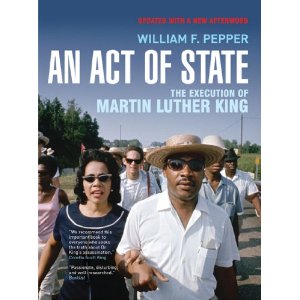
Review: An Act of State–The Execution of Martin Luther King, New and Updated Edition

5 Star, Crime (Government)
0Shares
Amazon Page
Amazon Page

Compelling Story of US Government Role in Death of Martin Luther King,

May 4, 2008

William F. Pepper

Edit of 8 May 08: Reverend Wright preaches in the negative, but this does not mean he is wrong, only inflamatory. Senator Obama's first instinct was correct: he can no more deny those who walked with us than we can the truth. In renouncing Reverend Wright, Senator Obama demonstrated his subordination to “the system,” the same subordination that swallowed Colin Powell, who confused loyalty with integrity.

John 8:32 Ye shall know the truth, and the truth shall make you free.

The updated book is better than the original because it includes a post 9-11 Afterword.

So many people are going to consider this book to be a provocation, a conspiracy theory, revisionist, etc. I will start with three compelling reasons to take this seriously:

1. The author is a recognized barrister in England and lawyer in the US. His reputation is impeccable, and he is respected by heads of state and of international organizations concerned with human rights.

2. The author brought a civil suit in which it took the jury less than one hour of deliberation after all the facts had been laid out, to find for the plaintiffs (the King family survivors) and agree that the US Government was complicit in his murder.

3. The evidence of US Government complicity in crimes against humanity as well as high crimes and misdemeanors of all sorts, is now over-whelming within the non-fiction literature. Cover-ups are the norm.

Here are my flyleaf notes:

+ King was leading a coalition of peace and civil rights in 1967, one that expanded to address economic injustice and the rights of indigenous people's everywhere, but especially in Viet-Nam. This “new politics,” like the third party politics of today, was so threatening to the Mafia, to banks and corporations, and to the US political and FBI leadership committed to “because we say so, right or wrong,” that he was ordered killed.

+ The author tells us that by 1970 King's moral authority was directly challenging the moral bankruptcy of the American “state,” which King aptly described as “the greatest purveyor of violence on Earth.” See my review of The Fifty-Year Wound: How America's Cold War Victory Has Shaped Our World and also Legacy of Ashes: The History of the CIA

+ Unlike others who accepted the government's fictional account at face value, the author actually interviewed James Earl Ray in prison, and over time clearly established both Ray's veracity, and additional evidence.

+ The FBI burglarized Martin Luther King over 20 times.

+ Less than one month after the John F. Kennedy assassination (he was warned and discounted the warning delivered by his brother), the FBI made Martin Luther King its top target, focusing on “neutralizing King as an effective leader.” The cover-up is exposed in Someone Would Have Talked: The Assassination of President John F. Kennedy and the Conspiracy to Mislead History.

+ At least two funded “hits” on King were discovered, but the one that succeeded involved Frank Liberto, a Mafia boss in the food business, who evidently forgave a major debt from Lloyd Jowers who served as the on-site cut-out for the weapon but did not do the shooting himself. Links are discussed between the FBI, the Mafia, and local police.

+ The local police pulled back all assigned security, took black officers off watch, and evidently arranged to have King moved from a protected inner courtyard room to an upper room directly in the line of sight from the bushes where the shooter was planning to be.

+ 30 years seems to be the magic time period that must pass before individuals sworn to secrecy to protect political malfeasance realize they should ease their consciences before death.

+ The book includes an appendix that shows the many times the Department of Justice willfully lied or omitted evidence in its own investigation.

+ The author presented nine areas to a court that found for the plaintiff; they are listed on page 108:

01 the background to the assassination
02 the local conspiracy
03 the crime scene
04 the murder weapon
05 Raul (the handler)
06 the broader conspiracy
07 the cover up–its scope and activities
08 the defendant's prior admissions
09 damages

The King family sought damages of just $100. Far more important to them was the verdict of the jury: the US Government, and particularly the FBI and US Army counterintelligence elements acting against US citizens on US soil, were complicit in the murder (assassination) of Martin Luther King.

The author places King is direct opposition to the materialism and the secularization of life to include a loss of morality in US foreign policy. Specifically mentioned in this book are King's objection to US Government support for dictators. See my review of Breaking the Real Axis of Evil: How to Oust the World's Last Dictators by 2025.

The author states that he could not have obtained a trial date, much less a verdict, without the full engagement of the King family. Their participation was of inestimable value, he says. He then goes on to describe how the media, which did not attend the trial, slandered (broadcast) and libeled (print) the family and the memory of Martin Luther King. [This is the same media that refused to run $100,000 cash in advance information advertisements against the elective war on Iraq.]

The author specifically warns of the discreet movement in 2007 of the Violent Radicalization Act allowing the White House to redirect the National Guard from any state to any other state, and believes that there is now an explicit fear among “the elite” of impending and complete system collapse and a public rebellion of consequence.

I have a note from the book, that Martin Luther King was branded a traitor. So also was General Tony Zinni, USMC (Ret), the most recently retired Commander in Chief of the U.S. Central Command, and the single most knowledgeable authority at the time on Iraq, Iran, the Middle East, the Pakistan wild card, and Afghanistan. My bottom line: we are lied to; the “experts” are not expert and pander for access–it is time we assert the collective intelligence of We the People.

Completely unexpected to me, but relevant in the context of other books I have been reading, is the author's outline of how King and all that he stood for called into question the entire-military industrial complex and the misdirection of most of our money toward waging war. See my review of War is a Racket: The Antiwar Classic by America's Most Decorated Soldier and of the DVD Why We Fight.

The last page of the body of the book, page 288, has this quote that I marked:

“Martin King firmly believed that non-violent civil disobedience was the best strategy to obtain justice. There is little doubt in my mind that massive non-violent civil disobedience has the potential to shut down the nation, and compel substantive social, economic, political, and cultural change, leading to the reconstruction of the Republic with a focus on the needs of people rather than capital. His dream lives on in each of us who internalized it.”

See these two books for a taste of our potential:
Spoiling for a Fight: Third-Party Politics in America
Collective Intelligence: Creating a Prosperous World at Peace

Why the two party system is organized crime at its best:
Running on Empty: How the Democratic and Republican Parties Are Bankrupting Our Future and What Americans Can Do About It

Why Senator Barack Obama is not the one (and today he Uncle Tom'ed himself–Reverend Wright's concerns are firmly founded on non-fiction):
Obama – The Postmodern Coup: Making of a Manchurian Candidate

To fulfill the dream, we need a third party with no experts, just us.

Vote on Review

Review: Blue Collar Ministry–Facing Economic and Social Realities of Working People

5 Star, Culture, DVD - Light, Democracy, Peace, Poverty, & Middle Class, Priorities, Values, Ethics, Sustainable Evolution
0Shares

Blue CollarRecommended by Micah Sifry, Final Review–McCain Benefits, May 3, 2008

Tex Sample

Micah Sifry in Spoiling for a Fight: Third-Party Politics in America recommends this book. This book is a seminal reference, a vital, urgent reading for anyone who wishes to do the right thing for our massive blue collar population that has been betrayed by both parties (see Running on Empty: How the Democratic and Republican Parties Are Bankrupting Our Future and What Americans Can Do About It.

Here are highlights from my fly-leaf notes:

+ Our society has structured inequality built in at all levels, and the blue collar and working poor populations will NEVER climb out of their pit unless we minister to them in an active manner.

+ The focus of the blue collar worker is the neighborhood, and a web of favors given and received, favors that define not just a community, but a covenant of community. See Off the Books for more on this.

+ Our “culture” has managed to make every individual that is structurally repressed feel guilty for not being able to rise above their circumstances because our churches and our state preach freedom of opportunity, but the REALITY is that the upper class web of connections trumps lower class striving every time.

+ The deindustrialization and deskilling of the economy (Bill Clinton's signal mistake, apart from being inept at getting single-payer health care where the working class would be the principal beneficiary) has deepened the disadvantages of race and gender in America.

+ The author does a superb job–truly a scholarly and responsible job–of properly reviewing applicable literatures and offering proper citation in text, not just endnotes, of a rich buffet of practical and intellectual contributions by others.

+ He discusses five types of blue collar groups:

– Blue Collar Winners, a threatened species
– Blue Collar Respectables, want family, school, and church to be in harmony, conformists, a morality of repression, lowered social norms make it harder to be “respectable,” and there is no social mobility
– Blue Collar Survivors, trapped like inmates, a daily struggle to stay even with life in the face of multiple challenges
– Blue Collar Hard Living, heavy drinking, marital instability, toughness, political alienation, rootlessness, present time orientation, strong sense of individualism

The author's greatest contribution is his full exploration of how a pastor in a blue collar neighborhood cannot think of themselves as being on the pinnacle of a pyramidal organization between the community and God, but rather as a member at the base, part of a web of giving and love, dignity and local empowerment. This book should be required reading for EVERY pastor of ANY faith. It should also be required reading for every Precinct Captain for any political party, ideally a third party such as the Libertarians or Greens. This book is a handbook for connecting, empowering, and enriching at the local level.

The author concludes that the “ward heeler” is the best model, an individual that is constantly moving throughout the community, touching each person and especially the many that do not come to church, offering favors with love, investing in each individual. I am MOVED by this book. This is pastoral reference A, and it is touching in its understanding while illuminating in its scholarship.

Citing Andrew Greeley the author notes that ethnic politics is not about ideas, but rather about intuitive brokering among a broad diversity of intersecting interests. He goes on to cite the three weaknesses of ethnic politics: it depends on the group being structured; it overlooks small but explosive groups; and it fails to engage the intellectuals.

This is where I experience two huge epiphanies (Republican word for Aha!):

1. At the blue collar level, the author tells us, patriotism is not just a given, it is an EXISTENTIAL deeply rooted part of being. This helps me understand why Reverend Wright's intemperate (but accurate) depiction of the USA and the crimes done “in our name” would cause anger among the white blue collar population. America right or wrong is a tangible value.

2. At the national level, any candidate who would lead America must trisect three groups: money, brains, and brawn. I do not see any candidate, although John McCain appeals to me if he can avoid Leiberman or Rice as a Vice President (I would recommend to him the protagonists in The Average American: The Extraordinary Search for the Nation's Most Ordinary Citizen, that is doing that. All three of the candidates are doing platitudes to the public with secret handshakes behind closed doors with the money people, and all three are completely neglecting the intellectual substance: we are hated or distrusted around the world; we are doing nothing to eradicate the ten high level threats to humanity; we are bankrupt as a Nation (financially, morally, culturally, and intellectually), and “there is no plan.”

Read my reviews of the following for additional perspective on how we have betrayed the lower two thirds of the population:
The Working Poor: Invisible in America
Off the Books: The Underground Economy of the Urban Poor

I read this book while trying to see if a third party candidacy is still viable. In that context:

1) I have written off Obama. His rejection of Reverend Wright is the final nail in his political coffin this time around, he has become, as one Reverend of color put it, the “House Negro.” See Obama – The Postmodern Coup: Making of a Manchurian Candidate.

2) Bloomberg (see my review of Bloomberg by Bloomberg) needs to understand the difference between transpartisan ship and the two-party organized crime and spoils system, and then he needs to put his integrity on the line and go for the full enchilada.

Other reform books that have impressed me:
The Revolution: A Manifesto
Don't Start the Revolution Without Me!
Society's Breakthrough!: Releasing Essential Wisdom and Virtue in All the People

Review: Spoiling for a Fight–Third-Party Politics in America

5 Star, Democracy, Politics
0Shares

SpoilingBeyond Five Stars–a Foundation Stone for Third Party Bid in 2008, May 3, 2008

Micah L. Sifry

I am not giving up on fielding a third-party team in 2008. All three of those running are part of the two party organized crime spoils system, and to mock 41, “this will not stand.”

This book is beyond five stars for its relevance, timeliness, and detail. It has gripped me all morning, and the level of detail including specific names, is phenomenal.

Although the author does not cover the 27 secessionist movements (but does cover the Vermont Progressive Party) and I could find no mention of the The Cultural Creatives: How 50 Million People Are Changing the World, I am totally impressed by the structure, the discipline, the detail. I started with the index and that alone persuaded me this was a phenomenal book worthy of every voter's attention.

The book was published in 2003, to early for the author to be following Reuniting America and its transpartisaship meme, or the World Index of Social and Environmental Responsibility (WISER) described in Blessed Unrest: How the Largest Social Movement in History Is Restoring Grace, Justice, and Beauty to the World but I can say with certainty that this author, who he knows and what he knows, is an essential contributor to appreciative inquiry and deliberative democracy.

I have a number of notes, and unlike many books, there is a lot in here that I simply did not know (I did not pay much attention in classes until I earned my MPA because it mattered).

+ Abe Lincoln was a third party candidate for president. The author is well-spo0ken and compelling in condemning the Supreme Court for several decisions that institutionalize the two-party spoils system, both within the states where Hawaii was allowed to ban write-in votes, in other states where the states are allowed to exclude all third parties from all debates

+ Although the author does not provide a policy framework, there is a great deal of compelling detail about how Jesse Ventura combined fiscal conservative and social liberal values in a centrist independent common sense platform that attracted the votes of the working class (the author notes that this class is bigger than most imagine, while the middle class is now smaller than most imagine).

+ Although I have read Don't Start the Revolution Without Me this book is in many ways better on policy details and personalities, and an ideal companions to everything written by Jesse Ventura, by Ron Paul (e.g. The Revolution: A Manifesto). I also recommend Our Undemocratic Constitution: Where the Constitution Goes Wrong (And How We the People Can Correct It) and The Thirteen American Arguments: Enduring Debates That Define and Inspire Our Country.

+ Four constituencies elected Jesse Ventura: women, moderate Republicans, blue collar suburbanites, and alienated 20-30 somethings. To this the author adds “unlikely voters” and says the polls always miss them but they make the difference for third party or independent candidates and are twice as likely to branch off from either of the two criminal parties. [I won't belabor this latter point, just see Running on Empty: How the Democratic and Republican Parties Are Bankrupting Our Future and What Americans Can Do About It.

+ The author teaches us that Americans certainly do want more choice (as well as honesty in politics) but third parties have a way to go.

+ 9-11 did not change the fundamentals, but did end public complacency and did start public engagement.

+ This book is especially strong and useful on why Ralph Nader won and why Ralph Nader did not undermine Al Gore, it was actually the other way around. Crashing the Party: Taking on the Corporate Government in an Age of Surrender is still a must read, but this author has given us a more concise and able ennumeration of all the reasons Gore lost, and he ends that section toward the end of the book by pointing out that Pat Buchanan took more states and more votes away from Bush 43 than Nader did from Gore.

+ Across the book the author outlines how states are deliberately disenfranchising all who would seek to run for office or vote as independents, but toward the end of the book he points out how Greens are winning half the elections they go for at the local level in some states.

+ I am personally inspired by this book to believe that on the 4th of July we need a third party transpartisan team with a balanced budget that also demands Electoral Reform prior to November 2008. We cannot led any of the three presidential contenders get away with the myth that this election means anything at all without debates open to all third party candidates, and voting on week-ends or holidays with instant run-offs to re-enfranchise the The Working Poor: Invisible in America.

+ The author enrages with his calm discussion of how voter registration is rigged to disenfranchise the working poor, and later in the book he observes that the true schism in America is between top and bottom, not left and right. See also The Global Class War: How America's Bipartisan Elite Lost Our Future – and What It Will Take to Win It Back.

+ This book is a mother lode of useful data in a coherent structure. My notes cannot do it justice.

+ On a positive note, while the book ends by saying third parties have a long way to go, the author notes across the book that the two-party spoils system is self-destructing and reform is largely inevitable. I agree.

+ We learn that Ralph Nader and Jesse Ventura are both of the view that any third party must attract people who can “raise hours, not just money.” Their logic is interesting, but with all the billionaires out there, and with Michael Bloomberg now strangely silent, I have to wonder if he has not been sidelined by the Trilateral Commission and the Councils on Foreign Relations in New York and Chicago, who now own Senator Obama lock, stock, and barrel (see Obama – The Postmodern Coup: Making of a Manchurian Candidate. He is an engaged young man of promise, but if he cannot lead conversations that matter and inspire citizen wisdom councils instead of listening to the Dr. Strangeloves (Bzezinski) and acolytes, then he is not worthy of governing and will be a repeat of Jimmy Carter, a gerbil on a wheel.

+ This book inspires me to think that a meme can be created between the League of Women Voters and WISER, “Our Deal or No Deal.” It should be possible to restore the League of Women Voters at every level, especially if we can finance legal challenges to every corporate donation to any entity that refuses to respect the need for transpartisanship and open source politics.

+ The author does a super job on how Ross Perot self-destructed and then Pat Buchanan more or less hosed the Reform Party into oblivion (after first wiping out their treasury to pay old debts, something we learn not from this author, but in Jesse Ventura's book.

+ Greens are not going to go away. I recommend everyone look for Paul Ray's “New Political Compass,” but there are green values that I do believe will carry the day within the decade:

– Ecological wisdom
– Personal and social responsibility
– Grass-roots democracy
– Nonviolence
– Respect for diversity
– Postpatriarchal values
– Decontralization (some would call this home rule, state and local officials are having to ignore federal laws paid for by special interests that specify CEILINGS on state and local standards instead of floors)
– Community economics (I am also very excited by the Interra Project for community credit cards, and the emergence of open money and no money economies)
– Global responsibility
– Future focus (what the Native Americans would call Seventh Generation thinking, a concept captured very well in Stewart Brand's Clock Of The Long Now: Time And Responsibility: The Ideas Behind The World's Slowest Computer.

+ I am completely blown away by the author's concise accounting of how the US Supreme Court has legitimized state exclusion of third parties. That is totally unacceptable and yet another reason for term limits on the Supremes.

+ The book ends with an overview of third parties (117 of them listed in the Encyclopedia of Third Parties in America, which is grotesquely overpriced but probably a useful candidate for a pass around shared purchase.

+ The bottom line in this book is that four national parties are viable: Green, Libertarian, the New Party and the Labor Party. The book was written too soon to see Reuniting America (110 million strong) and the Bloomberg phenomenon in New York which I note with concern may have been squelched by bigger multi-billionaires who want the two party system to remain “as is.” None of the three candidates in 2008 are true reformers, my vote right now is for Jesse Ventura with The Average American: The Extraordinary Search for the Nation's Most Ordinary Citizen as Vice President and Tom Atlee and Jim Rough and Paul Hawken and Juanita Brown and many others leading a national Wisdom Council at every level on the ten high-level threats to humanity and the twelve policies from Agriculture to Water that must be harmonized. I will be blunt: the “advisors” are disconnected from reality and vastly more dangeous to our future than any common sense appreciative open policy process might be.

+ The author concludes that Minnesota's Independence Party, Vermont's Progressive Party, and New York's Working Families Party are models that can inform any emergent national campaign.

Review: Design and Landscape for People–New Approaches to Renewal

4 Star, Culture, DVD - Light, Education (General), Nature, Diet, Memetics, Design
0Shares

DesignNot what I was hoping for–between eclectic and kludgy, May 2, 2008

Clare Cumberlidge

This book was a disappointment for me. As one who has appreciated Small Is Beautiful, 25th Anniversary Edition: Economics As If People Mattered: 25 Years Later . . . With Commentaries and Human Scale I was not expecting so much fine print and examples, even through grouped into the following five categories, struck me as kludgy:

Utility
Citizenship
Rural
Identity
Urban

My notes:

+ Imagination alone can work miracles in the absence of resources.

+ Worlds of planning, commerce, culture, technology, and politics are disconnected BUT the authors see a massive shift emergent toward participatory culture. I am reminded of Paul Hawkin's Blessed Unrest: How the Largest Social Movement in History Is Restoring Grace, Justice, and Beauty to the World and Collective Intelligence: Creating a Prosperous World at Peace.

+ There are a lot of buzzwords among the fine print, such as creative engagement, adaptive transformation, etcetera. This is where I begin to think this has crossed the line toward kludge.

+ I am *very* impressed with the small section that focuses on children play power, connecting a merry-go-round to pump water to a gravity storage container.

+ Page 17: What many of these strategies shared was the principle of putting information clearly in the public domain and drawing togetyher a debate between a public, political and professional audience to unlock different perspectives and produce different solutions. I am reminded of Jim Rough's brilliant work Society's Breakthrough!: Releasing Essential Wisdom and Virtue in All the People

+ Art in public spaces inspires new forms of social networks. Rivers can have “Save My River Chapters” all along its path, I am reminded of the Salmon Nation the future-oriented denizens of Eco-topia have put into place.

The book does downhill from there, in part because the small print is annoying, in part because while the photos are truly beautiful, this book does not convey what the Germans call “the feeling in the fingertips.”

I am however very impressed toward the end when the book talks about OASIS (Open Accessible Space Information System) and the discussion the authors offer of how training children and citizens to map their neighborhoods at the sapling level in unleashing enormous stores of energy. I am especially impressed by a map on page 158 that shows “Desireable Places to Plant a Tree.” THIS IS PERFECT. Now imagine a Global Range of Gifts table at the sapling and ceramic refrigerator level for the whole planet, so the 80% of the individuals that do not do planned giving can give a sapling or a cell phone or a month's worth of medicine. I this coming and pray it will arrive sooner.

The book re-engaged me at the end where there is a superb discussion of how we should plan neighborhoods with running water so that the poor can upgrade as they improve their condition, rather than vacating. Grow wealth locally.

This book is offered at a very fair price and on that basis am taking it up to four stars instead of three. If you love this topic, this is book by two people who care, offered by a publisher who has the integrity to price it affordably.

I read this book with A Civilization of Love: What Every Catholic Can Do to Transform the World and The Porto Alegre Alternative: Direct Democracy in Action (IIRE (International Institute for Resear) and in a fascinating way all three hung together–Civilization of Love ends by pointing out that the future Church is going to comprised of young urban poor; and the Porto Alegre book, an edited work, ends compellingly by saying that we should not have to choose between statism and the market, it is possible to put everyone's eyes on the whole of the budget, and dramatically redirect how our tax dollars are spent. I agree, but not in 2008. That just became another lost epoch. See my review of Obama – The Postmodern Coup: Making of a Manchurian Candidate and of course Running on Empty: How the Democratic and Republican Parties Are Bankrupting Our Future and What Americans Can Do About It.

With my last remaining link, I recommend All Rise: Somebodies, Nobodies, and the Politics of Dignity (BK Currents)

.

Review: The Porto Alegre Alternative–Direct Democracy in Action

5 Star, Country/Regional, Culture, DVD - Light, Democracy
0Shares

Puerto AllegreImportant Book with Deep Insights, May 2, 2008

Iain Bruce

I read this book along with Design and Landscape for People: New Approaches to Renewal and A Civilization of Love: What Every Catholic Can Do to Transform the World and in an odd sort of way they hang together.

I am stunned that it has not been reviewed by anyone else. This is a first class edited work, easy to understand, with very important lessons.

Here's what I got out of this book:

+ Progressives facing ambiguity have lost sight of the objectives

+ Participatory budgeting is completely different from consultative budgeting, and should eventually be joined by participatory planning.

+ Progressives are not likely to succeed any time soon (UNLESS we can mount a mass movement with teeth–Blessed Unrest: How the Largest Social Movement in History Is Restoring Grace, Justice, and Beauty to the World. We are all trapped in a strait-jacket of existing legal, constitutional and fiscal frameworks. I agree. Both Jean-Francouis Nouble and Jim Rough speak to the pyramidal organization (top down command and control) and its struggle to avoid being displaced by the circle organization. See their work in Collective Intelligence: Creating a Prosperous World at Peace which is also free online as a PDF of the whole book in or individual chapters as documents easy bound together for more selective study.

+ The bottom line on this book is that the Brazilian state chose to ignore the lessons of Porto Alegre, and chose to neglect its population while agreeing to externally imposed conditions that have ultimately made Brazil weaker than stronger. I cannot judge–that's the message I got.

+ The World Social Forum keeps coming up as I scan the horizon for early warning.

+ Local governments are going to become at least as important as national governments as they strive to deal with very large scale challenges characteristic of urban areas with large concentrations of both the poor and the young.

The book ends on a note in favor of socialism which leaves me uncomfortable. I believe that moral capitalism, combined with honest participatory government, strikes a better balance. Corruption, though, is the killer.

If you are interested in this area, I recommend this book as a very high value reading, and one that could merit several returns.

Other books I favor:
The Tao of Democracy: Using Co-Intelligence to Create a World That Works for All
The World Cafe: Shaping Our Futures Through Conversations That Matter
Society's Breakthrough!: Releasing Essential Wisdom and Virtue in All the People
All Rise: Somebodies, Nobodies, and the Politics of Dignity (BK Currents)
One from Many: VISA and the Rise of Chaordic Organization
The Wealth of Networks: How Social Production Transforms Markets and Freedom