Mr. Robert Young Pelton is perhaps the greatest journalist-adverturer on the planet. This is a man that gets kidnapped by accident, is recognized by the leader of the kidnappers, and is promptly released with apologies and an honor guard. His book World’s Most Dangerous Places and his TV series Come Back Alive are among the most extraordinary “ground truth” offerings available to the public and admired by the spies. In his every waking moment, in his every action, in his every report, he embodies the true spirit of Open Source Intelligence (OSINT).
“We do nothing by ourselves,” stated Information Sharing Executive Debra Filippi, of the Office of the Assistant Secretary of Defense for Networks & Information Integration, or OASD/NII. She referred to the many-faceted dimensions of information sharing across multiple agencies, partners, coalitions, and international organizations. Multinational operations are the norm today in combat, stability operations, or crisis intervention.
. . . . . . .
Stability Operations Require Information Sharing
Aligning with the conference theme, Bill Barlow, deputy director of the Integrated Information Communications Technology office within the OASD/NII, emphasized that sharing unclassified information is essential to the success of stability and humanitarian operations.
He also said that unclassified information sharing and collaboration with non-DoD entities continues to be problematic. The DoD culture is “classify by default” rather than “share by default.” Over-classification of documents, cumbersome policies, and ad hoc networks have led to distrust by non-government organizations (NGOs) and numerous civilian agencies.
DoD leadership is now working to strengthen military support for stability and humanitarian operations by working with all entities, public and private, that contribute to mission success. All these initiatives are in line with DoD Directive 3000.05, which mandates that “stability operations are a core U.S. military mission that the Department of Defense shall be prepared to conduct and support. They shall be given priority comparable to combat operations.” The directive also states that information shall be shared among DoD, U.S. government, foreign governments, NGOs, and the private sector to “secure a lasting peace and facilitate the timely withdrawal of U.S. and foreign forces.”
Superb, Well-Presented, Helpful at Multiple Levels, May 10, 2008
Ben Rigby
Edit of 18 May to recommend Groundswell: Winning in a World Transformed by Social Technologies as a different book, with more practical tips and annecdotal support, but in no way does that reduce my appreciation for this book. Both are excellent, I think of them as truly complementary of one another.
—–
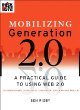
I *like* this book. Although I have years of exposure to advanced information technology and read everything by gurus like Paul Strasssman (cf. Information Productivity: Assessing Information Management Costs of U. S. Corporationsand Stephen E. Arnold (Arnold IT, look for “Google 2.0: The Calculating Predator, not sold on Amazon), I learned stuff from this book, and I found it to be exactly right for getting an old-school CEO or other management skeptic “oriented.”
In 268 well-organized and well-presented pages, the book covers:
+ Blogging
+ Social Networking
+ Video and Photo Sharing
+ Mobile Phones
+ Wikis
+ Maps
+ Virtual Worlds
Each chapter has extremely clear headlines, gray boxes, figures, and endnotes. To get a sense of the book and the online offerings that back it up, visit mobilizingyouth.org, just add the www.
A special value is short essays from top practitioners including Mitch Kapor whose essay, next to last, focuses on the coming convergence of virtual worlds and social networking. Visit BigPictureSmallWorld for a sense of the possibilities there–I have very deep admiration for Medard Gabel, who built the analog World Game with Buckminster Fuller, and I am so very eager to see him create EarthGame(TM) in which we all play ourselves and have access to all information in all languages all the time–at that point, we will end looting of our commonwealth, end corruption, and create invite wealth or as he puts it in the title of his new book, “Seven Billion Billionaires.”
Most useful to me were the following:
+ Use all these tools internally to get a sense of them, before trying to do something with the broader online population
+ One billion people are connected, the rest are not, but what the billion do with their connections could impact on how quickly we get the other 5-6 billion connected and creating wealth
+ 55% of teens are active online, 80% of college students have a Facebook profile
+ Digg is an example of a global intelligence service in which every citizen is an intelligence consumer, collector, and producer
+ Cool examples that I will certainly look into include Care2, Causes, Hi5, and Gather
+ Politicians (including the three running for President now) simply do not get it. They are still using phone banks that call at all hours and spamming (Obama does less of it) instead of asking permission and then building on the relationship
+ I am very impressed by the natural manner in which the book communicates the relationship between having a good story with heroes, villians, and catalysts, and the sequence of fund-raising via text connection and follow-up. This book strikes me as both a very very good elementary text for digital immigrants (us old guys) and also a useful “once over” for the more experienced who may be overlooking a couple of pieces of the overall campaign.
+ The book emphasizes the many uses of the wiki, many of them internal, some external, but the most important being that wikis are a way of crowd sourcing. See the first book from Earth Intelligence Network, Collective Intelligence: Creating a Prosperous World at Peace (free at oss.net/CIB just add the www, but utterly lovely here at Amazon) and especially the later chapters on large scale collective and collaborative intelligence in action.
+ Tag clouds are vital, as is the selection of unique tags for clusters of informaiton you want to make easily available.
+ Virtual worlds are in their infancy, and when they finally develop, will be extraordinary as nuanced immersive learning environments (low cost low risk environmental, I would add).
The last essay from Katrin Verclas is great, and I selected the following quote with which to end this review–it captures the essence:
“Web 2.0 describes a participatory, bottom-up, decentralized world full of individual expression where people have direct access to one another and enjoy an unprecedented ability to organize, meet, and coordinate without centralized control or traditional hierarchies.”
Focused on Media, Art, Culture, Less So on Social Networks, May 10, 2008
Henry Jenkins
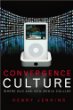
I come late to this book, published in 2006. I do not regret it. It is a bit too focused on media, art, and “culture” for me, but I cannot penalize the author for being a master of arcane tid-bits. This book is a collection of previously published articles reworked into a book–for me, that is a good thing, as I do not cover the sources that originally carried the pieces.
The book comes recommended by Howard Rheingold and Bruce Sterling, two of the originals, so that alone should encourage anyone interested in this area to take this book very seriously.
Although the author focuses on “participatory culture” the emphasis is this book is on the CULTURE part, not the social networks, integral consciousness, appreciative inquiry, co-intelligence, and so on as I have learned from my Eco-Topia colleauges.
The author himself speaks early on about the book speaking to three concepts:
+ Media convergence
+ Participatory culture
+ Collective intelligence
He gets an A for the first, a B for the second, and a C for the third.
I don't consider myself qualified to be critical of this book, so here are the tid-bits that grabbed me:
+ Paradigm shift is not about communications among individuals but rather about their *being* in *being* with one another (from one to many and one to one to many to many)
+ Author credits Ithiel de Sola Pool (1983) with seeing the transitions that were coming
+ Convergence changes relationships and logics
+ The biggest convergence may be the sharp total confrontation between top down attempts to keep control, and bottom up demands to wrest control
+ Media right now is being excessively influenced by the wealthy that can afford the trinkets (look for my 1993 rant to INTERVAL on “God, Man, and Informaiton: Comments to Interval” for the other side of the story)
+ Emotions and feelings of connection matter more–the author writes of an “affective economy”
+ Producers are finding they must agree to co-creation (this media or cultural trend has a counterpart in the business world, see the Business Week cover story of 20 June 2005 on “The Power of Us”)
+ Media industry is split between the prohibitionists and the collaborationists, and I am most fascinated to see mobile telephone companies in the latter category. If I had to place a bet on Nokia versus Google, I would go with Nokia.
+ Citing another author (always with credit) I am engaged by the concept of “adhocracies” as the opposite of bureaucracies.
+ Digital enclaves are becoming counter-productive, allowing nesting rather than engagement (at least among the one billion rich), need to get out and cross those cultural divides.
I am glad I got and read this book. It is clearly very learned in the media convergence and media-mind aspect, but it is not at all as versed as I was expecting in the nuts and bolts of participatory networking, appreciative inquiry, deliberative democracy, integral consciousness, world brain, etcetera, nor is it all oriented toward large scale problem solving with collective intelligence.
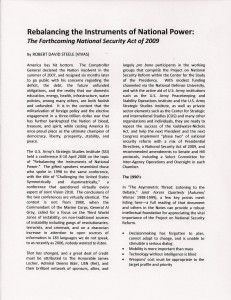
The Army Strategy Conference is generally the best and most serious show in town when it comes to thinking about its topic–strategy. In 1998 the conference nailed the future, but the Services remained beholden to their budget share wars and contractor-driven bells and whistles for profit strategies–they betrayed the public interest. In 2008 the conference again nailed it, and here is the draft article in both document form (click on the image) . The military talks about “we can't do it all” but the military leadership is still not serious about enabling inter-agency planning, programming, budgeting, and campaigning.
At the very bottom, following the full-text online, Frog left is the full detailed notes from this conference, and Frog right is the summary article of the 1998 conference.
Together with C. K. Prahalad's The Fortune at the Bottom of the Pyramid: Eradicating Poverty Through Profits (Wharton School Publishing Paperbacks), this book redirected my life. Although I have been an intelligence and operations professional all my life, and spent the last 20 years kicking doors down all over the world to get secret intelligence communities to focus on the 96% of the information they could get legally, ethically, and generally free or at very low cost, I was lacking a strategic frame of reference.
Free Online
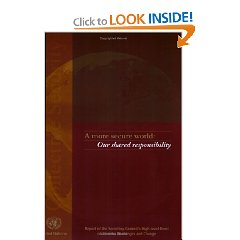
This book literally blew my mind into smithereens. Starting with the fact that LtGen Dr. Brent Scowcorft is one of the last adults still standing with his integrity intact, I was moved to the core of my being by the following list, which is in priority order:
I cannot under-state the force with which this list hit me. In combination with Prahalad's book, which makes the point that capitalism is focused on the billion rich with a one trillion marketplace, while the five billion poor represent a FOUR trillion marketplace, I suddenly realized that the Panel had delivered one side of a strategic matrix for creating a prosperous world at peace.
These two books led to my decision to sell my for-profit, OSS.Net, and create, with 23 other co-founders, the Earth Intelligence Network, a 501c3 Public Charity, and to commit myself to being intelligence officer to the poor for the remainder of my life.
I will just list the twelve policies and the eight humanities below, all other information is at EIN, and I do not want to distract from other reviews. This book, this list, is the single most important first step in empowering the collective intelligence of the public to the point that we can eradicate corruption, protect our commonwealths, and achieve a prosperous world at peace.
Twelve policies that must be harmonized at the budget level across all Nations and corporations and foundations, and organizations (this is important because governments are organized as stovepipes–it is lunacy to use up water we don't have to grow grain we do not need to create ethanal with food instead of sugar cane, bacteria, or algae):
01 Agriculture
02 Diplomacy
03 Economy
04 Education
05 Energy
06 Family
07 Health
08 Immigration
09 Justice
10 Security
11 Society
12 Water
The eight humanities (this is important because nothing the US or EU do unless we create, within seven years, an EarthGame that helps these dominant demographics avoid our mistakes:
01 Brazil
02 China
03 India
04 Indonesia
05 Iran
06 Russia
07 Venezuela
08 Wild Cards (e.g. Congo)
There are so many books relevant to all of the above I must point to my lists, but want to list just a couple of future-oriented books here, the last being the first by EIN (free online, but lovely here at Amazon):
Seminal Work for Commercial Intelligence, May 8, 2008
Benjamin Gilad
This is one of a tiny handful of truly useful, insightful, and applicable books in commercial intelligence.
Page 1 has the following line that I continue to cite:
“Top manager's information is invariably either biased, subjective, filtered, or late.”
True then, true today, and also applicable in government and in the non-profit world.
The other vitally important quote:
“Using intelligence correctly requires a fundamental change in the way top executives make decisions.”
Ben Gilad, Babette Bensoussan, Jan Herring, Leonard Fuld, Mats Bjore, Arno Reuser, and Steve Edwards are the only minds that I consider to be at the pinnacle of the profession. No doubt there are others, but these are the ones that in all of my reading, have never, ever, been displaced from the top rank once I understood their work.
Buy this book used, it is a CLASSIC of enduring value. Buy anything published by this brilliant practitioner.