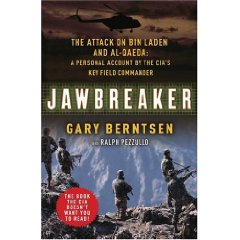
Review: Jawbreaker–The Attack on Bin Laden and Al Qaeda: A Personal Account by the CIA’s Key Field Commander (Hardcover)

5 Star, Intelligence (Government/Secret)
0Shares

Amazon Page
Amazon Page

5.0 out of 5 stars Bottom Line: CIA Managers and Reluctant Generals Let Bin Laden Fly,

January 30, 2006
Gary Berntsen
The bottom line in this book is quite clear: US forces on the ground, consisting of fully integrated clandestine case officers, special operations teams, and selected allied operations officers, were able to find Bin Laden's final lair and track him as he escaped over the course of several days toward the Waziristan sanctuary in Pakistan. Also clear is the reluctance of CIA managers to press the President to order the military to insert a Ranger battalion capable of blocking that escape, and the reluctance of the “all or nothing” US generals to commit troops “behind the lines.”

The book would normally lose one star for failing to be current with the varied sources pertinent to the story, including Sy Hersh's excellent story on how Secretary of Defense Rumsfeld gave the Pakistani's an air corridor with which they evacuated close to 3,000 Taliban and Al Qaeda leaders over the course of one night. I believe the author of this book when he says that Bin Laden was not among those so evacuated–Bin Laden's style would be to distrust a Pakistani offer of air evacuation, and to want to lead his men directly over ground to sanctuary.

Before detailing my extensive notes on this book, let me just note that it cannot be fully appreciated if you cannot read between the lines (for myself, as a former clandestine case officer, this is perhaps easier, but I find the whining about redaction from some reviewers to be naive–the redacted sections are veils, to be sure, but helpful in being shown). This book is also best appreciated if you have first read Charlie Wilson's War: The Extraordinary Story of the Largest Covert Operation in History; Ghost Wars: The Secret History of the CIA, Afghanistan, and Bin Laden, from the Soviet Invasion to September 10, 2001 and The Main Enemy: The Inside Story of the CIA's Final Showdown with the KGB as well as the book by the author's predecessor in field command, First In: An Insider's Account of How the CIA Spearheaded the War on Terror in Afghanistan I have reviewed all those books–if you don't want to buy and read them, at least read the reviews as preparation for a full appreciation of this book. If you can find it, a used copy of The Black Tulip: A Novel of War in Afghanistan is both fun read and provides atmosphere.

A few points really jump out at me and make my fly-leaf notes:

1) The author takes a reasonable shot at “First In” by pointing out that he led a team into the area in 2000 to deliver radio intercept training to the Northern Alliance.

2) He carefully documents that George Tenet's “declaration of war” was meaningless, and not backed up by either resources or management commitment. Tenet was a world-class posturer obsessed with pandering to the President and unwilling to actually lead the operators. The author provides what may be one of the best and most factual accounts of Directorate of Operations petty politics, backstabbing, and minor jealousies. The author specifically slams the Latin America Division Chief for being a chickens–t who ordered his officers to NOT volunteer after 9/11 even if they had relevant languages and experiences, and he accuses both Tenet and Jim Pavitt, then the nominal head of the Directorate of Operations (nominal because I never considered him to actually be competent) of panicking after 9/11 and as the Counter-Terrorism Center (CTC) leadership pushed the envelope and did the right things. My impressions of Cofer Black and other CTC leaders jumped up several notches on the basis of this book, and for that alone it is very worthwhile.

3) The most important strategic observation made in this book is the author's documented denouncement of George Tenet's poor judgment in closing stations in Afghanistan, Somalia, Sudan, and Tajikistan, among others, leaving CIA blind and without localized resources in the most critical years leading up to and following 9/11. The author demonstrates that he is more than just a case officer with a superb quote on page 312 in which he not only calls for a global clandestine presence, but recognizes the value of having a national cadre of “trained experts who speak the languages and show sensitivity to native cultures” and also calls for a dramatic increase in “student, cultural, and scientific exchanges” with other societies. In this context, while glossing over the CIA's general lack of languages, he noted that the Special Forces people sent to help him had no languages skills at all (relevant to this battle).

4) The author and CTC leadership get huge face with me for having the brains to go out and recruit native language speakers without college degrees, giving them the GS-13 and GS-14 grades normally reserved for PhDs. I absolutely admire the author for taking on the CIA's personnel bureaucracy and telling them in essence, “the college degree can come later, right now we need the languages and the Muslim attributes.” Absolutely spot on, this is the kind of inspired *leadership* we need in clandestine operations.

5) A few minor notes that add to the scholarship in the area of clandestine intelligence and counter-terrorism:

a) CIA relied on Northern Alliance helicopters instead of having its own capable of providing more reliable transport. This was fixed later, but the bottom line is that both CIA and the US military are completely lacking in not having a squadron of mixed aircraft (helos, VSTOL, and gunships) optimized for high altitude operations (10,000 feet to 18,000 feet).

b) Clean fuel was the major safety hazard–this taught me that one of our first priorities needs to be setting up a Forward Area Refueling Point (FARP) and having a trained fuel master responsible for ensuring clean fuel is available to all of our clandestine and special operations flights in and out of denied areas.

c) The author slams Tenet and Deutch (and David Cohen) for putting intelligence analysts in charge of stations overseas. An analyst is no more capable of managing clandestine operations than a ballerina is of coaching a football team.

d) The author documents that the Nairobi Embassy bombing was tipped in advance, but the informant was blown off (as were the two who told FBI about 9/11 in advance).

e) The author knows that our compartmentation rules are stupid, and shared *everything* with his military counterparts in the field. This worked.

In Afghanistan, for this campaign, unlike in Somalia or Iraq, the clandestine service worked as advertised. Wish that it were so for the rest of the world.

Vote on Review
Vote on Review

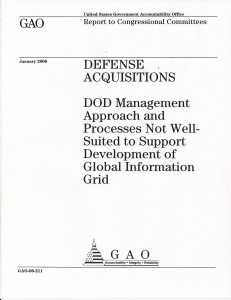
2006 General Accountability Office (GAO) Defense Acquisitions DoD Management Approach and Processes Not Well-Suited to Support Development of Global Information Grid

General Accountability Office
0Shares
Full Report Online
Full Report Online

Summary Only

Oops 2006: DOD’s management approach for the GIG–in which no one entity is clearly in charge or accountable for results–is not optimized to enforce investment decisions across the department. The DOD Chief Information Officer has lead responsibility for the GIG development effort, but this office has less influence on investment and program decisions than the military services and defense agencies, which determine investment priorities and manage program development efforts. Consequently, the services and defense agencies have relative freedom to invest or not invest in the types of joint, net-centric systems that are consistent with GIG objectives. Without a management approach optimized to enforce departmentwide investment decisions, DOD is at risk of not knowing whether the GIG is being developed within cost and schedule, whether risks are being adequately mitigated, or whether the GIG will provide a worthwhile return on DOD’s investment. The department’s three major decision-making processes are not structured to support crosscutting, departmentwide development efforts such as the GIG. In some significant respects, the department’s processes for setting requirements, allocating resources, and managing acquisitions encourage investing in systems on an individual service and defense agency basis.

Review: Conspiracy of Fools–A True Story (Hardcover)

5 Star, Capitalism (Good & Bad), Corruption
0Shares

Amazon Page
Amazon Page

5.0 out of 5 stars Inspired detail on corporate stupidity and dishonesty, government incapacity,

January 12, 2006
Kurt Eichenwald
There are some superb reviews here that I will not replicate. Here are a few things that jump out at me:

1) This author sets the gold standard for investigative journalism and non-fiction authorship. 1000 hours of interviews, 200 three-ring binders, and a gifted ability to communicate extremely complex issues. Perhaps more pointedly, the author shows what a good solid investigation can produce in the way of facts and context and understanding, to the point that one wonders why the government cannot do as well.

2) This book confirms the author's earlier findings as documented in “The Informant,” to wit, the government does not take enforcement seriously, and lets very bad people off with very minor sentences. When combined with the books on “The Cheating Culture,” or “The Soul of Capitalism,” or “Rogue Nation,” what we see is a complete break-down of ethics in business–Wall Street business, not Main Street. Enron, and then WorldCom, are the poster children of greed run amok. The profligacy of Enron is quite amazing—they paid 25% to 100% above the industry average in salaries, and made huge deals with falsified projections of future profit that were used to hemorrhage tens of millions in cash bonuses to key Enron managers.

3) Neither Arthur Anderson nor the government did their jobs. Arthur Anderson “sold out” and as the author concludes, deserved to die a corporate death penalty for its malfeasance. The government, for lack of deep economic understanding among key staffers, allowed itself to be manipulated into opening the door for Enron to cook its books.

The level of detail in this book is extraordinary, and I find that it softens my view of Ken Lay and others in a substantial way. One can see how they were drawn in, how the context led them to make bad uninformed decisions, avoid due diligence, avoid holding corrupt officers to account. This is a deeply human story, full of failings at every turn.

I put the book down reminded of the Long-Term Capital Management (LTCM) scam that stole billions from the public, and then the series of scams outlined in this book. To that one can add the very negative findings outlined in “Crossing the Rubicon,” where the author documents $3 trillion stolen by Wall Street from Main Street and the public.

It is possible to conclude that between the illicit profits of the overtly criminal gangs in the US, and the illicit profits of the covertly criminal Wall Street high-flyers, that the USA is as close to being a narco-crime state as is Colombia or Afghanistan. We have a superficial semblance of order and freedom and good living, but it is a Potemkin Village. We are being hollowed out as a Nation. This book is as close as I have seen to a medical diagnosis of all that is wrong with Wall Street and the very large corporations.

Vote on Review
Vote on Review

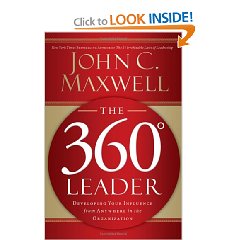
Review: The 360 Degree Leader–Developing Your Influence from Anywhere in the Organization (Hardcover)

5 Star, Leadership
0Shares

Amazon Page
Amazon Page

5.0 out of 5 stars Valuable reflections for the middle manager,

January 12, 2006
John C. Maxwell
I do not share the somewhat down reviews of this book, and give it five stars to make that point. Instead of seeing this book as uninspired, I actually see it as reflective, and helpful in showing that we often overlook some of our most potential contributions.

Above all, the book stresses relationships and the nurturing of relationships up, down, sideways, all over. For this alone it is meritorious. The book also concludes with a comparison of the industrial era leaders versus the new leaders who take risks, serve others, nurture outsiders, etcetera.

My appreciation of this book is influenced by my interview of Alvin Toffler last night at the Lowes hotel in Beverly Hills. The new book that he and Heidi Toffler have coming out, on “Revolutionary Wealth,” has many important insights but among those he summarized for me last night were three that help show the value of this book:

1) Sub-state and non-governmental organizations have been as important if not more important than national governments. How we study them, interact with them, nurture our relations with them, will have a lot to do with how promising a future we build.

2) The industrial era corporations and government bureaucracies are broken beyond repair. Entirely new network and localized alternative organizations are emerging or needed, that take a task force approach that fully integrates what have up to now been confrontational forces (e.g. Defense versus State).

3) Decision making is broken also. The scientific method is repressed and under-funded, while decisions are made based on shared assumptions, comfort levels, and consensus, regardless of what the facts are.

This excellent book is on a level with the Tofflers, and in my own view, is a fine primer for middle managers that would like to avoid becoming yes men drones under the dinosaurs, and instead break out to find new paths to moral capitalist success.

Vote on Review
Vote on Review

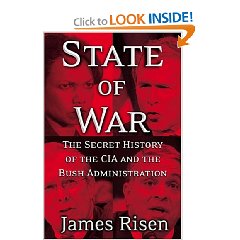
Review: State of War–The Secret History of the CIA and the Bush Administration (Hardcover)

5 Star, Intelligence (Government/Secret)
0Shares

Amazon Page
Amazon Page

5.0 out of 5 stars Three major scoops, useful summary of tidbits from others,

January 11, 2006
James Risen
EDITED to add note at bottom addressing anonymous sceptic. EDITED 6 Jun 06 to add note of Pentagon failing to capture Bin Laden.

There are three major scoops in this book that earn it five stars where the rest of the book might only merit four:

1) The obvious scoop now before Congress and the press, with respect to the National Security Agency (NSA) eavesdropping on citizens without a warrant.

2) The really really huge scoop, that Charlie Allen, then Deputy Director of Central Intelligence for Collection, was able to guide the recruitment of no fewer than 30 Iraqis able to travel back to see their relatives and conclusively document that there was no nuclear program and no weapons of mass destruction–this information was evidently not provided to Congress, the President, or (naturally), the public.

3) Slightly less sensational, the book reveals for the first time that a CIA “bait” operation actually delivered to Iran completely useful plans for creating a nuclear bomb…the CIA “flaws” intended to render the plans unworkable were detected in one glance by a Russian courier scientist, and easily correctable by the Iranians.

Over-all the book renders an important public service by pulling together in one place the many tid-bits that are publicly known, but is distressingly weak on crediting those many other sources (e.g. Jim Bamford, the last word on NSA).

The cover of the book is quite revealing in that it has photos of Bush, Rumsfeld, Rice, and Tenet–those who follow the politics of the Executive know that Cheney is the man pulling the puppet strings, generally without being detected, and it is Cheney that allowed Rumsfeld to blatantly ignore the President, steam-roll Condi Rice, disrespect Tenet, and sideline Colin Powell.

Other major points in the book that merit our attention and respect:

1) According to the author, but consistent with my own experience across three three of CIA's directorates, CIA consistently screws those that try to tell the truth, such as the Chief of Station in Iraq that wrote the report saying the insurgency was going to hurt us badly and we were not winning.

2) CIA developed a “poisonous culture” that sought to mollify the President, avoid conflict with the Pentagon, and generally not be serious about its mission {“ye shall know the truth and the truth shall make you free”)

3) CIA did not blow the whistle on the ramping up of Afghan drug production, and allowed the Pentagon to ignore the urgent calls from the Department of State for aerial spraying and other eradication measures–today Afghanistan provides 80% of the opium on the market.

4) Israel's Mossad briefed the neo-conservatives along lines they were pleased to hear, going around and against the CIA.

There are several minor flaws in the book that would normally reduce my appreciation to four stars, but the above scoops more than compensate. However, they are worth noting:

1) The book seriously over-sells and exaggerates NSA's capabilities. While they can indeed do some wondrous things, on balance NSA is in the 1970's and not at all ready for the modern world of emails, web directories, and phone texting.

2) The book touches on New York Times stories based on “leaks” from the White House but avoids naming Judith Miller or exploring whether she was an Israeli agent of influence.

3) The book touches on torture and rendition, but does not discuss how many have been imprisoned erroneously (in the dozens according to some accounts) or died as a result of torture (as many as two dozen according to some accounts). CIA literally made people “disappear” making it no better than the Argentines or the Israelis or the Nazis. Most of CIA is honest; a small segment engaged in torture and renditions is out of control.

4) The book supports the CIA field claims that the Northern Alliance allowed Bin Laden to escape, but fails to mention the well-documented facts that Secretary of Defense Rumsfeld, without consulting anyone, gave the Pakistanis an air corridor, ostensibly to evacuate a few of their “observers,” that was used to actually evacuate over 3,000 Taliban and Al Qaeda personnel trapped by US forces in the Tora Bora area; and that CIA tracked Bin Laden for four days from Tora Bora to the Waziristan border, but the Pentagon was too chicken to drop a battalion of Rangers in his path (see my review of “JAWBREAKER.”

5) The book comments on the 9-11 Commission being contradicted by open records in many respects, but fails to examine the close relationship between the White House, the Bush Family, and the Saudis, who were complicit in Al Qaeda's global growth and unwilling to help the US until after 9/11 and even then, very marginally.

6) The book has a highly questionable allegation that a single error by a CIA communicator “blew” all CIA Iranian assets. My understanding is that the CIA has been equally incompetent in recruiting Iranians as it was in recruiting Iraqis. This smells like a fish story.

Over-all the book delivers two compelling indictments:

1) Of CIA for self-censorship, pandering to the President and the Vice President, and failing to cover the Middle East properly over a period of decades.

2) Of Cheney and Rumsfeld, for orchestrating a virtual coup in which the President could be ignored, the National Security Advisor steam-rolled, the Secretary of State side-lined, and the entire policy process set aside in favor of Cheney-Rumsfeld dictates.

This is quite an amazing book, and highly recommended.

NOTE TO SCEPTIC: I bought this book from Amazon as soon as it was offered, read it on an airplane to Los Angeles on 10 Jan, and posted my review along with those of three other books I read on the trip, the evening I returned, 13 January. I read a lot, mostly on airplanes and hotel rooms. I put my notes on the flyleaf and mark the books up heavily.

Vote on Review
Vote on Review

Review: Breach of Trust–How Washington Turns Outsiders Into Insiders (Hardcover)

5 Star, Congress (Failure, Reform)
0Shares

Amazon Page
Amazon Page

5.0 out of 5 stars Extraordinary Case for a New Independent Party,

January 11, 2006
Tom A. Coburn M.D.
This is an extraordinary book, an easy to read book, which is organized to provide 10 truths, 3 myths, 4 dangers, and 5 actions that citizens can take to restore the integrity of the Congress (both Senate and House).

The author's conclusions, based on his experience as a three-term Congressman, are consistent with both the recent polls that show that Americans damn both the Democrats and the Republicans as corrupt and ineffective at representing We the People, and with books such as Peter Peterson's “Running On Empty: How The Democratic and Republican Parties Are Bankrupting Our Future and What Americans Can Do About It.”

As a moderate Republican, I found this book representative precisely of the vision I signed up to in the 1970's–smaller government, less waste, more discretion to the states.

Two quotes really stand out:

xix: “Although the events o September 11, 2001 have focused the public attention on the threat of international terrorism, the greatest threat to the continuity of our form of government is our government itself.”

79: “What makes this [Party Line] mentality dangerous is that when the team is held together by careerism and mindless partisanship, individual members are punished for thinking for themselves [or their Districts]. When members can't think for themselves their constituents are deprived of honest representation.”

The book itemizes the positive aspects of the “Contract with America” that the Republican class of 1994 hoped to achieve, and blasts Newt Gingrich for failing to honor the contract and failing as a leader.

Robert Novak is to be complemented for his superb foreword and his support of this book.

All of my reading suggests that America is ready to demand that the bulk of their representatives follow the example of the Member from Vermont, and declare Independence from the two corrupt incumbent parties. America appears to be ready for a new political party that will restore government of, by, and for the people. This book is a good starting point, and makes the case for discarding both parties as being so corrupt and unrepresentative as to be beyond salvation. We are on our own.

Vote on Review
Vote on Review