Reference: 2009 National Intelligence Strategy of the United States of America

Director of National Intelligence et al (IC), Government
0Shares
National Intelligence Strategy
Click on Image to Read Document

One day we hope to see each State, Commonwealth, Tribe, County, and Municipality realize they need their own unique intelligence strategies tailored to their strategic, operational, tactical, and technical challenges.  The aggregate of all of those bottom-up strategies will, we speculate, turn the national intelligence on its head and get it back to basics.  Smart Nations make intelligence with integrity the central architecture for what Ada Bozeman calls “the thing entire.”

Assuming that the DNI is now thinking about creating his own new strategy, we volunteer the full strength of the Phi Beta Iota network.  Just send an email to Robert Steele, whose TS has been reinstated, at robert.david.steele.vivas AT gmail DOT com.  It would be a pleasure to help out with this task.

Wikipedia provides a useful commentary.

Phi Beta Iota Editorial Comment (DOI: 11 August 2009)

The Foreword acknowledges that 21st Century adversaries tend to be non-state actors using off-the-shelf capabilities, while not mentioning but implicitly acknowledging that the U.S. Intelligence Community (US IC) is trained, equipped, and organized only to focus on hard-target state actors whose capabilities development process takes decades.

The most important aspect of Ambassador Negroponte’s Foreword is his recognition, in his words:

“The first order of business for U.S. national intelligence, therefore, is to inform and warn the President, the Cabinet, the Congress, the Joint Chiefs of Staff and commanders in the field, domestic law enforcement and homeland security authorities in the heartland, and our international allies.”
Click on Image to Enlarge

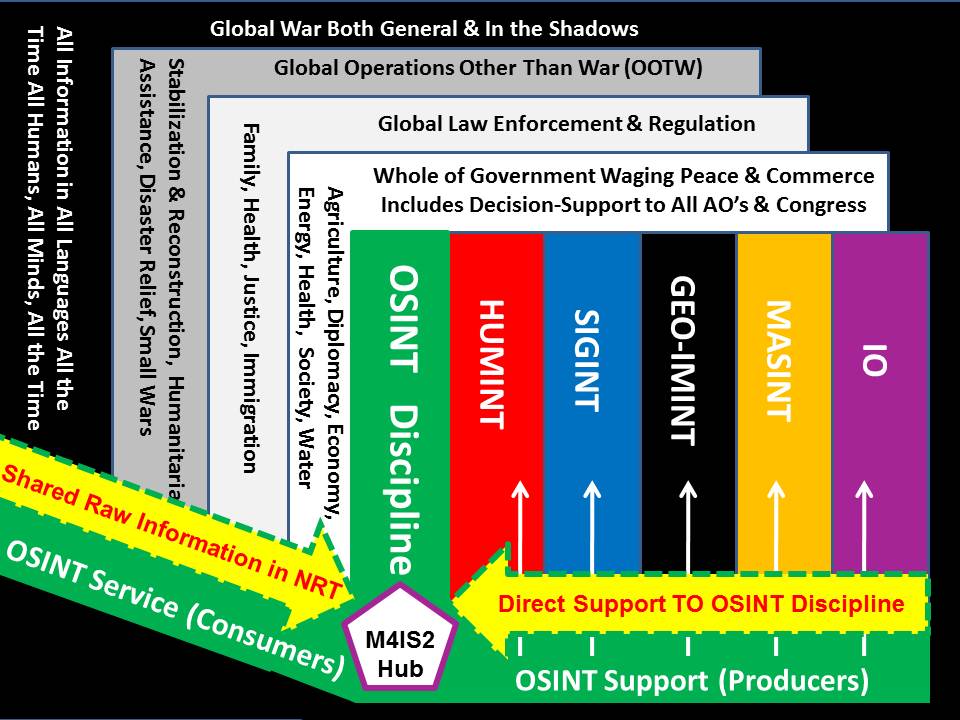
OSINT, properly funded with its own program line, is the ONLY way the DNI can achieve the scope and depth of the support promised by the above but not in any way shape or form fulfilled by the CIA's Open Source Center, which has made promises it did not understand and could not keep.

OSINT is a “hybrid” discipline, and the DNI must work with the consumers as well as the producers to assure that OSINT capabilities are both funded and fenced as sub-disciplinary or consumer-internal capabilities, AND managed as a Whole of Government program that is neither exclusively within the secret world budget nor left to the scattered and often ignoranant managers across the consumer community.   The multinational implications are obvious and will never be achieved without diplomatic and Civil Affairs engagement as the lead stakeholders in multinational information sharing and sense-making.
Click on Image to Enlarge

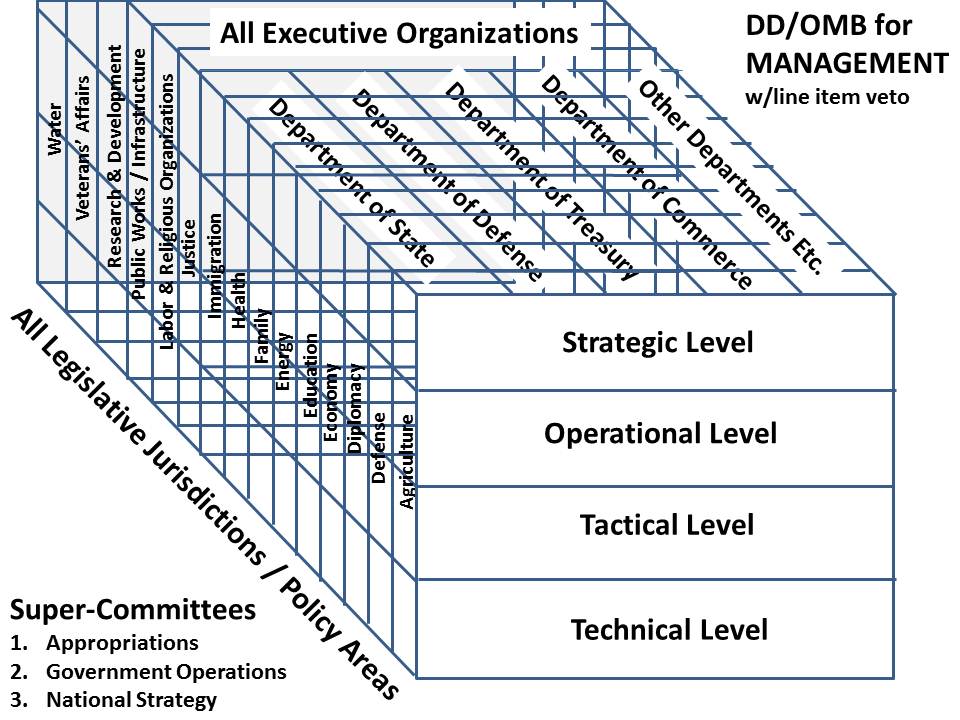
From a Mission perspective this document is too politicized, focusing on terrorism and proliferation (we must remember that the USA sells five times more arms than the next nearest member of the UN Security Council) which are political threats, not real threats.  The ten high-level threats to humanity identified by LtGen Dr. Brent Scowcroft, USAF (Ret) and other members of the UN Secretary General's High-Level Panel on Threats, Challenges, and Change should be the proper focus on a national intelligence strategy, placing terrorism and proflieration in proper perspective as threats nine and seven, respectively.

From an Enterprise perspective this document put forward laudable goals that will never be achieved unless and until the DNI acknowledges that at leasst 80% of the information needed to do all-source intelligence is not secret, not in English, and not online.  Only a properly constructied OSINT discipline with its own program line and full access to ALL multinational partners both governmental and non-governmental, will enable the DNI to actually BE the nation's top intelligence officer–otherwise he is just managing a lost ship hard aground on the past.

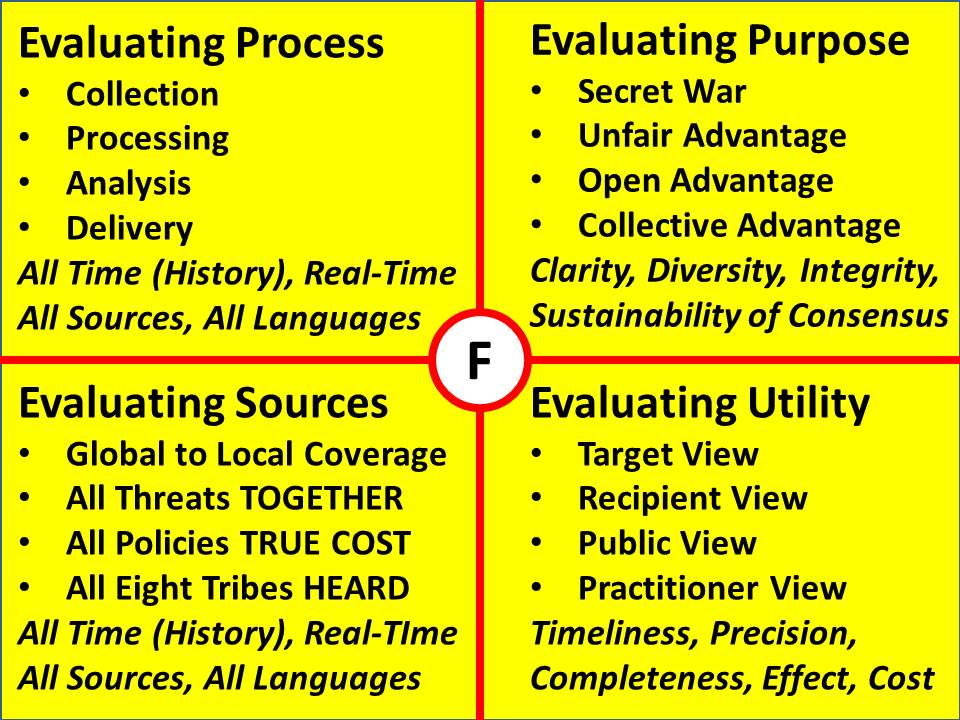
The calle for strategic planning and evaluation process does not yet exist, and will not exist until the DNI recognizes that consumers are a third of the solution and multinational non-governmental partners are the other third.  You cannot integrate what you cannot embrace, and you cannot be effective working with 20% of the relevant information.
Click on Image to Enlarge

Updated 18 March 2013:  Emphasis added to last line, and three graphics inserted with this comment and more links.  Since John Negroponte we have had two other DNIs — Mike McConnell and Dennis Blair — and now have Jim Clapper, who appears to have survived the transition, but who remains vulnerable to John Brennan over-reaching from CIA to retake the DCI role.  Our views on restructuring the White House and intelligence and reintegrating human and open source intelligence are in the links below.  We have a new stable China, an Argentine Pope and an Argentine Chef de Cabinet at the United Nations, Turkey is rising and Iran is standing pat — now is the time to bring to bear all of the intelligence and integrity we can muster.  We've blown it twice before: after WWII we went off on a self-inflicted 50 year wound; after the Berlin Wall went down we invented the Global War on Terror is a successful attempt to maintain a perpetual war society.  What is different today is that we are bankrupt.  Intelligence with integrity is a substitute for violence, wealth, land, labor, time, and space.  Now is the time to be creative — to include creative destruction — and rise like the Pheonix, stronger and smarter than before.  Counterintelligence — utterly ruthless counterintelligence against traitors and the corrupt among us, should be, with Open Source Intelligence (OSINT), Open Source Everything (OSE), and M4IS2, one of the pillars of a transformed US Intelligence Community.  The Hourglass Strategy — healing the Americas as our first priority, while securing the Arctic, makes a great deal more sense than the pivot to Asia.  Reducing the size of govvernment while still creating a 450-ship Navy, a long-haul Air Force, and an air-liftable Army makes a great deal more sense than playing Russian roulette with sequestration and continuing resolutions that perpetuate corruption.  All it takes is intelligence with integrity.
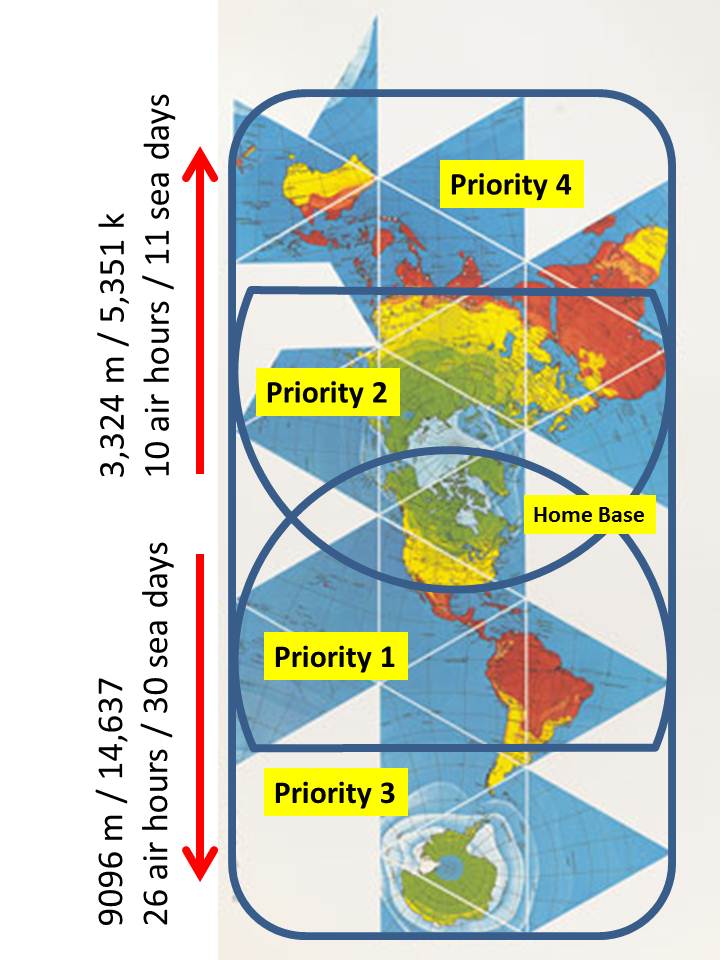
 

Click on Image to Enlarge

2013 Healing the Americas with an Open Source Agency

2012 Global Trends 2030: Review by Robert Steele — Report Lauds Fracking as Energy Solution, Disappoints on Multiple Fronts

2012 PREPRINT: The Craft of Intelligence 3.4

2010: Human Intelligence (HUMINT) Trilogy Updated

2010 Robert Steele: Reflections on Integrity UPDATED + Integrity RECAP

2010 INTELLIGENCE FOR EARTH: Clarity, Diversity, Integrity, & Sustainability

2009 DoD OSINT Leadership and Staff Briefings

2008 Open Source Intelligence (Strategic) 2.0

2008: Creating a Smart Nation (Full Text Online for Google Translate)

Reference: DNI Global Threat Testimony 2013

Review: Empire of Illusion: The End of Literacy and the Triumph of Spectacle

Review: Griftopia–Bubble Machines, Vampire Squids, and the Long Con That Is Breaking America

Review: High Noon–Twenty Global Problems, Twenty Years to Solve Them

Review: Powershift–Knowledge, Wealth, and Violence at the Edge of the 21st Century

Review: Open Veins of Latin America–Five Centuries of the Pillage of a Continent

Search: The Future of OSINT [is M4IS2-Multinational]

Sepp Hasslberger: Making Salt Water Drinkable Just Got 99 Percent Easier — Lockheed Martin Achieves a MAJOR Breakthrough

YouTube Sex with Pilots vs. Intelligence Officers

Review: Rain Fall (Spy Fiction)

4 Star, Intelligence (Government/Secret)
0Shares

Amazon Page
Amazon Page

4.0 out of 5 stars

Been a Spy, Done Japan, This is a Great Tax Write Off,

October 11, 2005
Barry Eisler
I've been a spy, out from under cover for a long time, and I would not normally have touched this, but my spouse suggested it on a rainy afternoon, and I have to give it four stars because it held my attention and I finished it.

On balance, I would put this between a 3 and a 4, but I gave it a four for coherence. Still, this author is not John Le Carre at his best (George Smiley series).

What I found most interesting, as I read through the book and found connections with both my past and with Japan, was the manner in which the author appears to have found a formula for connecting what he has done in his own past, what he has read about, and what he is presumably writing off on his taxes–comprehensive travel.

I put the book down, not disappointed–I certainly recommend this book to anyone who has not been a spy–but thinking to myself, WOW, this is what I can do when I retire–travel all over the world, write a spy novel with details about each place I visit, and presto, it is all a grand tax write-off.

Professionally speaking the book is way too facile. Planting an audio device is very very tough. The need for line of sight from the transmitter to the receiver kills most applications. Generally speaking, you have to listen for four hours to get five minutes worth of useful stuff. Killer technologies certainly abound, but as CIA found when it tried to kill Castro with exploding cigars, infected dive suits, beard killers, and the bomb-dropping pigeons, generally technology is not the answer.

3 for former spies, 5 for the general public, 4 on balance. Absolutely recommended for a rainy afternoon.

Vote on Review
Vote on Review

Review (Guest): Propaganda–The Formation of Men’s Attitudes

5 Star, Misinformation & Propaganda
0Shares
Amazon Page

Review by Jill Malter

5.0 out of 5 stars A classic work that is relevant today
October 10, 2005

Jacques Ellul

I've witnessed the phenomenon of bright people falling for propaganda, hook, line, and sinker, on numerous occasions. I'm sure I'm taken in by much of it as well, but even I can't be fooled all the time.

Still, the answer is not to simply give up. On a few topics, I actually am well enough informed so that (while I still may be susceptible to propaganda myself) I can recognize the symptoms of others falling for it. And this is definitely a phenomenon one ought to look for in others if one wants to cure oneself! I do think we ought to try to become so informed about at least a few topics that we can recognize nonsense. On these topics, we ought to listen, but we also ought to be unafraid to state facts and make judgments. On other topics, we ought to be much more careful.

Perhaps the most dramatic examples for me have been some truly amazing statements about the Arab war on Israel made by some rather well-educated and generally skeptical people. It makes me wonder why those who are ready to challenge all sorts of claims in so many other areas accept some extremely dubious, afactual, and illogical nonsense about this topic without question, and repeat it to me. Are they unaware that they are making statements that may well be false? Are they unable to discuss this issue without making very controversial comments as if they were not only accepted and indisputable facts, but relevant facts as well?

On one occasion, when I suggested to a colleague that I happened to know quite a bit about the Arab war against Israel, hoping to politely give him a way to defer to me, temporarily, on a couple of facts, I merely got an outraged reply. Was I not aware that my colleague was a highly intelligent and well-informed person? What made me think that I knew something he didn't? I was more than a little surprised by such a reaction: normally if a person claims to know something better than we do, we listen, even if we disagree.

This book, written over four decades ago, helps explain a little of what is going on. It shows how intellectuals can be so horribly susceptible to propaganda. As both the book and Konrad Kellen's preface to it state, intellectuals absorb a great deal of second-hand and unverifiable information. They often feel a need to have an opinion about such information. In addition, they consider themselves so smart that they can “judge for themselves.” And they seriously underestimate their susceptibility to propaganda given that they can see mere idiots reject some of it with ease.

The truth, as Ellul explains, is that high intelligence, a broad culture, constant use of critical faculties, and access to and use of sources of information are indeed the best weapons against propaganda. They simply aren't used often enough.

Ellul shows how propaganda can have a powerful effect if one is saturated with it. It is useful, he explains, to have someone from one's own frame of reference come up with it. The German National Socialists were careful to put Englishmen on their radio. Anti-Zionists, by the way, are very proud to have Jews state their case, although we should all know that there is no objective reason to trust every Jew, any more than there is to trust every person.

We readers see how propaganda is most useful when it reinforces earlier biases and misconceptions. And how it becomes extremely powerful once a person makes an active commitment to a cause: that person finds it very tough to recant.

The book also shows how propaganda gets one to come up with strange ideas about what is relevant material to support one's arguments. That has the effect of precluding dialog with those who disagree with you. That's why my colleague “knew” better than to take anything I said seriously or reply to it coherently. And it is why careful and cautious statements on my part sounded not merely like admissions that truth was fiction, and vice-versa, but evidence that I was hopelessly biased, impervious to reason, and hooked on rather wild propaganda myself.

This book is fascinating. It made me realize that propaganda is indeed more effective than most of us might realize. And that it is dangerous. Ellul implies that propaganda may well be the most serious threat we humans face. And I think we ought to treat it as such.

Vote on Review

Review: Imperial Grunts–The American Military on the Ground (Hardcover)

5 Star, Empire, Sorrows, Hubris, Blowback, Military & Pentagon Power
0Shares

Amazon Page
Amazon Page

5.0 out of 5 stars Admiring of Grunts, Deep Between the Lines Slam on Washington,

October 3, 2005
Robert D. Kaplan
Most important in this book is Kaplan's documentation of the fact that transformation of the U.S. military is NOT taking place–Washington is still enamored of multiple layers of rank heavy bureaucracy, the insertion of very large cumbersome task forces in to every clime and place; an over-emphasis on technology; and a lack of appreciation for the urgency of providing security, food, water, and electricity IMMEDIATELY so as to start the cycle of counter-insurgency information collection from volunteers. The author is brutal in his indictment of the bureaucracy for failing to provide the linguistic skills, four years after 9/11, that are far more important to transformation than any weapons system. He is also brutal on the delays in approving operations in the field that are associated with layered bureaucracies that come with joint task forces, and completely detrimental to fast moving tactical success at the A Team level.

Key here is the conclusion that American power can only be exercised in a sustained way through discreet relationships at every level from neighborhood and village on up to provinces and tribes. The emphasis here is on discreet, humanitarian, tangible goods and services including security. When America introduces major forces, it spikes resistance and delays the achievement of its very objective. What jumps out is the need to change how the US achieves its presence around the world. The author recommends a change in the State Department model of embassies focused on countries–State tends to be co-opted country by country and loses sight–if it ever had it–of regional or tribal nuances. The author also recommends a sustained peaceful presence at the provincial and village level around the world, through a combination of modern civil affairs and humanitarian assistance cadres and retired military given leave to choose a place they get to know and stay there to finish out their careers and then be “on tap” for retired reserve plus up.

A third theme in this book, one that Ralph Peters also makes in “NEW GLORY,” is that a lot of these countries are NOT countries and should not be countries. Many borders imposed by colonialism are simply lunatic when taking into account historical and geographic and related ethnic realities. It *makes sense* to have regional summits that re-locate borders in a manner that respects historical, geographical and cultural realities, and to do so with a massive Berlin Airlift/Marshall Plan application of the benefits of peace. Ceding southernmost Thailand and the insurgent southern part of the Philippines to Malaysia, and establishing an Indonesian-Malaysian Muslim Crescent, makes sense. Similarly, in Africa and in the Middle East, there is good that could come of a deliberate recalculation of borders.

A fourth theme, and I share his admiring view of Special Operations and the Marine Corps, is that of the separation of the military ethos of service and dedication to mission, from that of the Nation at large, where Tom Friedman in “The World is Flat” declares that we are suffering from a new generation that is, in a word, apathetic. We need to return to universal service, with options for serving in the Peace Corps or the local constabulary at home. America has lost its civic integrity.

A fifth theme, one that corrected a misimpression I have shared, was of the rather special nature of the National Guard elements of the U.S. Special Forces and the Army civil affairs teams. They come out in this book as being among the best of the best.

Sixth, I found the author's field appreciation of citizen militia in Iraq, Afghanistan, the Philippines, and elsewhere to be quite illuminating. Washington is wrong to rush the transition to a centralized Army in places where tribes and militia still hold sway and can be used to provide provincial stability. We ignore the possibilities of unconventional indigenous forces at our peril.

Seventh, as on page 230, the author highlight those occasions when our unconventional warriors point out that Toyotas are better than Humvees, commercial cell phones are better than military communications alternatives. Across the book, a few good men and women with independent authority and cash resources to do instant compensation and instant aid authorization come across as vastly superior to Washington-style contracting and major joint force insertions.

Eighth, throughout the book, force protection mania is killing us and gutting our counter-insurgency potential. This comes out especially strongly in Colombia, where A Teams are forbidden to go tactical with the forces they are training, and are limited to training within safe encampments only. Force protection is a modern variation of the Soldier's Load-we are so nuts about force protection and heavying up that we are shackling our troops and our small unit leaders and completely avoiding the military value of “fast and furious.”

Ninth, national and military intelligence are not meeting needs of front-line grunts. Bottom-up intelligence collection, including passive collection from observant civil affairs teams and foot patrols, is what is really working. We appear to need a whole new concept of operations and a whole new doctrine for field intelligence, one that floods areas with non-official cover and overt personnel, one that puts analyst and translators heavy-up into the front lines.

Sidenotes include great admiration for SOUTHCOM, accustomed as it is to getting along with the short end of the stick; and derision for PACOM, “twenty years behind the times, afraid of messy little wars and of a transparent humanitarian role for SF.” The author regards the Global War on Terror (GWOT) as a convenient “set up” for a future war with China, not something I agree with but evidently a perception within the military that has specific outcomes from day to day. Other side notes include a brutal indictment throughout of “Big Army” and also of the US Air Force which is obsessing on more super-bombers and unwilling to fund what really works well, long-haul transports, AC-130 gunships (Puff the Magic Dragon), and more air controllers in the field with the grunts.

Super book! NOTE: I have the sense that some in the SF community have taken an intense dislike to Kaplan, and vote against the review as a way of voting against Kaplan. Fair enough, but for what it's worth, the review is a good summary intended to be helpful to all in appreciating what I take to be some pretty useful themes.

Vote on Review
Vote on Review

Review: Transforming U.S. Intelligence (Paperback)

4 Star, Intelligence (Government/Secret)
0Shares

Amazon Page
Amazon Page

4.0 out of 5 stars “Must Read” Superb Collection, But Not Transformative,

October 3, 2005
Jennifer E Sims
This is a valuable book and merits careful study by policymakers, practitioners, and students who may be future intelligence professionals. The book is not, however, transformative, nor is it particularly innovative, and for that, I must with reluctance limit it to four stars, but with the caveat that it is a “must read.”

Some of the best contributions are those of Jennifer Sims, and the deeper that I read into the works of others, the more I wished that she had had the time to make the entire book her own, casting a broader net for iconoclastic thinkers, foreign intelligence practitioners, non-governmental experts in open source intelligence, religious and labor experts on foreign threats from foreign religions, whose thoughts do not appear in this book.

The book's major premise is that it was not the institutions that failed, but rather leadership–that all that is needed is a change in priorities, perspective, and methods. This is typical of books written by those who, by their own admission, were “part of the problem.”

The section on new requirements is more than adequate if one wishes to continue to focus on unilateral secret intelligence about major state threats but fails to acknowledge that we earned a D, at best, on everything else, to include terrorism, proliferation, environmental scarcity, ethnic conflict, and dictatorial corruption (our friends) as a long-term threat to our vision of participatory democracy and moral capitalism. The requirements section suffers from a rather staid focus on states and “actor” threats, with little mention of history, geography, culture, religion, or demographics, all forces vastly more potent than your average failed state or single transnational group.

The middle third of the book, on capabilities, is the strongest part of the book. It opens with a chapter on open sources by Amy Sands that I would say is now the best available short summary of that discipline's potential. I especially applaud the focus on the need for analysts (who are NOT under cover) to have professional networks that transcend borders and cultures, and to be comfortable with local as well as global information. Where this important chapter falls short, however, is in failing to recognize that 90% of what we need to know from open sources will never be shared with U.S. “intelligence” and we therefore need an Open Source Agency under diplomatic sponsorship; and that we will never unilaterally collect and process all that we need to know, hence we need a global network of regional information-sharing centers, initially doing open sources, eventually doing all sources. These latter two ideas are transformative, the chapter itself, while very solid, is not.

Clandestine intelligence is well covered from a traditional perspective, but stops short by contenting itself with asking for more authority, tighter lanes in the road, and “staying the course.” It does have gems of insight on both possibilities and obstacles, and is a good read. It does not, however, make the transformative leap toward a much larger non-official cover cadre hired at mid-career; toward regional multinational clandestine stations with mature officers on rotation from other nations; toward a much larger career principal agent network; and toward the excellent idea of one recently retired ADDO, that of one-time “it's just business” contracts for specific operations.

Digital dimension is very fine but could have benefited from a much stronger appreciation of what can be done in addressing the contributions that can be made now by man-machine translation networks with automated online dictionaries, and advanced geospatially-based analytics including predictive analysis.

I have no quarrel with the substance of either the analysis or denial sections, other than to observe that they completely eschew multinational, multiagency analysis.

The management section is strong in terms of understanding what insiders think the problems and solutions are, but for one who has read most books in this field, it is so deeply tied to the past and to past biases and perceptions as to forego any claim to being transformative.

The section on homeland defense is well-meaning, but incorrect in its assertion that the FBI has done well with a good model for joint terrorism task forces (JTTF). First off, the FBI remains a completely dysfunctional organization when it comes to either counterintelligence or sharing with state and local organizations. Secondly, as more than one expert has noted, it is the height of ignorance, especially in the aftermath of Hurricane KATRINA and the imminent bird-flu pandemic, to obsess on terrorism as the sole area where national to state and local sharing will take place. 50% of the “dots” that will help prevent the next 9/11 are bottom up dots observed by citizens and cops on the beat, and those dots have no place to go. We need 50 state intelligence centers and networks.

Britt Snider is unique in America-one of two people, the other being Loch Johnson-who have served on both the Church Committee staff and the Aspin-Brown Commission staff. He is one of America's foremost observers of national intelligence, and his chapter on Congressional oversight is one of the best pieces in the book. Having said that, I would note that it lacks two transformative thoughts, both being explored at this time: first, the time has come for every Congressional committee to have its own Sub-Committee on Intelligence and Information Operations (I2O), and for the ranking members of those sub-committees to form a new Special Committee on I2O with concurrent jurisdiction over both secret and open source information expenditures and capabilities across the entire U.S. Government; secondly, and enabled by this new committee, it is time for a new form of hybrid agency, an Open Source Agency that integrates the Library of Congress and is equally responsive to Congress, the Governors, and the Executive as well as the public, with its Director appointed for life, as are Supreme Court justices, and a fixed percentage of the disposable budget (1%) for complete independence from the White House.

“Must read,” but not transformative.

Vote on Review
Vote on Review

Review: Democracy Matters–Winning the Fight Against Imperialism (Hardcover)

6 Star Top 10%, Democracy, Empire, Sorrows, Hubris, Blowback, Justice (Failure, Reform), Peace, Poverty, & Middle Class, Philosophy
0Shares

Amazon Page
Amazon Page

5.0 out of 5 stars Nobel Prize Material–Extraordinarily Thoughtful and Articulate,

September 29, 2005
Cornel West
I found this gem in the Tampa Airport bookstore and bought it for the title, not realizing that the author was the world-class professor that Larry Summers disrespected.

This is, easily, Nobel Prize material. The reflections of Professor West are extraordinary, and they are well-presented with a wealth of both names and carefully selected quotations from the works of others that make this book both a tour of the horizon, and a bright shining light on the topic of democracy and how to save the American democracy.

As I absorbed this superb material over the course of flying from Tampa to DC and into the evening, I felt that on the one hand, Professor West was truly gifted at singling out and embracing the best literary, religious, and musical talents, and that I was receiving, in the course of a single book, a course on thoughts of others that mattered to democracy. My other thought, once reminded of his dust-up with Larry Summers, was how extraordinarily courteous this author is, in identifying the very destructive tendencies of extremist Christianity, extremist Judaism, and extremist Islam. This is a man who is both innovative and polite.

A few notes from the margins of this heavily under-lined and annotated work….

1) There is marvelous deliberate aliteration throughout the book, with many pages having the resonance of poetry. This is gifted articulation and reflection, hand-crafted communication of the highest order. “Superb artistry of words” is my note on page 27.

2) Professor West is absolute correct to highlight the fact that America is built on genocide against the Native Americans, and slavery of the Africans, and remains in denial of these core realities. Then fast forward to America's support of 44 dictators, its virtual colonialism, its immoral capitalism, it schism between rich and all others–I am reminded by Professor West of Nelson Mandela, and write in the margins: America needs two “Truth and Reconciliation Commissions”–one for what we have done to our own Native Americans, Americans of African descent, and to the working poor, another for what we have done to the rest of the world.

3) Thoughout this book run the themes of prophetic or embracive Christianity, love versus materialism, nurturing versus imperialism. Most interesting to me is the consistency of thought between Professor West and that icon of the leadership literature, Margarent Wheatley. Both understand the extraordinary importance of dialog and openness and the need to share information and perspective, in sharp contrast to the ideologues in the White House that call General Anthony Zinni a traitor for questioning the false facts that led us into an unjust and prohibitively expensive war in Iraq. Dialog, not force, is the way to spread democracy.

4) On page 104 I have the annotation “THIS IS THE MESSAGE!” and “WOW!!!! If Karen Hughes wants to succeed as Undersecretary of State for Public Diplomacy, she has only to read this book and memorize page 104. Professor West is stunningly brilliant in both his assessment of America's vulnerabilities from its inherent hipocrasy, and in his evaluation of the faith-based democratic message that has real possibilties in the Middle East and elsewhere. Page 137 is also essential to Karen Hughes–Professor West is incisive in understanding that Western democracy has no chance in the Islamic world; that we must undermine the repressive autocratic clerics; and that we must help Islam modernize on its own terms–Islamic democracy will not look like Western democracy, but it can be democratic.

5) The author is just down-right superb in evaluating the Jewish condition, and the insanities of America's wasteful and counter-productive generosity toward extremist Jews who receive 33% of all our foreign aid, $500 per Israeli (against 10 cents a year for Africans). He is brilliantly coherent when he suggests that we should continue to spend these sums in the Middle East (Egypt gets 20% of our foreign aid) but put our money on the side of indigenous democratic movements, not the autocratic extremists on both the Arab and Israeli fronts.

6) Professor West gently slams Salman Rushdie and V. S. Naipaul while introducing the reader to the wealth of insight and passion in the literature from the African Islamic world.

7) The entire book, in its brilliance, coherence, and insightfulness, is a spanking of Larry Summers, one of Harvard's least qualified Presidents, but on page 189 ff the author addresses Summers directly, and his account of the encounters has the ring of truth. Tenured at Yale and Princeton as well as Harvard, with more publications to his credit than most of his peers, one puts down the book with appreciation for the author's condemnation of the sell-out of universities to greed and corporate grants, and one can easily choose to respect the author over his antagonist.

There are numerous other books I have reviewed here at Amazon that bear witness to Professor West's thoughtful and balanced critique of American imperialism and the loss of our democratic ideals here at home. Princeton is fortunate to have this great mind return to its busom, and one can only pity Harvard for violating its motto and allowing a white supremacist (who does not respect women either) to eviscerate their prophetic Christian and Black Studies faculty.

This is an absolutely grand piece of reflection, ably presented, with enormous respect for the views of others and very delicate manners in the discourse of disagreement. Very few books have aroused in me a passion such as this one has–Bonhoffer would say it is the passon of the black Church. I would say that this one man truly represents all that could “be” in the American democratic tradition. He merits our affectionate respect, embodiying as he does the thought that struck me early on in the book: life as religion, religion as life. In God We Trust, and damnation to those lawyers that seek to remove God from our Republic's identity. One can separate the church from the state, but one cannot separate religious faith from the foundation of democracy–it is as water is to cement, an essential ingredient for a lasting construct.

Vote on Review
Vote on Review

Review: The World Was Going Our Way–The KGB and the Battle for the Third World (v. 2) (Hardcover)

5 Star, Intelligence (Government/Secret)
0Shares

Amazon Page
Amazon Page

5.0 out of 5 stars Extraordinary largely for showing contractors as the weak link ,

September 28, 2005
Christopher Andrew
This is, like the first book, an extraordinary piece of scholarship. While it can be tedious in both its detail and in the drollness of the “accomplishments” that enjoyed so much Politburo attention and funding, it joins books such as Derek Leebaert's The Fifty-Year Wound: How America's Cold War Victory Has Shaped Our World in documenting the insanity and waste that characterized much of the so-called “secret wars” between the US Intelligence Community (within which the CIA is a $3 billion a year runt against the larger defense budget approaching $50 billion a year) and the KGB and GRU.

For those who have the patience or speed to get through this entire book, the single most important revelation and documentation concerns the ease with which the Russians were able to recruit traitors within the US defense community contractors. Ralph Peters has written about this in New Glory : Expanding America's Global Supremacy but speaks mostly of legal treason–corruption and waste. This book carefully addresses the sad reality that DoD is totally penetrated by foreign spies (one would add, Third World and allied spies including France, Germany, and Israel, never mind China and Iran) via the contracting community.

One day someone will do a careful calibration of both the good and the bad of secret intelligence. When that day comes, this book will be as good a place as any with which to start.

Best General Couonterintelligence Books:
Traitors Among Us: Inside the Spy Catcher's World
Merchants of Treason America's Secrets for Sale from the Pueblo to the Present

Vote on Review
Vote on Review