Review: Burn Before Reading–Presidents, CIA Directors, and Secret Intelligence (Hardcover)

4 Star, Intelligence (Government/Secret)
0Shares

Amazon Page
Amazon Page

4.0 out of 5 stars Useful to Congress, a President, or a Future DCI,

September 28, 2005
Stansfield Turner
This is a useful retrospective by Admiral Stansfield Turner, Director of Central Intelligence under President Jimmy Carter, but it is most useful if you are a Member of Congress, a sitting or future President, or perhaps being considered as a future DCI. For the general public, and even for intelligence professionals, this is an interesting personal recollection and evaluation that reflects a limited appreciation for the broader literature on intelligence reform and is less likely to be exciting to those seeking to understand the minutia of intelligence.

It could be very useful to the public under one condition or rather one hope: that the public react to this book as I did, to wit, the author may not have intended this, but his superb tour of the relations between Presidents and Directors of Central (or in today's terms, National) Intelligence has persuaded me that our national intelligence community must be removed from the Executive Branch. We need a new hybrid national intelligence community in which the Director is simultaneously responsive to the President, to Governors, to Congress, and to the public. It's budget must be set as a fraction of the total disposable budget of the federal government, on the order of 1%. This agency must be completely impervious to Executive or Congressional abuse, and must act as a national objective source of truth upon which to discuss policy and acqusition and liaison options. A national board of overseers could be comprised of former Presidents, former Chairmen of the Joint Chiefs of Staff, and former Leaders of the House and Senate, as well as selected representatives of the public. Intelligence is now too important to be subject to the whims of politics. Intelligence is the revolutionary source of wealth as well as conflict resolution, and this author has made it clear that most Presidents simply cannot be trusted to either manage it or listen to it with wisdom. I would go so far as to suggest that national science and education also require a similar form of hybrid oversight and management. This is not to say that each Executive agency should not have its own intelligence and information operations (I2O) capabilities and functions, only that intelligence and science, like justice, need a court of last resort that cannot be undermined by ideology and personality.

This suggestion is probably too radical, BUT there is one opening for a first step: the DNI should recommend to the President and to Congress that the new planned Open Source Agency integrate the Library of Congress and be the first new hybrid organization, with the Director appointed for life, as are Supreme Court Justices.

The author has done an excellent job, albeit with some obvious gaps and a few errors, in focusing on the relationships between Presidents and Directors of Central Intelligence. However, the book suffers from the author's understandable but incorrect assumption that national intelligence should remain focused on secrets by, of, and for the President. In fact, not only is most intelligence today from open sources of information, but finished intelligence is a small fraction of Information Operations (IO), that larger matrix of all operational, logistics, geospatial, and other information (including information from non-governmental organizations, universities, and corporations as well as religions and labor unions), and thus the author's perspective and recommendations, while valuable, are relevant only to 10% of the challenge facing DNI John Negroponte and DDNI Mike Hayden.

A few notes from the margins:

The author's largely cursory review of past reform efforts completely ignores the earnest efforts of Senator Boren and Congressman McCurdy with the National Security Act of 1992. That Act was undone by Dick Cheney, then Secretary of Defense, and Senator John Warner, then ranking member of the Senate Armed Services Committee. The author does correctly note that all of the recommendations of the Aspin-Brown Commission, a device used by Senator Warner to delay and stop reform, have not yet been implemented.

The author is incorrect when he credits Tenet with focusing on the operational side of the CIA, and for focusing on global coverage. In fact, Tenet appointed a White House mess buddy to be DDO, James Pavitt screwed up for seven years, and then Tenet has the temerity to tell the 9-11 Commission that he needed seven more years to get it right. Tenet also commissioned and then refused to follow the recommendations of a report called “The Challenge of Global Coverage,” where Keith Hall, then Director of the National Reconnaissance Agency, among others, told Tenet directly that with the secret world's obession on seven hard targets, it desperately needed an insurance policy on the order of $10M a year for each of 150 countries or topics including terrorism and disease. Tenet is reported by one present to have said “we are in the business of secrets, speak no more of this report.”

The author is politically correct but wrong to give the recent intelligence reform legislation a qualified “yes” when asking it makes us safer. It does not. The lead article in the Fall issue of the International Journal of Intelligence and Counterintelligence, by Michael Turner, is absolutely on target when it calls the legislation a loss for the American people and the widows and orphans of 9-11, and a victory for entrenched interests including Congressional pork rolling in Virginia.

The author is completely correct to suggest that “CIA” is an acronym ready for retirement. As I suggested in my first book, ON INTELLIGENCE (with a Foreword by Senator David Boren), CIA needs to be come the National Analysis Agency, and be stripped of its S&T and clandestine functions. [NSA needs to become the National Processing Agency–Washington is operating on 2% of the relevant information, and most of it is not online.]

There are two important recurring themes across the book that the author is extraordinarily qualified to address. The first is the long-term political, social, economic, and cultural costs of “covert actions” including assassinations, coups, and other nefarious interventions in foreign affairs. The second is the extremely negative impact on national intelligence of military ownership of three “national” agencies. He points out that we missed the Indian nuclear developments in part because the Department of Defense was demanding that all the satellite capabilities be focused on Iraq, and through ownership, was able to enforce its demands and neglect national priorities.

The author praises George Bush the First as a model President and director, and seems to hint that the son would do well to follow his father's active engagement. The author is brutal about Casey, suggesting (to this reader) that not until Karl Rove has there been a more negative employment of government assets for political advantage. The author is subtly critical of Henry Kissinger, calls Woolsey's tenure a lost opportunity to redirect CIA, and has many other insights that can only come from a DCI, about other DCIs. Overall this is a good read for anyone who cares deeply about the health and nuances of U.S. intelligence.

The book loses one star for gaps here and there. The sources used are very limited–in the critical Viet-Nam era, for example, the author does not cite George Allen's “NONE SO BLIND,” and he does not mention at least 15 other retrospective books on intelligence that would have added substantially to his endeavor, which seeks to end with recommendations for the DNI and future reform legislation that remains needed.


Vote on Review
Vote on Review

Review: Why the Rest Hates the West–Understanding the Roots of Global Rage (Paperback)

5 Star, America (Anti-America), Empire, Sorrows, Hubris, Blowback
0Shares

Amazon Page
Amazon Page

5.0 out of 5 stars Sane, Calm, Reasoned, Useful,

September 26, 2005
Meic Pearse
It takes a great deal of education, experience, and faith to write a book such as this. Originally a series of lectures, the author has developed some useful, and calmly articulated, thoughts on both why there is a disconnect between the “West” and “the Rest,” and why the West is on a downward spiral to oblivion in practical terms, with the triple whammy of declining birth rates (non-replenishment), increased longevity (generally among those who are not necessarily productive in their older years), and substantial apathy among the self-absorbed, self-righteous, and largely clueless teen-agers and 20-30 “me me me” generation.

There are many books that I have reviewed here for Amazon that support this author's personal reflections, and his citations of those books that did stimulate him are more than adequate. A few themes made by the author strike me as worthy of emphasis, for they provide a road-map for any Western society that wishes to survive into the 22nd century:

1) Morality matters. It is a historical force. Will and Ariel Durant emphasized this in their “Lessons of History,” and many strategic confrontations have borne out the point. Tribes and nations that become amoral ultimately decline and fall.

2) Western myopia cannot be understated. The ignorance of the West regarding global realities and the relationship between Western behavior (inclusive of US support for 44 dictators, immoral and predatory capitalism, virtual colonialism, and the general view of others that the West is “barbaric” in sexual and other matters of fidelity and integrity) and how others view is simply unrealistic.

3) The West fails to understand that the rest of the world, where faith and integrity and loyalty to the family and tribe are often all that keeps the entire society from disintegrating in the face of more primitive environments that we ourselves experience, wants to be modern but not Western–modern with cultural cohesion, not modern with the commoditization of the individual, which both the author of Lionel Tiger (“The Manufacture of Evil”) credit with destroying family, community, tribe, and nation.

4) The author excels at discussion how Western individuals today have lost the context of history, the reverence for tradition, the utility of specified morality. Westerners are “out of touch” with the lessons of history, out of touch with the implications of our selfish decisions in the present that have implications for the future generations.

5) The author discusses competing concepts of legitimacy, and here he goes into nuances all too often lacking in “objective” Western analysis of competing social models. He sees the value of personal versus impersonal authority in the context of societies where bureaucracy is not yet developed and kinship remains the foundation for trust.

6) The author, educated at Oxford, would agree with Philip Alcott, brilliant Cambridge scholar and author of “Health of Nations,” in dismissing most nations as false constructs inconsistent with their tribal and religious networks and beliefs. This is as true of the “Nine Nations of North America” (Joel Garreau) as it is of most of Africa, where colonialism heritage is that of inevitable genocide.

The author concludes, as one would expect of a Christian moralist, that “Nothing less than a massive cultural reversal is necessary. We need to rejoin the rest of the human race.” He focuses on the renewed relevance of religious and moral vision, and here he would find common cause with David Johnson, distinguished author of books on “Faith-Based Diplomacy” and the vital role of religion in fostering reasoned dialog between West and East.

Apart from restoring the role of morality within our over-all culture, the author concludes that we must become informed–like it or not, our lives are bound up with those of everyone else all over the world. Here he is in tight agreement with both President David Boren (former Senator) of the University of Oklahoma, and David Gergen, advisor to multiple Presidents of the United States (most of whom did not listen too well). We must internationalize and modernize our educational system, restore the importance of history and international studies, and give life to the finding of E. O. Wilson from “Consilience,” to wit, that the sciences demand the humanities if they are to be in the service of humanity.

This is a most thoughtful book, reverent in its arguments, one that reminds us all of the value that can be had from listening to or reading the careful reflections of a man of the cloth, born in Wales, educated in England, and now speaking to all of us.

Vote on Review
Vote on Review

Review: A Simpler Way (Paperback)

5 Star, Intelligence (Collective & Quantum), Leadership
0Shares

Amazon Page
Amazon Page

5.0 out of 5 stars Simpler way to absorb ideas from Leadership and the New Science,

September 25, 2005
Margaret J Wheatley
Margaret Wheatley is addictive. After reading “Leadership and the New Science” I have bought the rest of her books, and also those that she recommends by contributing a foreword.

This book has a great deal of white space, lots of photos, is double-spaced, but by no means is it simplistic. To play on the title, it is a “simpler way” to absorb the large deep ideas that are documented in “Leadership and the New Science.” If her primary writing were a trilogy, this is the entry-level book, “Finding Our Way” is the intermediate volume, and “Leadership” is the graduate course. However, I recommend they be read in reverse order, because the simpler books are more clearly appreciated if one has the deeper background.

What I find most compelling about this book is the manner in which it captures core ideas from a wide variety of works that have been bubbling into human consciousness in the past 20 years. The bibliography is quite good although by no means all-inclusive (missing Kurzweil, E. O. Wilson, and Stephen Wolfham, as well as Tom Atlee and Bill Moyers, among others).

Among the core ideas in this book that are presented with elegance are the absurdity of thinking that life can have a boss–or that rigid ideas and identities will lead to anything other than rigid non-adjustable organizations. The author stresses the value of diversity, passion, connectedness, humanity and humanness, and tieing it all together, the role of information and of ethics as facilitators for “being.”

There is a very useful discussion of bacteria and the manner in which human attempts to impose machine and medical solutions are ultimately defeated by bacteria. Although Howard Bloom's “Global Brain” is not in the bibliography, everything the authors discuss here is consistent with his concerns about bacteria winning the inter-species war with humanity.

Taking this a step further, I would contrast this book, and the varied books on collective intelligence, wisdom of the crowd, ecological economics (Herman Daly) and so on, with a book I recently reviewed about the National Security Council, aptly titled “Running the World.” The stupidity and arrogance of that title reveals all that we need to know about why U.S. foreign policy is failing, and how desperately we need to take the ideas from this book and apply them to how we manage ourselves and our relationships with other nations, other tribes, other religions, other communities.

Vote on Review
Vote on Review

Review: The World Cafe–Shaping Our Futures Through Conversations That Matter (Paperback)

5 Star, Future, Intelligence (Collective & Quantum)
0Shares

Amazon Page
Amazon Page

5.0 out of 5 stars Bridges the Gap From Atlee to Wheatley,

September 25, 2005
Juanita Brown
This remarkable book has a foreword from Margaret Wheatley, genius guru and author of Leadership and the New Science: Discovering Order in a Chaotic World who inspired Robert Buckman's tremendous work on Building a Knowledge-Driven Organization and it has a review from Tom Atlee, author of The Tao of Democracy: Using Co-Intelligence to Create a World That Works for All and founder of the Co-Intelligence Institute.

As I finished this book and dealt with my teen-ager who at 16 is quite certain that even the great schools of Fairfax County are largely boring and dysfunctional, still teaching by rote and testing memory rather than the ability to discover, it occurred to me that this book is in fact a handbook for both educating the world, and for reforming education. Instead of the current didactic form of instruction (one-way lectures) we should be teaching, at every level, interactive discovery. It's not what you can remember from the past, but what what you can discover in tandem with others, and apply constructively!

EDIT of 12 Dec 07: Lots has happened since I reviewed this book, and it was a delight to discover that this long buried insight actually found itself manifested in the new non-profit, the Earth Intelligence Network, whose 24 co-founders recognize that we need an EarthGame where we all play ourselves, and that to save the planet, we must educate the five billion poor “one cell call (or conversation) at a time,” something we can do by giving out free cell phones and recruiting 100 million volunteers with Internet access who among them cover the 183 languages we do not speak–that will create infinite wealth (see books at bottom of this review).

As someone who has been trained to be dysfunctional, overly reliant on “command and control” and predictability, I can certainly see how this book would cause discomfort and inspire disbelief among the mandarins of industry and government, but I can also see this book sensibly defines the only path likely to lead to collective intelligence and collective consensus solutions.

Context, hospitable spaces, questions that matter, encouraging everyone's contribution, cross-pollination of diverse perspectives, listening for patterns, cultivating collective intelligence and insight through dialog instead of debate–this book has it all.

My last annotation in the book is “Wiki!” As smart people like Jock Gill and Howard Rheingold start to think about how to create a global Wiki that enables a World Cafe with a space for every topic, every challenge, every zip code, every neighborhood, I have a strong feeling that “bottom up people power” may at last be in the offing.

Alvin and Heidi Toffler are publishing a new book in April called Revolutionary Wealth: How it will be created and how it will change our lives Knowing their past work, I suspect it will be an epic statement that carries the work of Tom Stewart The Wealth of Knowledge: Intellectual Capital and the Twenty-first Century Organization and Barry Carter Infinite Wealth: A New World of Collaboration and Abundance in the Knowledge Era to new heights, and that is where I will end this review: the world cafe is about creating wealth and peace through dialog. Done right, there are no limits to our ability to engage one another in conversation, and no limits to the wealth that we might create, the peace we might foster, by so doing.

EDIT of 12 Dec 07: two additional books have had a deep impact on me since this was first written:
The Fortune at the Bottom of the Pyramid: Eradicating Poverty Through Profits (Wharton School Publishing Paperbacks)
The Wealth of Networks: How Social Production Transforms Markets and Freedom

This book is very serious, very valuable. It is worth reading and it is worth sharing with others. It is part of our “Collective Intelligence” and leads straight to Peace Intelligence and Commercial Intellligence. In the next ten years I plan nothing less than the reduction of the secret budget of $60 billion a year, to $12 billion, with the savings redirected toward national education and connection the five billion poor to knowledge so they can create infinite stabilizing wealth.

Vote on Review
Vote on Review

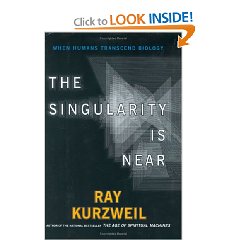
Review: The Singularity Is Near–When Humans Transcend Biology (Hardcover)

4 Star, Future, Information Society, Science & Politics of Science
0Shares

Amazon Page
Amazon Page

4.0 out of 5 stars Technically brilliant, culturally constrained,

September 25, 2005
Ray Kurzweil
Ray Kurzweil is unquestionably the most brilliant guru for the future of information technology, but Joel Garreau's book Radical Evolution: The Promise and Peril of Enhancing Our Minds, Our Bodies — and What It Means to Be Human covers the same ground, with the same lack of soul, but more interesting and varied detail.

This is really four booklets in one: a booklet on the imminence of exponential growth within information technologies including genetics, nano-technology, and robotics; a booklet on the general directions and possibilities within each of these three areas; a booklet responding to critics of his past works; and lengthy notes. All four are exceptional in their detail, but somewhat dry.

I was disappointed to see no mention of Kevin Kelly's Out of Control: The Rise of Neo-Biological Civilization and just one tiny reference to Stewart Brand (co-evolution) in a note. Howard Rheingold (virtual reality) and Tom Atlee (collective intelligence) go unmentioned. It is almost as if Kurzweil, who is surely familiar with these “populist” works, has a disdain for those who evaluate the socio-cultural implications of technology, rather than only its technical merits.

This is an important book, but it is by a nerd for nerds. [Sorry, but anyone who takes 250 vitamin supplements and has a schedule of both direct intravenous supplements and almost daily blood testing, is an obsessive nerd however worthy the cause.] It assumes that information technologies, growing exponentially, will solve world hunger, eliminate disease, replenish water, create renewable energy, and allow all of us to have the bodies we want, and to see and feel in our mates the bodies they want. All of this is said somewhat blandly, without the socio-cultural exploration or global evaluation that is characteristic of other works by reporters on the technology, rather than the technologists themselves.

The book is, in short, divorced from the humanities and the human condition, and devoid of any understanding of the pathos and pathology of immoral governments and corporations that will do anything they can to derail progress that is not profitable. It addresses, but with cursory concern, most of the fears voiced by various critics about run-away machines and lethal technologies that self-replicate in toxic manners to the detriment of their human creators.

The book is strongest in its detailed discussion of both computing power and draconian drops in needed energy for both computing and for manufacturing using new forms of computing. The charts are fun and helpful. The index is quite good.

I put the book down, after a pleasant afternoon of study, with several feelings.

First, that I should give Joel Garreau higher marks for making this interesting, and recommend that his book be bought at the same time as this one.

Second, that there is an interesting schism between the Kurzweil-Gates gang that believes they can rule the world with machines; and the Atlee-Wheatley gang that believes that collective **human** intelligence, with machines playing a facilitating but not a dominant role, is the desired outcome.

Third that there really are very promising technologies with considerable potential down the road, but that government is not being serious about stressing peaceful applications–the author is one of five advisors to the U.S. military on advanced technologies, and it distresses me that he supports a Defense Advanced Research Programs Agency (DARPA) that focuses on making war rather than peace–imagine if we applied the same resources to preventing war and creating wealth?

Fourth, information technologies are indeed going to change the balance of power among nations, states, and neighborhoods–on balance, based on his explicit cautions, I predict a real estate collapse in the over-priced major cities of the US, and a phenomenal rise of high-technology villages in Costa Rica and elsewhere.

The singularity may be near, as the author suggests, but between now and then tens of millions more will die. Technology in isolation is not enough–absent broad ethical context, it remains primarily a vehicle for nerds to develop and corporations to exploit. As I told an internal think session at Interval in the 1990's (“GOD, MAN, & INFORMATION:. COMMENTS TO INTERVAL IN-HOUSE”. Tuesday, 9 March 1993″ can use as a Yahoo search) until our technologies can change the lives of every man, woman, and child in the Third World, they are not truly transformative. This book hints at a future that may not be achieved, not for lack of technology, but for lack of good will.

EDIT of 24 Oct 05: Tonight I will review James Howard Kunstler's The Long Emergency: Surviving the End of Oil, Climate Change, and Other Converging Catastrophes of the Twenty-First Century His bottom line is that cheap oil underlies all of our surburban, high-rise, mega-agriculture, and car-based mobility, and that the end of cheap oil is going to have catastrophic effects on how we live, driving much of the country into poverty and dislocation, with the best lives being in those communities that learn to live with local agriculture and local power options. Definitely the opposite of what Kurzweil sees, and therefore recommended as a competing viewpoint.

EDIT of 12 Dec 07: ethics is something I have thought about a lot, and my first public article outside the intelligence community was entitled “E3i: Ethics, Ecology, Evolution, & Intelligence: An Alternative Paradigm for *National* Intelligence.” It must be something about engineers. Neither the author of this book, nor the Google Triumverate, seem to grasp the moral implications of technology run amuk without respect for ethics, privacy, copyright, humanity, etc. This is one reason I admire E. O. Wilson so much–the first of his works that I read, Consilience: The Unity of Knowledge, answered the question: “Why do the sciences need the humanities?” The second, The Future of Life, answered the question, “What is the cost and how do we save the planet?” Science had little to do with the latter. The two authors are poles apart.

Vote on Review
Vote on Review

Review: Time Present, Time Past–A Memoir (Hardcover)

4 Star, Biography & Memoirs
0Shares

Amazon Page
Amazon Page

5.0 out of 5 stars Thoughtful and Depressing–American Does Not Elect the Smart Ones,

September 25, 2005
Bill Bradley
Bill Bradley and John McCain may go down in history as the two smartest men who should have been President, but could not get elected. This is an extraordinarily thoughtful book, and it makes one almost cry out in despair. America has given up the idea of an informed democracy led by informed representatives of the people, and as the author concludes his book, given over all the power to two kinds of technocrats: political technocrats like Karl Rove who will do anything to get their man elected, including unethical misrepresentations against Republicans like John McCain, never mind Democrats; and corporate technocrats, who will kill off the middle class and increase the working poor in the name of corporate bottom lines that pass off the social and economic costs to the very taxpayers being disenfranchised.

The current Congressional and Executive systems do not work as intended. Congress has become insular and corrupt, and the Executive–at the political level–has become ideological and corrupt. Bill Bradley's writing makes it clear that there are solutions, but men like Bill Bradley will not get elected–nor even heard–until sufficient catastrophe befalls America and the people rise up in desperation to reclaim their heritage.

The index is helpful in looking up specific views of the author, e.g. on health care, national security, etcetera.

The New American Story
Blessed Unrest: How the Largest Movement in the World Came into Being and Why No One Saw It Coming

Vote on Review
Vote on Review

Review: Presence–An Exploration of Profound Change in People, Organizations, and Society (Hardcover)

3 Star, Future
0Shares

Amazon Page
Amazon Page

3.0 out of 5 stars Smart, Self-Absorbed Taped Conversation Unlinked to Work of Others,

September 18, 2005
Peter M. Senge
This is a fairly annoying book if you are at all well-read, and especially so if you read Charles Hampden-Turner's Radical Man: The Process of Psycho-Social Development. in the 1970's and are familiar with a sampling of Eastern “connectedness” thought as well as the range of human and global problems and solutions literature running from the Club of Rome to the econological economics of Herman Daly to the integrative science and humanities of E.O. Wilson and Margaret Wheatley to the World Bank and United Nations global studies.

The book is especially annoying because it is so self-absorbed and undisciplined in its presentation. Essentially, four smart people, each a world-class performer in their narrow domain (and familiar with the standard range of knowledge management and futures forecasting literature), but not at all well-read across either the spiritual or the ecological and game of nations literature, cooked up a plan for tape-recording their conversations and turning it into a book

The book is double-spaced throughout, and its obliviousness to the larger body of literature created in me, as I moved from chapter to chapter looking for gems, a growing sense of impatience and annoyance.

The “U” is a cute idea if you have not heard of self-awareness, collective intelligence, synergy (an over-used word, but one that existed with meaning long before this book or the “U”), or informal “think globally, act locally” that the Co-Evolution Quarterly and Whole Earth Review were pioneering long before these authors decided it would be cool to fund their reflections among themselves.

Don't waste your time or money. Instead, buy Charles Hampden Turner's Radical Man: The Process of Psycho-Social Development. Robert Buckman's Building a Knowledge-Driven Organization and any of Margaret Wheatley's books. This book is a very weak and rather poorly executed second-hand rendition of the thoughts of others, both those the authors' have been exposed to, and the many others the authors have not bothered to read into.

There is one serious thought in this book that bears quotation. It is on page 216. “At the heart of the challenge facing HP–and lots of other businesses–is the way information moves around the world. In order to grow in line with our business, new ways of experiencing information will be needed. When Humberto says that ‘love is the only emotion that expands intelligence,' it reminds us that legitimacy and trust are crucial for the free flow of information and for how information gets transformed into value.” Perhaps I expect too much, but the fact that the authors fail to cite the Nobel Prize awarded for the proof that trust lowers the cost of doing business, and they have no awareness of key works on legitimacy as the foundation for global stability, such as the edited work by Max Manwaring on The Search for Security: A U.S. Grand Strategy for the Twenty-First Century simply confirmed my sense that this book is “disconnected” from a larger body of thought.

Reading this book was like being forced to sit next to four active cell-phone users for three hours in a cramped space. Not fun at all.

Vote on Review
Vote on Review