Fixed 24 Nov 09

The truth at any cost lowers all other costs — curated by former US spy Robert David Steele.
Fixed 24 Nov 09
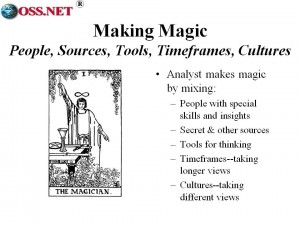
Technology is not a substitute for thinking. Memorize this sentence, the last sentence in Jim Bamford's book, BODY OF SECRETS: Anatomy of the Ultra-Secret National Security Agency (page 613, literally the last sentence in the book, note the last three words:
“Eventually NSA may secretly achieve the ultimate in quickness, compatibility, and efficiency–a computer with petaflog and higher speeds shrunk into a container about a liter in size, and powered by only about ten watts of power: the human brain.”
Fixed (Reloaded) 18 Sep 2012
Book 2 Chapter 15 New Rules for the New Craft of Intelligence
These rules are also spelled out in text form in the chapter that is provided for the book THE NEW CRAFT OF INTELLIGENCE: Personal, Public, and Political.
See Also:
Continue reading “2004 NEW RULES for the New Craft of Intelligence”
This work benefitted form the thoughtful inquiries by Tom Atlee of the Co-Intelligence Institute.


Across the board, from his narrative to his footnotes to his bibliography to his index, this book is as good as it gets. This is a world-class contribution to our understanding in three areas: 1) what can be known about terrorism and militant Islam from open sources of information (but is being largely ignored by the so-called professional intelligence agencies that are obsessing on secret sources and methods; 2) what governments in Southeast Asia are and are not doing about it (in many cases, abusing American naiveté or being put off by American arrogance; and 3) where militant Islam is going in this area–be afraid, be very afraid.
If all academics were this good, we would not need spies. This book and this author represent the very best scholarship that one could ask for. The author is the Program Director for East Asian Studies and associate professor of international politics at Simmons College. Goggling him yields a fine selection of interviews and Congressional testimony.




For me, the book is important in two ways. First, it tells me there is a person out there who really understands all this stuff in detail, and can help me rethink our national policy when the time comes that we have a sane White House willing to be serious about this vital long-term matter.
Second, it lists up front the various areas that impact on population policy (drawing on the Commission on Population Growth and the American Future) and is worth the price of the book for this superb list (each with a paragraph about the sub-policy area): Population Education; Sex Education; Child Care; Children Born Out of Wedlock; Adoption; Equal Rights for Women; Contraception and the Law; Contraception and Minors; Voluntary Sterilization; Abortion; Methods of Fertility Control; Fertility-Related Health Services; Personnel Training and Delivery of Services; Family Planning Services; Services for Teenagers; Population Stabilization; Illegal Aliens; Immigration; National Distribution and Migration Policies; Guiding Urban Expansion; Racial Minorities and the Poor; Depressed Rural Areas; Institutional Responses; Population Statistics and Research; Vital Statistical Data; Enumeration of Special Groups; International Migration; Current Population Survey; Statistical Reporting of Family Planning Services; National Survey of Family Growth; Distribution of Government Data; Mid-Decade Census; Statistical Use of Administrative Records; Intercensal Population Estimates; Social and Behavioral Research; Research Program in Population Distribution; Federal Government Population Research; Support for Professional Training; Organizational Changes; Office of Population Affairs in the Department of Health, National Institute of Population Sciences; Department of Community Development; Office of Population Growth and Distribution; Council of Social Advisors; Joint Committee on Population; State Population Agencies and Commissions; Private Efforts and Population Policy.
The author makes a very strong case for how, as his subtitle suggests, US population policy has been doomed by a lack of political will and the inappropriate influence of the Catholic Church and Mexico, in addition to strong private sector interests seeking low-wage workers while avoiding any associated social costs that are put on to the taxpayer.
I consider this book a primary reference that will be needed soon as America becomes more thoughtful and participatory democracy is restored. Population policy is fundamental. Missing from the official documents are serious discussions about citizenship, civics, ethics, morality, the restoration of the one-income two-parent family as the foundation for a strong nation, and the role that taxation policy can play in strengthening families while holding employers accountable for not making illegal immigration sustainable by hiring undocumented aliens.