The following key issues will be explored under this topic:
1. The Nature of the Problem
A) The vulnerabilities of national and international infrastructures B) Infrastructure dependencies C) Infrastructure failures and attacks D) Models for information attacks E) The international dimensions of the problem F. The need for international cooperation
2. Strategic Defence Options
A) Preventing an attack B) Thwarting an attack C) Limiting damage D) Reconstituting after an attack E) Passive and active defences F) Some specifically international problems
3. Forms of International Cooperation
A) Standards B) Information Sharing C) Halting cyber attacks in progress D) Harmonizing legal systems E) Providing assistance to developing nations
4. Finding a Suitable Framework for International Cooperation
A) An ideal model B) Necessary characteristics of an approximate real-world construction C) Some difficult problems to overcome
In the past decade, governments in both rich and middle-income countries have invested enormously in ICT in education, especially in schools. Universities have also invested, sometimes for the benefit of students or administrators on their campuses, and sometimes to facilitate distance learning, which has expanded rapidly, especially for the delivery of MBA programmes in the developed world and for educational expansion in general in the developing world. Finally, many employers in both the public and private sectors have experimented with ICT to deliver job training.
ICT in education holds out much promises – of lower costs, wider access and more precise delivery of the right course at the right level and the right time. But experience so far has been mixed. This paper will review what has been achieved so far and examine the possibilities for the future and the scope of overcoming some of the challenges that have emerged.
Information is uneven, with a large number of studies of distance learning and some of ICT in schools, but less on its use on campus in universities and for job training. Good information is also relatively rare for the two most common uses of ICT in universities, for the purpose of giving students online access to publications (i.e. as an extension of the library) and for streamlining administration.
Under this topic, the following key issues will be explored:
1. What do we mean by education? What kind of human capital are we trying to build?
2. Distance Learning. What do we mean by distance learning? What are the different forms of distance learning?
3. Technology can be used in different ways. What are the uses of ICTs in building human capital? Where has it been well developed and where is it relatively new? Why use ICTs? To cut costs? To improve quality?
4. Evaluating ICTs. The difficulties involved in evaluation. Compared with what? How well are other educational interventions evaluated?
5. The benefits of ICTs. Are educational outcomes improved? Can courses be launched and updated more readily? How do ICTs enhance access to education?
6. The cost of ICTs.
7. What technological improvements would raise the impact of ICTs on education?
Communication is fundamental to the valorisation of information, and together information and communication play multiple roles in social development. For example, layers of information have accumulated over generations to provide us with the stock of knowledge we take for granted in science, culture and everyday life. This knowledge is communicated from person to person and from generation to generation, thus becoming the foundation for all new innovation. The system of intellectual property rights has been devised as one way of achieving a balance between rewarding creativity, by granting limited rights to withhold or charge for information, and simultaneously ensuring that there is a viable public domain with information freely available to future generations of creative minds.
Communication is also recognised as a basic requirement for democratic society because it underpins other human rights; ensuring that people can participate in the (re)organisation of their social, cultural and political environments. These rights are embodied in institutions and practices and evoked in international covenants such as Article 19 of the Universal Declaration of Human Rights.
Together information and communication are the fundamental building blocks of our societies – essential for everything from technological innovation to cultural development.
In the last quarter of the twentieth century, the information domain became ‘turbo-charged', first through mass media and then ICTs. Suddenly, information processing could be ‘industrialized'; copying and dissemination could in principle be virtually instantaneous and infinite; access could be made universal, or universally denied. The stakes were hugely raised in terms of creativity, the balance between ownership and social use of information, and information and communication rights. Today the roles of information and communication are international arenas of contention, with dynamics often pulling against each other.
This research will contribute to defining a vision of an information and communication society by examining a number of aspects of these dynamics and by mapping out a series of alternative scenarios for governance of information and communication. The scenarios will examine implications of the different levels of participation by various actors from multilateral bodies, governments, private sector, and civil society. The paper will conclude with a number of proposals for actions.
The following key issues are explored under this topic:
1. Introduction to the global information society
A) Technology B) Borderless communication
2. The social infrastructure
A) Network infrastructure B) Platform C) Applications
3. Fostering ICTs: a country-wise approach
A) Economically advanced countries B) Information- advanced countries C) Developing countries D) Asian perspective
4. Increasing accessibility
A) Evolving notion of universal service B) Digital empowerment C) Competition or government monopoly?
D) Sustainable infrastructure
5. Affordability
A) Choice of infrastructure B) Usage optimization C) Pricing strategy for a fast penetration
D) Subsidy and WTO principle E) Affordability for whom?
6. Governance of the Global Information Society
A) International telecommunications union B) Internet engineering task force C) Convention on cyberspace
D) Sustainability and diversity
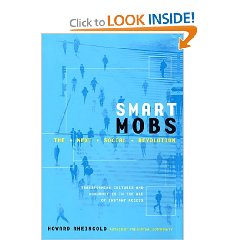
At the very end of the book, the author quotes James Madison as carved into the marble of the Library of Congress: “…a people who mean to be their own governors must arm themselves with the power which knowledge gives.” And there it is–Howard Rheingold has documented the next level of the Internet, in which kids typing 60 words a minute with one thumb, “swarms” of people converging on a geospatial node guided only by their cell phones; virtual “CIAs” coming together overnight to put together massive (and accurate) analysis with which to take down a corporate or government position that is fradulent–this is the future and it is bright.As I go back through the book picking out highlights, a few of the following serve to capture the deep rich story being told by this book–breakthroughs coming from associations of amateurs rather than industry leaders; computer-mediated trust brokers–collective action driven by reputation; detailed minute-by-minute information about behaviors of entire populations (or any segment thereof); texting as kid privacy from adult hearing; the end of the telephone number as relevant information; the marriage of geospatial and lifestyle/preference information to guide on the street behavior; the perennial problem of “free riders” and how groups can constrain them; distributed processing versus centralized corporate lawyering; locations with virtual information; shirt labels with their transportation as well as cleaning history (and videos of the sex partners?)–this is just mind-boggling.
Finally, the author deserves major credit for putting all this techno-marvel stuff into a deep sociological and cultural context. He carefully considers the major issues of privacy, control, social responsibility, and group behavior. He ends on very positive notes, but also notes that time is running out–we have to understand where all this is going, and begin to change how we invest and how we design everything from our clothing to our cities to our governments.
This is an affirming book–the people that pay taxes can still look forward to the day when they might take back control of their government and redirect benefits away from special interests and back toward the commonwealth. Smart mobs, indeed.
Self-Serving, Distortions, But Worth Buying in Paper,
November 11, 2002
Andy McNab
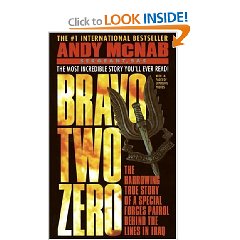
As a former Marine Corps infantry officer I was among those who praised this book when it first came out, and I thought it quite spectacular. Years later, last week actually, I picked up Michael Asher's book, “The Real Bravo Two Zero,” and was stunned by how a quality investigative journalist and former SAS'r fluent in Arabic, with three years under his belt living with the Bedouins, could actually trace back the exact paths outlined in the original book, only to reveal massive deceptions and fabrications. I actually recommend buying McNab's book, because it has a lot of useful detail and the protagonists are heroes simply for surviving–but if you want to take your experience up an order of magnitude, and be just plain flat out amazed, buy both this book and Asher's paperback, and see just how he reconstructed the truth deep within Iraq, talking to Bedouin's (three of whom actually were the “hoards of Iraqi's with tanks and personnel carriers” during the fateful battle that broke the mission apart) and actually walking the ground and finding all the traces.