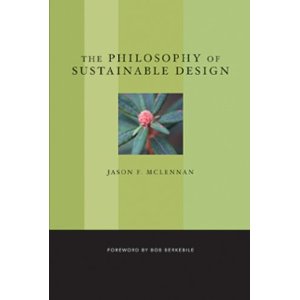
Review: The Philosophy of Sustainable Design

5 Star, Change & Innovation, Complexity & Catastrophe, Consciousness & Social IQ, Decision-Making & Decision-Support, Nature, Diet, Memetics, Design, Strategy, Survival & Sustainment, Values, Ethics, Sustainable Evolution

Amazon Page

Can Be Considered “Ref A” or the Prime Directive, March 9, 2008

Jason F. McLennan

I came late to bioneering, after I was inspired by Herman Daly's Ecological Economics: Principles And Applications, Brian Czech's Shoveling Fuel for a Runaway Train: Errant Economists, Shameful Spenders, and a Plan to Stop them All; and everything by Paul Hawkin, but especially The Ecology of Commerce.

I have had an interest in the intersection of global science, sustainable political and social and economic orders, and the vulnerability of the nation-state in the face of growing complexity for some time, and many of my other reviews focus on these literatures, as well as the literatures of collective intelligence, global assemlages, wealth of networks, localized resilience, and so on.

I make mention of that broader literature to add emphasis to my view that this book is one of the most extraordinary I have ever encountered. I made a mistake when I first got it months ago and put it sight unseen into my “hard and dense, save for intercontinental trip.” This book is not hard, not dense, and it is both easy to read and intellectually elegant. I can easily see this book as the single mandatory first year or summer pre-reading at any level–undergraduate or graduate–along with contextual books such as:
High Noon 20 Global Problems, 20 Years to Solve Them
Plan B 3.0: Mobilizing to Save Civilization, Third Edition
The Future of Life
The leadership of civilization building: Administrative and civilization theory, symbolic dialogue, and citizen skills for the 21st century and
Collective Intelligence: Creating a Prosperous World at Peace

The sixteen chapters and five appendices are elegant–concise, clear key points, short, just the right mix of photos (including color in a center spread) figures, and text.

The publisher has been criminally remiss in failing to load the varied items that Amazon allows, such as the table of contents. I am increasingly disenchanted with publishers and of the view that Amazon should get into the book publishing business, sending digital copies to FedExKinko's, helping authors self publish (full disclosure: BOTH Fred Smith at FedEx and Jeff Bezos at Amazon blew me off–these guys are simply not serious about innovation).

Preface: Philosophical Beginnings
Chapter 1: The Philosophy of Sustainable Design
Chapter 2: The Evolution of Sustainable Design
Chapter 3: The Principles of Sustainable Design (Biomimicry)
Chapter 4: The Principles of Sustainable Design (Human Vitality)
Chapter 5: The Principles of Sustainable Design (Ecosystem/Bioregional)
Chapter 6: The Principles of Sustainable Design (Seven Generations)
Chapter 7: The Principles of Sustainable Design (Energy/True Cost)
Chapter 8: The Principles of Sustainable Design (Holistic Thinking)
Chapter 9: The Technologies and Components of Sustainable Design
Chapter 10: Shades of Green–Levels of Sustainability
Chapter 11: Productivity and Well-Being
Chapter 12: Greening Your Organization
Chapter 13: Green Economics
Chapter 14: The Sustainable Design Process–Holistic Thinking
Chapter 15: The Aesthetics of Sustainable Design
Chapter 16: The Future of Architecture
Appendix A: The Green Warrior Reading List
Appendix B: Who's Who in Green Design
Appendix C: The Phases of Green Design
Appendix D: The Elements of Green Design Methodology
Appendix F: The Principles of Sustainable Design–Summary

I put this book down with several thoughts:

1) Enormously impressed with the University of Oregon in Eugene, to the point of trying to get my oldest to take his computer and creative skills there.

2) Profoundly delighted with the deep philosophical underpinning that one finds throughout the book, without pretense or pomposity.

3) The one appendix I would have liked to see that is not there is the one entitles: Green to Gold–Bottom-Line Dollar Savings Over Time, and then a whole range of the elements of sustainable design by climate zone.

This is an extremely satisfying book to read. My last throught: it's time to write the Operating Manual for Spaceship Earth. Read more about this at Earth Intelligence Network. This book by Jason McLennan is a perfect model for what the larger systems book should strive to be.

See also the literatures under panarchy, resilience, sustainability.

Vote and/or Comment on Review

Review: Resilience Thinking–Sustaining Ecosystems and People in a Changing World

5 Star, Complexity & Resilience, Environment (Solutions), Nature, Diet, Memetics, Design
Resilience Thinking
Amazon Page

Gem of Useful Education, February 24, 2008

Brian Walker

This is a gem of an educational book. Mixing case studies with elaborating chapters on key concepts, it's as a good a volume as I have found for teaching undergraduates, graduates, and practitioners (farmers, factory managers, investors) the core ideas needed to restore a sustainable social-ecological system.

Highlights for me:

+ Optemization is a false premise, simplifies complex systems we do not understand, with the result that we end up causing long-term damage.

+ Resilience thinking is systems thinking. I cannot help but think back to all of the excellent work in the 1970's and 1980's–the authors were simply a quarter century ahead of their time.

+ In a nut-shell, resilient system can absorb severe disturbance.

+ System resilience is affected by context, connections across scales of time and space, and current system state in relations to threshholds.

+ Fresh water, fisheries, and topsoil depletion are major failures.

+ Drivers of environmental degradation are poverty, willful excessive consumption, and lack of knowledge (from another book, I recall that changes to the Earth that used to take 10,000 years now take three, one reason we need real-time science).

+ Key concepts are threshholds and adaptive cycles. Adaptive cycles have four phases: Rapid Growth; Conservation; Release; and Reorganization.

+ Redundancy is NOT a dirty word (just as intelligence–decision support–should not be a dirty word within the United Nations)

+ Ecological networks cannot be understood nor nurtured with a tight linking and understanding of the social networks that interact with the ecological networks.

+ Subsidies are a form of social denial, as they subsidize unsustainable practices and prevent adaptation and change.

+ Lovely–absolutely lovely–chart on page 89 about time-scales of climate and natural disasters like major fires.

+ One size does not fit all–solutions for one social-ecological network, e.g. in the USA, will not be the same as for another, e.g. in Norway.

+ Diversity is the key to regeneration.

+ Governances must be able to see and act upon key intervention points.

+ A Resilient world would be characterized by:

1. Diversity
2. Ecological variables
3. Modularity
4. Acknowledgement of slow variables
5. Tight feedbacks
6. Social capital
7. Innovation
8. Overlap in governance
9. Ecosystem services

Within this small and very easy to absorb book one finds a great annotated bibliography of recommended readings, a fine reference section, and a very solid index.

Other books that come to mind as complements to this one (limited to ten links by Amazon):
The leadership of civilization building: Administrative and civilization theory, symbolic dialogue, and citizen skills for the 21st century
Society's Breakthrough!: Releasing Essential Wisdom and Virtue in All the People
Ecological Economics: Principles And Applications
Natural Capitalism: Creating the Next Industrial Revolution
Green to Gold: How Smart Companies Use Environmental Strategy to Innovate, Create Value, and Build Competitive Advantage
Cradle to Cradle: Remaking the Way We Make Things
The HOK Guidebook to Sustainable Design
High Noon 20 Global Problems, 20 Years to Solve Them
Pandora's Poison: Chlorine, Health, and a New Environmental Strategy
The Blue Death: Disease, Disaster, and the Water We Drink

Vote on Review

Review: Plan B 3.0–Mobilizing to Save Civilization, Third Edition

5 Star, Complexity & Catastrophe, Complexity & Resilience, Environment (Problems), Environment (Solutions), Future, Intelligence (Public), Nature, Diet, Memetics, Design, Peace, Poverty, & Middle Class, Priorities, Security (Including Immigration), Stabilization & Reconstruction, Survival & Sustainment, Values, Ethics, Sustainable Evolution

Plan 3.0The Best and Most Essential Guide, Not the Whole Picture, January 11, 2008

Lester R. Brown

I have followed Lester Brown's dedication to evaluating the state of our planet for over a decade, and wrote to the Nobel Committee urging them to recognize him, Herman Daly, and Paul Kawkins and the two Lovins instead of Al Gore. They have all done a great deal more of the heavy lifting.

I decided to purchase this book when Medard Gabel, creator of the analog World Game with Buchminster Fuller, gave me a budget for saving the planet that totals no more than $230 billion a year (at a time when we spend $1.3 trillion waging war).

I've gone through the book and consider it to be a best in class effort, a seminal work no one else on the planet could have produced. In the author's chosen area of focus, there is no other book like this one. However, some other books are easier to read and understand, such as High Noon 20 Global Problems, 20 Years to Solve Them, and others do a better job of addressing all ten high-level threats to Humanity and Earth, such as A More Secure World: Our Shared Responsibility–Report of the Secretary-General's High-level Panel on Threats, Challenges and Change.

Here are a few highlights:

+ Book is offered free online (but the hard copy is much better deal, easier to work with, mark up and return to as a reference….use the online version to search for specifics.

+ The Introduction is clear and inspiring. This book is loaded with carefully collected facts ably presented.

+ $12 per gallon of fuel in “true costs” externalized and not billed

+ One 25 gallon ethanol tank takes enough grain to feed a person for a year. This means that those in hunger going to double from 600 million to 1.2 billion, as cars compete for grain (which is nuts).

+ Food-oil axis is developing into a triple crisis: oil, food, water. As 50% live in cities, the fuel intensity of food in the face of Peak Oil is becoming a major issue.

+ Stopping the ethanol program dead in its tracks is the single best thing US Government could do, followed my more wind farms and an end to coal plants.

+ Amazon reaching a tipping point, mega-fires are foreseen (as with New York City if its 1920's water system fails and a firestorm emerges)

+ Western model will not work for China or India (or Brazil, Indonesia, Iran, Russia, Venezuela, and other Wild Cards)

+ Ice cap is melting fast, gfalciers are melting fast and causing small earthquakes.

+ 600 million refugees expected if sea level rises ten meters (33 feet)

+ Mortality has been reduced, but fertility has not, leaving persistent population issues.

+ 15 of 24 primary ecosystems degraded or pushed beyond their limits.

+ Climate has become more destructive, with 55 weather events costing $1.5 billion or more each since the 1980's.

+ Great discussion of the ecology of cities, Bioneers would resonate with all the author recommends.

+ Scarcity crossing national boundaries.

+ Excellent notes, heavy reliance on UN and other primary sources.

+ He proposes a budget of $190 billion a year to achieve our social goals and restore the Earth.

+ The only thing missing from this book are some of the positives, for example bacteria as an energy source, healing bacteria, eletrified water as a cleanser needed no other ingredients, the recovery of the Dead Sea with furrows that retain every drop of water.

I am so surprised to find only one review that I wanted to quickly add my praise for this author, while also pointing out three things that a handful of wealthy philanthropists could do tomorrow to execute this vision.

#1 We should all support the World Index of Social and Environmental Responsibility (WISER) as created by the Natural Capital Institute, and encourage colleges and universities around the world to begin loading the “true cost” information for all products and services (e.g. 4000 gallons of water in a designer T-shirt). Delivered to end-users via cell phone query at the point sale, this will dramatically affect markets.

#2 We should ask the 90 major foundations in the USA to host a summit to which all governments, non-governmental organizations, prominent wealthy individuals, and the United Nations are invited. The objective should be to create an online “Range of Gifts” Table that identifies specific contributions that can be made at every cost level, to eradicate the ten high level threats within fifteen years, by harmonizing the twelve policies such that ALL organizations and ALL individuals can opt in on a master budget that is strategically sound, operationally executable, and tactically open to all.

#3 We must absorb the wisdom of C. K. Prahalad, Alvin and Heidi Toffler, and others listed below, and recognize that the only enduring sustainable solutioin lies in educating the five billion poor, who do not have the time or the money to sit in a classroom for 18-22 years. We can create today, using Telelanguage.com, an immediate registry of 100 million volunteers with Internet access, speaking 183 languages among them, who can educate the poor–who are not stupid, just illiterate–one cell call at a time.

I believe that Reuniting America, True Majority, and WISER are reaching critical mass. All we lack now is one well endowed champion who sees that it is our collective intelligence that will solve the world's problems, and there is no need to run for President. Here are the handful of books I would recommend to Michael Bloomberg if he were to ask me today how to fulfil his vision of political, educational, and philanthropic reform.

Visit Earth Intelligence Network for free public intelligence on the ten threats, twelve policies, and eight challengers. The weekly report “GLOBAL CHALLENGES: The Week in Review,” will appeal to anyone interested in this book and its topic.

The Wealth of Networks: How Social Production Transforms Markets and Freedom
The Fortune at the Bottom of the Pyramid: Eradicating Poverty Through Profits (Wharton School Publishing Paperbacks)
Revolutionary Wealth: How it will be created and how it will change our lives
Infinite Wealth: A New World of Collaboration and Abundance in the Knowledge Era
THE SMART NATION ACT: Public Intelligence in the Public Interest
The Future of Life