2008 War and Peace in the Digital Era (Draft)

Monographs, Peace, Poverty, & Middle Class, Priorities, Security (Including Immigration), Strategy, Threats (Emerging & Perennial), Truth & Reconciliation, United Nations & NGOs, Values, Ethics, Sustainable Evolution, War & Face of Battle
Earth Rescue Network

General Peter Schoomaker–the same general that gave Open Source Intelligence (OSINT) a proper hearing at the U.S. Special Operations Command, created the first active duty Army Civil Affairs Brigade since WWII, stood up by Col Ferd Irizarry, USA.  I personally believe that the theaters commands must become Whole of Government commands, and that Army Civil Affairs Brigade should become the hub for a global Earth Rescue Network that includes all relevant personnel from all eight “tribes” (government, military, law enforcement,  academia, business, media, non-profit and non-governmental, and civil society including labor unions, religions and citizen wisdom councils and advocacy groups.

This monograph, commissioned by the Strategic Studies Institute (SSI) had *not* been validated and is offered in draft to avoid delay in sharing the core ideas for enhancing US Army performance in Stabilization & Reconstruction operations.  I am *very* interested in having a dialog on this including errors and omissions, and will respond to any comments.

Review: Never Surrender–A Soldier’s Journey to the Crossroads of Faith and Freedom

5 Star, Biography & Memoirs, Values, Ethics, Sustainable Evolution, War & Face of Battle

Never SurrenderHelpful, Illuminating, and Inspiring, October 12, 2008

Jerry Boykin

I ordered this biography on a whim, as one of a dozen books on irregular warfare that I am using to review the thoughts of others before I publish my own book. When the three boxes from Amazon arrived, this book was buried under others, but was immediately the most attractive for the week-end.

Several important insights are available from this book:

1) Charlie Beckwith, whose book Delta Force: The Army's Elite Counterterrorist Unit I really enjoyed, especially the part where he refused to leave a British field hospital for an American one, learned from the SAS the most important lesson it had to teach, and brought it to DELTA: to be *truly* unconventional, to be *truly* irregular, you must be UNMILITARY. From this page (69) I simply relaxed and enjoyed a great account. I got what I was looking for, sooner than expected.

2) The 12-hour long march from point to point is a time-tested method of screening for individuals who have inherent resolve that cannot be trained for. I quote from page 78: “The Army can train a man to spy, shoot, blow things up, and kill with his bare hands. But it cannot instill in a man the series of two-sided personality coins that cash out as a successful operative: patience and aggression, precision and audacity, the ability to lead or fall in line. Above all, the Army cannot instill resolve beyond physical and mental limits.”

3) In the above context, faith is helpful, and faith cannot be taken for granted. Early on I enjoyed the author's explanation of how he reconciled faith with a profession that wages death (for life), finding that every war is a spiritual battle. The author explicitly identifies America as God's land of faith and tolerance, and I agree with him.

4) On page 130, he concludes that some men are evil and simply need to be killed. I agree with that completely. In the 1990's when I first started advocating the need to shift away from the Soviet Union and toward Third World terrorists and criminals, I used the phrase, “one man, one bullet.” We still cannot do that today, while the Navy and the Air Force continue to buy fewer really big things for more and more money.

I enjoyed every minute with this book. This is not a “shoot 'em book.” This is, as the subtitle communicates, the story of an extraordinary individual, a man born and trained to be the best possible fighter, who found faith and kept faith with God and America. He is “the way it ought to be.”

Here are some side notes.

Rumsfeld created the Undersecretary of Defense for Intelligence because he was furious that his Special Forces had to be “led” into Afghanistan by the CIA (see my review of Jawbreaker: The Attack on bin Laden and al-Qaeda: A Personal Account by the CIA's Key Field Commander.

George Bush Junior betrayed all of us in crucifying and disavowing General Boykin in the face of media lies and exaggerations for which the author was fully exonerated by two Inspector General endeavors.

Media–the out of control largely ignorant media–is the best weapon that terrorists and others who hate America can use. I agree with that, and I am especially concerned at the ignorance of both our current presidential candidates, neither one of whom can talk substance in the context of a balanced budget–and they get away with it because the media has no idea what the substance of governance is (see the free online book, also on Amazon, Election 2008: Lipstick on the Pig (Substance of Governance; Legitimate Grievances; Candidates on the Issues; Balanced Budget 101; Call to Arms: Fund We Not Them; Annotated Bibliography).

9/11 struck the author as the opening salvo in a long battle for our own soul. I agree with the soul part, but the battle started when we decided to run the world for 50 years, very badly, while ignoring the spread of violent Islam funded by Saudi Arabia. See these four books:
Sleeping with the Devil: How Washington Sold Our Soul for Saudi Crude
The Looming Tower: Al Qaeda and the Road to 9/11 (Vintage)
The Fifty-Year Wound: How America's Cold War Victory Has Shaped Our World
Wilson's Ghost: Reducing the Risk of Conflict, Killing, and Catastrophe in the 21st Century

Other tid-bits:
+ 1 of three officers to make cut in creating DELTA. Peter Schoomaker was another.
+ DELTA pool was 118 of whom 25 finished the Long Walk, of whom 19 were selected (in the first class)
+ Boykin's dad was one of five brothers who served in “The Good War,” three in the Army, two in the Navy.
+ He was 6 feet tall and weighed 180 lbs in the eighth grade.
+ Played guitar and wound up playing at World's Fair in 1965 (the thought, “well-rounded” came into my head–not a thug stereotype)
+ Virginia Tech Corps of Cadets
+ Drawn to brotherhood of infantry, inspired by Viet-Nam stories.
+ One of his coaches taught him that faith and reality could go together
+ Once married, his first child drove him to the Dean's List
+ “I really wanted to learn everything the Army had to teach.”
+ Found faith for real in the Army, it filled a void.
+ He LIKED Ham and Lima Beans in C-Rats. That alone makes him strange in an amusing sort of way. I always thought of that C-Ration as one step down from bread and water.
+ He had his failures, in both school and the Army, but they drove him to excel and honors came his way when he bore down.
+ Aide de Camp tour in Korea got him to Viet-Nam for three months, and gave him a strategic understanding of the Army
+ Lost the general's dog, ended up running him down. Very funny.
+ Was one of the originals as paratroopers migrated into air assault.
+ Almost shut out of DELTA by the shrink for “excessive faith in God,” but he connected with Beckwith in the final interview and got in, the clear message being that the faith was not misplaced.
+ Excellent discussion of the time value of instinctive shooting (with the necessary training) over aimed fire–life of a hostage, the first takes one second, the second takes two seconds, time for the hostage to be killed.
+ Beckwith understood the killing nature of bureaucracy
+ I have a note, this book is the anti-thesis to Colin's Powell's biography, My American Journey and a shorter different book-end to Hackworth's About Face: Odyssey of an American Warrior

The author takes us through a number of operations in a manner that does not compromise any tradecraft and is not tedious. I appreciated very much the light once over on Tehran (the students thought they would have to get out in three days, they under-estimated the timidity of the US under President Carter), Sudan, Graneda which was not a surprise and for which CIA had no intelligence of substance for the fighters, Panama, Somalia, and then Bosnia.

Sixteen pages of photos are in the middle of the book, all appropriate and helpful. There is no index.

I thought to end this review with several of the phrases from the Bible that the author quoted in the book. I bought Leadership Lessons of Jesus: A Timeless Model for Today's Leaders because it was on sale in the uniform store at MacDill, and now that I have read this book, believe that our Irregulars of the future will be well-served by being required to understand faith, and to memorize portions of the Bible, the Koran, and other Holy Scriptures (just think of the impact as shown in Lawrence of Arabia, when his completing a reading instantly won over King Faisal and sidelined the conventional colonel).

“I am the light of the world. Whoever follows me will never walk in darkness, but will have the light of life.” John 9.4-5

“He gives power to the faint, and to him who has no might he increases strength. Even youths shall faint and be weary, and young men shall fall exhausted; but they who wait for the LORD shall renew their strength; they shall mount up with wings like eagles; they shall run and not be weary; they shall walk and not faint.” Isaiah 40

“For they that wait upon the Lord shall renew their strength. They shall mount up on wings of eagles, they shall run and not be weary and they shall walk and not faint.” Isaiah 40.31, faxed from around the world as he struggled to survive a 50 caliber bullet shattering a radio into his body.

Amazon won't let me have more than ten links, but this one, by Navy Capt Doug Johnston, is worth a close look: Faith-Based Diplomacy. There is an intersection of UNMILITARY, faith, and Irregular War: Waging Peace that no one in power seems to understand.

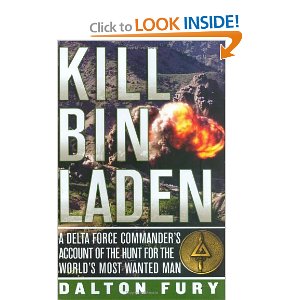
Review: Kill Bin Laden–A Delta Force Commander’s Account of the Hunt for the World’s Most Wanted Man

4 Star, Insurgency & Revolution, Terrorism & Jihad, War & Face of Battle
Amazon Page

Dalton Fury

Over-Hyped by Marketing, Excellent for Students of SOF, October 15, 2008

This book has been very heavily over-sold by the publisher and will disappoint those who are expecting something other than a professional account of a professional mission with all its warts.

This is a very fine first person account with ample detail that I for one found very rewarding and worthy of both my time and money (the book is very reasonably priced). The reader will benefit from first reading the reviews of the books I list at the end–one would never know from this account that Rumsfeld gave the Pakistani's an air corridor to evacuate 3000 Taliban overnight from Tora Bora, that the Navy was certain they killed Bin Laden, or that General Franks refused to put a battalion of Rangers on the back door (the author does tell us of his understanding that President Bush personally ruled that the back door belonged to the “trusted” Pakistanis).

The author tries hard to be nice to intelligence, but his true bottom line is captured in his description of what they had for him:

1) It's winter in Afghanistan
2) Bin Laden can ride a horse

We all know they had more than that–even with a US Senator blowing the fact that we were listening to Bin Laden's cell phones and satellite phones–but the reality is that CIA could meet with the warlords but did not have actual people within the tribes and on the ground as the Pakistani ISI did.

The author also makes clear that it was just as hard to figure out the friendly situation as it was the enemy situation. From where I sit, “total battlefield awareness” is a pipe dream–a fraud–and it's time we started refocusing on humans that can live up to the Gunny Poole “Tiger's Way.”

Here I my notes, ending with my conclusions and ten books I recommend in partnership with this one.

Early on the role of snipers, and the possible uses of snipers if we could get bureaucrats and politicians out of the way, impress me.

Small teams with a forward air controller that can go deep and stay for days impress me, very much. Unfortunately, we don't field them often enough (I only have read of use in Colombia, not generally, but SOF operates in over 150 countries so who knows).

Author reinforces the concept of Irregular Warfare as bottom-up thinking in which every person has a say, but takes pains to distinguish this from leadership, with the self-effacing comment that the leaders will decide after the enlisted personnel tell the leaders what they need to know.

Early on he laments to misplacing of the Special Operations “truths,” the first one being “Humans are more important than hardware.” Today privates are being selected for special operations right out of boot camp, and between private military contractors being allowed to loot the public treasury of both money and skilled manpower, and the complete dismissal of all standards, one can sense the author's thoughts between the lines: DELTA is the last vestige of “true” special forces (although I would include SEALs and some special air).

Air Force air strikes were not great–1 out of 3 hit the target, and the so-called super bomb, the BLU-82, did not explode as advertised.

Bin Laden's “order of battle” was surmised to be an inner circle of Saudis, Yemenis, and Egyptians, with an outer circle of Afghans, Algerians, Jordanians, Chechnyans, and Pakistanis.

Taliban liked to wear black on black…I could not help being reminded of the Viet-Cong.

Terrain blocked our radios. General Clark and others have made it clear that we are not trained, EQUIPPED, or organized for mountain operations, and between this point, and the personal knowledge I have of how few special Chinooks we have that can operate above 12,000 feet–and only because their CWO pilots have learned to fart into the fuel–it's clear the US is not serious about mountain or jungle warfare, and marginally competent as urban warfare.

After seven days they were out of batteries and water.

There was a “surrender” gambit when they got close, the primary purpose being to keep an Afghan warlord between Bin Laden and the Americans.

We still have total disconnect between ground troop use of grids on a map, and Air Force demand for latitude and longitude. The $150 GPS conversion is great, Navy and Air Force still not joint.

Lovely account of how they did a field hire of a seeming gift from heaven, a second translator who spoke English, only to learn later he also spoke Arabic and had been sent as a penetration. Sidebar on Pakistani penetration of the Afghan group they were with.

No mules. Very very tough to resupply in the mountains in winter. Even without loads, four kilometers on one occasion took five hours.

Bin Laden evidently wrote his will on the 14th of December, coincident with his rather desperate sounding call over the radio to all to arm their women and children.

We dropped 1100 “precision” bombs and $550 “dumb” bombs on Tora Bora, plus tens of thousands of rounds of other artillery and ammunition. I am so reminded of Viet-Nam, where what we paid for artillery shells being fired could have bought every Vietnamese a two-story cinderblock house with electricity and running water.

Author concludes that the CIA model of buying warlords DOES NOT WORK for specific objectives.

I learn for the first time that a visit was made to Tora Bora after the fact, a forensic visit. [He know from Bin Laden's later emergence that he did get out.]

The author is scathingly critical of the Army Center for Army Lessons Learned, which has exactly one hit on Tora Bora against thousands of documents visible via the web.

What I learned from this:

DELTA is over-trained and under-utilized.
Conventional Army leaders have no idea how to use special forces in advance of operations or deep behind enemy lines–they simply do not have the mind-set.
CIA paramilitary and some clandestine needs to be transferred into a new Active Measures Command that is the dark and dirty side of Irregular Warfare.

Fine book! See also:
First In: An Insider's Account of How the CIA Spearheaded the War on Terror in Afghanistan
Jawbreaker: The Attack on Bin Laden and Al-Qaeda: A Personal Account by the CIA's Key Field Commander
Delta Force: The Army's Elite Counterterrorist Unit
About Face: Odyssey of an American Warrior
Tactics of the Crescent Moon: Militant Muslim Combat Methods
None So Blind: A Personal Account of the Intelligence Failure in Vietnam
Who the Hell Are We Fighting?: The Story of Sam Adams and the Vietnam Intelligence Wars
The Tunnels of Cu Chi
Legacy of Ashes: The History of the CIA
War Without Windows: A True Accout of a a Young Army Officer Trapped in an Intelligence Cover-Up in Vietnam.

See Also the Comments

Robert David Steele
ON INTELLIGENCE: Spies and Secrecy in an Open World

Vote and/or Comment on Review

Review: Poets For Palestine

5 Star, Atrocities & Genocide, Culture, DVD - Light, Empire, Sorrows, Hubris, Blowback, Values, Ethics, Sustainable Evolution, War & Face of Battle

Poets PalestineRemarkable Gift, Bargain Price, Provokes Reflection, October 30, 2008

Remi Kanazi (Editor)

This is one of those rare books that I agreed to read and review after hearing from the publisher. At first I said no, then I realized Palestine was very much within my range of interests even if poetry was not, and I am glad to have said yes.

The book brings together 37 poets offering 48 poems interwoven with 30 artist renditions each on their own page. The book is made possible in part by a New York based organization, Al Jisser or “the bridge.”

The introduction connects the Palestinians to the much broader concerns of indigenous peoples everywhere, social justice being the shared issue.

Turns of phrase that stayed with me:

– hybrid ideology

– our city is a cell

– memory holding history too harsh to taste

– feel the future dissolve in a moment

– clean water

Five of the poems that resontated with me in a more special way (all are worthy of reading):

– Fathers in Exile

– Moot

– The Coffin Maker Speaks

– Those Policemen are Sleeping: A Call to the Children of Israel and Palestine

– This Is Not a Massacre

As I was preparing to write the review, I noticed the other books that Amazon brings up, using reader choice to connect to other readings of interest, and it hit me: this books is a perfect beginning for anyone who wishes to explore the literature on Palestine's history, current condition, and dubious (or inevitably triumphant) future.

In my notes I wrote “cornerstone for the resurgence of Paletinian identity and self-determination. I am certainly among those who stands with Gandhi, who said “Palestine belongs to the Palestinians the way France belongs to the French.”

I was struck by the book's extension to include Iraq, Afghanistan, Sudan, and Lebanon, the latter a country I have come to care about after a teaching mission there in 2007. In that light, below are some links to books I recommend along with this one:

Other non-fiction books I recommend:
Web of Deceit: The History of Western Complicity in Iraq, from Churchill to Kennedy to George W. Bush
The Looming Tower: Al Qaeda and the Road to 9/11 (Vintage)
Leap of Faith: Memoirs of an Unexpected Life
Global Brain: The Evolution of Mass Mind from the Big Bang to the 21st Century
Robert Maxwell, Israel's Superspy: The Life and Murder of a Media Mogul
They Dare to Speak Out: People and Institutions Confront Israel's Lobby
The Unconquerable World: Power, Nonviolence, and the Will of the People
The Tao of Democracy: Using Co-Intelligence to Create a World That Works for All
Society's Breakthrough!: Releasing Essential Wisdom and Virtue in All the People
Collective Intelligence: Creating a Prosperous World at Peace

You can buy this book with confidence that it will satisfy and provoke. Still, as a service to the publisher, who did not use the Amazon “look inside this book” features, here are the titles of all the poems; I type them as a gesture of respect for all that they represent:

Who Am I, Without Exile?
Enemy of Civilization
Portrait of Mona Lisa in Palestine
The Camp Prostitute
Fathers in Exile
Palestinian Identity
Ar-Rahman Road
And So It Goes…
Curfew
Installation/Occupation
The Seven Honeysuckle-sprigs of Wisdom (extract)
Untitled
a moonlit visit
Black Horses
Moot
The Promised Land
Hate
Wall Against Our Breath
Lights Across the Dead Sea
The Coffin Maker Speaks
Morning After the US Invasion of Iraq
The Price of Tomatoes
Regret
Calm
Palestine in Athens
Saudi Israelia
Hamza Aweiwi, a Shoemaker in Hebron
Humming When We Find Her
Wire Layers
Making Arabic Coffee
My Father and the Figtree
The Tea and Sage Poem
Letter to My Sister
In Memoriam: Edward Said 1935-2003
At the Dome of the Rock
Those Policemen Are Sleeping: A Call to the Children of Israel and Palestine
This is Not a Massacre
23 isolation (Infirad)
Free the P
Another Day Will Come
Morning News
break (bas)
Baby Carriages
Kindness
An Idea of Return
changing names
Abu Jamal's Olive Trees
A Tree in Ratah

One last observation: here in the United States of America, the Republic has been destroyed–the people are no longer sovereign. Instead, two criminal parties conduct electoral fraud as theater to they can retain their monopoly of political power which they prostitute to Wall Street and the inbred very small financial class that considers both the American people and the Palestinian people to be virtual slaves of no consequence. At some point soon, the American system will “break” and new possibilities will emerge–it remains lunacy as well as criminal for the USA to spend $1.3 trillion a year on war when a third of that amount could assure a prosperous world at peace, including an international Holy City, a Palestine with access to the sea, and an Israel that is not stealing all the water from the Arab aquifers but instead trading high technology for food grown by Arabs.

Poetry–and indigenous peoples reasserting the sovereignty of people over organizations–may yet save us all.

Review: Anthropologists in the Public Sphere–Speaking Out on War, Peace, and American Power

5 Star, Information Operations, Insurgency & Revolution, Intelligence (Public), Peace, Poverty, & Middle Class, Power (Pathologies & Utilization), Public Administration, War & Face of Battle

Anthro PublicPublisher Lazy, Content Shines, June 6, 2009

Roberto J. Gonzalez

It infuriates me to run across mediocre publishers who refuse to use the simple tools that Amazon provides for loading a proper description of the book, providing the table of contents, or even offering “look inside the book” where an index can sell a book faster than the table of contents.

Minus one star for a rotten lazy publisher. Here is the table of contents. Buy the book, along with Anthropological Intelligence: The Deployment and Neglect of American Anthropology in the Second World War this is fundamental reading that calls into question both the sanity of how we engage with foreign publics, and the incompetence combined with mendaciousness with which we seek to abuse the profession of anthropology for wrong ways and wrong ends.

The highest praise I can give to this book is that it forced me to think and it inspired new work–my forthcoming article on Human Intelligence: All Humans, All Minds, All the Time (see comment for URL) was directly inspired by this book and the huge mess the U.S. Army is making of the Human Terrain Teams (HTT), code for abused pretend anthropologists without a clue. I have the fly-leaf note: our HUMINT is at war with itself.

The kindest thing I can do for the brilliantly selected and organized contributors to this volume is respect their work by providing the table of contents, which has reminded me better than my own notes of how diverse and valuable this collection is.

Part I: War, Peace, and Social Responsibility
01 Franz Boas, “Scientists as Spies” (1919)
02 Margaret Mead, “Warfare is Only an Invention–Not a Biological Necessity” (1940)
03 Marshall Sahlins, “Once You've Broken Him Down…” (1965)
04 Gerald Berreman, “Contemporary Anthropology and Moral Accountability” (1973)
05 Laura Nader, “Two Plus Two Equals Zero–War and Peace Reconsidered”
06 Beatriz Manz, “Dollars that Forge the Guatemalan Chains”
07 David Price, “Anthropologists as Spies” (2000)
08 Pierre Bourdieu, “Abuse of Power by the Advocates of Reason” (1998)

Part II: Prescient Anthropology: Diagnosing Crises Abroad
09 Robert Hayden, “West Must Correct Its Mistakes in Yugoslavia” (1992)
10 Robert Hayden, “NATO Fuels the Balkan Fire” (1999)
11 Anna Simons, “No Exit From Somalia” (1991)
12 Anna Simons, “Our Abysmal Ignorance About Somalia” (1992)
13 Anna Simons, “The Somalia Trap” (1993)
14 Winifred Tate, “Increased Military Aid to Colombia Won't Curb Drug Trafficking” (1999)
15 Winifred Tate, “Colombia” Rules of the Game”, 2001
16 Lesley Gill, “Unveiling US Policy in Colombia” (2002)
17 Marc Edelman, “The Price of Free Trade: Famine” (2002)
18 Ali Qleibo, “How Two Truths Make One Tragedy” (2000)
19 Jeff Halper, “The Matrix of Control” (2201)
20 Jeff Halper, “After the Invasion: Now What” (2002)
21 Hugh Gusterson, “If U.S. Dumps Test Ban Treaty, China Will Rejoice” (2001)

Part III: Prelude to September 11
22 Ashraf Ghani, “Cut Off the Arms Flow and Let Afghans Unite” (1989)
23 James Merryman, “US Can Strengthen African Ties in Wake of Terrorism with Aid, Clear Policies” (1998)
24 Robert Fernea, “Egyptians Don't Like Saddam, But….” (1991)
25 Barbara Nimri Aziz, “Gravesites–Environmental Ruin in Iraq” (1997)
26 Fadwa El Guindo, “UN Should Act to Protect Muslim Women” (1998)
27 Zieba Shorish-Shamley, Interviewed, “Women Under the Taliban” (2001)
28 William Beeman, “Follow the Oil Trail–Mess in Afghanistan Partly Our Government's Fault” (1998)

Part IV: Anthropological Interpretations of September 11
29 Catherine Lutz, “Our Legacy of War” (2001)
30 David Harvey etal, “Local Horror, Global Response” (2001)
31 William Beeman, “A War Our Great-Grandchildren Will Be Fighting–Understanding Osama Bin Laden” (2001)
32 Janet McIntosh, “What Have 9/11 Investigators Overlooked?” (2002)

Part V: On Afghanistan, Central Aisa, and the Middle East
34 Robert Canfield, “Nation is Home to Afghans, Mujahedeen, Taliban, Afghan-Atabs, to Name a Few” (2001)
35 Ashraf Ghani, “The Follow of Quick Action in Afghanistan” (2001)
36 Nazif Sharrani, “Afghanistan Can Learn From Its Past” (2001)
37 Zieba Shorish-Shamley Interviewed, “Women in the New Afghanistan” (2001)
38 David Edwards and Shahmahmood Miakhel, “Enlisting Afghan Aid” (2001)
39 Kamran Asdar Ali, “Pakistan's Dilemma” (2001)
40 Francesca Mereu etal, “War Destroyed Chechnya's Clan Structure” (2002)

Part VI: Examining Militarism and the “War on Terror”
41 William Beeman, “U.S. Anti-Terrorist Message Won't Fly in Islamic World” (2001)
42 David Price, “Terror and Indigenous Peoples–War without End”
43 John Burdick, “Afghan War Could be Recruiting Tools for Terrorists” (2001)
44 Dale Eickelman, “First Know the Enemy, Then Act” (2001)
45 John Burdick, “Sept 11 Exposes Futile Search for `Perfect' Missile Defense” (2001)
46 Roberto Gonzalez, “Ignorance Is Not Bliss,” (2202)
47 Mahmood Mamdani, “Turn Off Your Tunnel Vision” (2002)
48 Thomas McKenna Interviewed, “The Roots of Muslim Separatism in the Philippines” (2002)

Part VII Academic Freedom and Civil Liberties
49 Roberto Gonzalez, “Lynn Cheney-Joe Lieberman Group Puts Out a Blacklist” (2001)
50 David Price, “Academia under Attack: Sketches for a New Blacklist” (2001)
51 Hugh Gusterson, Interviewed, “Lynn Cheney's Free Speech Blacklist” (2002)
52 Laura Nader, Harmony Coerced Is Freedom Denied” (2001)

Epilogue: Unconventional Anthropology: Challenging the Myths of Continuous War

I was pleased to see several CounterPunch contributions. I respectfully encourage Amazon readers to seek out my CounterPunch short piece on “Intelligence for the President–AND Everyone Else.” Obama is a front for the Borg, he is not getting proper decision-support, and neither is any other element of the government. We need to get back into being the sovereign people.

In addition to the book cited above, I recommend:
War is a Racket: The Antiwar Classic by America's Most Decorated Soldier
Confessions of an Economic Hit Man
The Global Class War: How America's Bipartisan Elite Lost Our Future – and What It Will Take to Win It Back
None So Blind: A Personal Account of the Intelligence Failure in Vietnam
Who the Hell Are We Fighting?: The Story of Sam Adams and the Vietnam Intelligence Wars
The Fifty-Year Wound: How America's Cold War Victory Has Shaped Our World
The Unconquerable World: Power, Nonviolence and the Will of the People
The Shock Doctrine: The Rise of Disaster Capitalism

Review: Fighting Identity–Sacred War and World Change (The Changing Face of War)

5 Star, War & Face of Battle

Fighitng IdentityOur Bunker Hill-a STAKE in the Heart of “The Borg”, June 27, 2009

Michael Vlahos

I consider this book one of the most important books of our time, for it takes on “the Borg” at an intellectual level in a cultural context, and in so doing, speaks truth to power: our Emperors (“the Borg”) are naked and ignorant.

Early on he points out that ours is not the first globalization, and that previous globalizations have demonstrated that new identities rise within globalization and *cannot be put down* (his emphasis). New ideas, counter-establishment ideas, cannot be suppressed, and ultimately triumph in new consciousness at multiple levels. States struggle vainly, equating everything “new” with being a “threat,” and ultimately collapse under the weight of their own ignorance and inability to adapt.

The first few chapters suggest that our reaction to 9-11 opened a Pandora's box, that AF-IQ are our Waterloo, and that “non-state actors” is a generic term for all that is outside the state.

He specifies six “identity” migration paths: networks of conversion and subversion (e.g. the Muslim Brotherhood and the Pentecostals); autonomous urban subcultures (e.g. gangs); emerging nations; fighter fraternities; militarized Bucellani (vandal elites, e.g. the Taliban, a state within a state); and our own cross to bear, intercessor security sub-cultures (e.g. our military-industrial complex to which I would add, a Congress lacking in integrity).

TWO MAJOR POINTS:

1. The US Military is no longer Of, By, and For We the People, no longer a collective citizenry that is armed–in brief, the militarization of national policy has made us arrogant, ignorant, and repugnant.

2. By resisting change we are promoting change. I cannot help myself, I think of the anti-Borg from outer space that grows when we nuke it, shrinks when we show love.

The author points out that every US military intervention into a Muslim society has failed; that our failures lead to new formulas (reformations) rather than new directions (transformations); and that in being drawn in and maintaining the chaos space, we are feeding the metamorphosis of non-state cocoons into butterflies very hard to hit with an artillery shell or even an aimed bullet.

The middle of the book expands on the theme of war as “creative destruction” (a mantra in the commercial intelligence world), while pointing out that in ignoring morality, the Napoleonic and Clauswitzian essential (“the moral is to the physical as three is to one”–today I would make it 10:1) the US is giving up the very power that matters, and failing to understand that identity is stronger than materiel. He points out that the “others” have commitment, sacrifice, collective effectiveness, breeding in battle, are fighting on their home ground, and achieve transcendence in resisting the US. Meanwhile, in the US, 1% do the fighting and the other 99% are asked to go shopping.

P26: “America's problem comes with the discovery that it is merely the midwife rather than the godfather. We fight so as to get nothing from those we legitimize.”

I have a note culture is identity is being is sacred and together form consciousness.

The author is critical of Al Qaeda and its many mistakes, but credits them with drawing the US out into creating the chaos space within which other indigenous forces are rising.

His section on method discusses the utility of history and anthropology, both foreign “denied areas” to the USG IMHO.

The author points out the obvious that is not so obvious to those sacrificing America's blood, treasure, and spirit in our name, i.e. two thirds of humanity is “the other” living the Hobbsian life that is “poor, nasty, brutish, and short.,” For these people, war is an entry point to negotiations, and the new players acquire legitimacy by out-lasting (not necessarily out-fighting) US forces.

As we move toward the conclusion the author speculates that we may be headed for a new Middle Ages with a global pandemic, climate change, and an energy crunch (to which I would add water crunch).

AF-IQ went wrong in five ways:

1. Liberation fizzled (I add, because neither Rumsfeld nor Gates are serious about waging peace)

2. Al Qaeda showed up in Iraq (the author neglects Iran's glee and strategic leverage)

3. No miraculous reconstruction (according to Paul Wolfowitz , “at their expense”)

4. No democratic transformation (to have expected one was idiocy or mendacity)

5. World did not, will not, accept the “Long War”

Chapter 8 on “fit” credits Martin van Creveld with the term, and elegantly discusses how our leaders went to war, ordered others to war, without the slightest understanding of “the other.” The “American way of battle” that Tony Echeverria has pointed out is not a way of war at all, has been, in the author's words, “the helpmate to enemy realization.”

On page 176 the author itemizes our “transformation” rules set and concludes it is flat out wrong.

1. Situational awareness (based on remote technologies)
2. Precision killing (ineffective for individuals)
3. Rapid dominance (not so fast)
4. Kill enough of the enemy and their leaders, and resistance will fold (simply not so).

PP191-192 are a stake in the heart of COIN–it is not wrong, it is simply ignorant and oblivious of the strategic Whole of Government and Whole Earth ramifications of spending all of our money on a lemon. COIN is (my words) “Borg triumphant.” COIN is “bento-box consciousness” and RAND–normally a supplicant cheer-leader– has outlined its demise in detail.

P202: “The events of 9/11 drove us back to Great War, but this time without *the people.* This Great War was *and remains* a war of the leadership and its tribal confederacy. It is a state-military enterprise, but far more significantly, *it is also now a state-military liturgy.* (Emphasis in original.]

The author notes that the “other” has a faster learning curve than we do, and on page 182: “Today's non-state actors know us better than we wish to know them.” This is an indictment of the USG.

See the images loaded under the book cover, and below books consistent with author's intent:
The Lessons of History
The Landscape of History: How Historians Map the Past
The Health of Nations: Society and Law beyond the State
The Unconquerable World: Power, Nonviolence and the Will of the People
A Power Governments Cannot Suppress
Breaking the Real Axis of Evil: How to Oust the World's Last Dictators by 2025
Uncomfortable Wars Revisited (International and Security Affairs Series)
Who the Hell Are We Fighting?: The Story of Sam Adams and the Vietnam Intelligence Wars
The Tunnels of Cu Chi: A Harrowing Account of America's “Tunnel Rats” in the Underground Battlefields of Vietnam
Radical Man


Review: Horse Soldiers–The Extraordinary Story of a Band of US Soldiers Who Rode to Victory in Afghanistan

5 Star, War & Face of Battle

Horse SoldiersRead with the Two CIA Books, June 11, 2009

Doug Stanton

Others have provided ample reader substance on the book itself.

I strongly recommend the following two books as contextual reading:
First In: An Insider's Account of How the CIA Spearheaded the War on Terror in Afghanistan
Jawbreaker: The Attack on bin Laden and al-Qaeda: A Personal Account by the CIA's Key Field Commander

Also:
Never Surrender: A Soldier's Journey to the Crossroads of Faith and Freedom
Kill Bin Laden: A Delta Force Commander's Account of the Hunt for the World's Most Wanted Man

For an understanding of what SOF were/are up against in general terms:
Afghanistan's Endless War: State Failure, Regional Politics, and the Rise of the Taliban
Afghan Guerrilla Warfare: In the Words of the Mujahideen Fighters
Phantom Soldier: The Enemy's Answer to U.S. Firepower
Tactics of the Crescent Moon: Militant Muslim Combat Methods