Phi Beta Iota: This is the month's good news story–the silver lining in the cloud over America resulting from the loss of political integrity within both political parties. We continue to support both universal service (to bond the public and keep Congress honest), and military service as the finest possible coming of age experience. The crucible of Iraq and Afghanistan have hurt America as an international political and economic entity, but they have also raised a new generation of young leaders–not just officers, but non-commissioned officers down to the “strategic corporal,” that could be the Greatest Generation of our era.
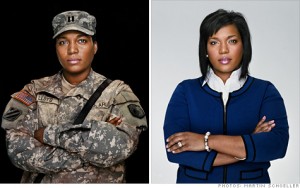
Battle-tested: From soldier to business leader
“The thinking was that we could bring in world-class leadership talent that was already trained and ready to go,” says Jennifer Seidner, a senior recruiting manager at Wal- Mart. “And then we could teach them retail, because we know that pretty well.”
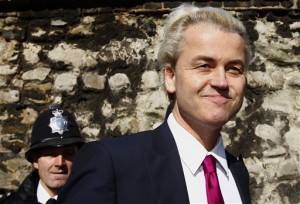
Phi Beta Iota: This website is focused on public intelligence in the public interest and strives to avoid favoring any specific policy proiposition. Our view is that an informed public is a nation's greatest strength. When we post information that takes a strident position, it is for informational purposes, not as an endorsement. Below, linked from the photograph, is a speech delivered in the House of Lords of the British Parliament.
Geert Wilders
EXTRACT: Ladies and gentlemen, I don’t have a problem and my party does not have a problem with Muslims as such. There are many moderate Muslims. The majority of Muslims are law-abiding citizens and want to live a peaceful life as you and I do. I know that. That is why I always make a clear distinction between the people, the Muslims, and the ideology, between Islam and Muslims. There are many moderate Muslims, but there is no such thing as a moderate Islam.
Islam strives for world domination. The Quran commands Muslims to exercise jihad. The Quran commands Muslims to establish shariah law. The Quran commands Muslims to impose Islam on the entire world.
Germany- Russia: German Chancellor Angela Merkel said today that Russian President Medvedev should discuss his security initiative “within the framework” of the Organization for Security and Cooperation in Europe, RIA Novosti reported. Merkel said, “President Medvedev and I spoke by telephone last week and we reiterated that we should discuss his initiative on partnership in the security sphere.”
Note: The Russians are proposing a new European security treaty that rivals and might eventually replace NATO, but with Russia, Germany and France as the new leaders. The Germans plus some of the original NATO members appear to want more balance in their foreign relations, meaning they appear to be seeking to reduce their subservience to the US by establishing offsetting relations with Russia.
While that might seem odd, that is the way it looks. Even stranger is that the US is presented as supporting European NATO’s call for a withdrawal of nuclear weapons from western Europe, potentially leaving Russia and Frances as the only states possessing nuclear weapons in Europe. Of course, the French will not dismantle their nuclear weapons, even while they support withdrawal of American weapons.
US actions in Iraq and Afghanistan in the past nine years have forced the maturation of relations and attitudes in Europe and Asia. The security regime of the post-World War II era is finally ending, albeit slowly and a decade after it should have ended.
US strategic planners need to be thinking about the implications of being first among equals, more than of being the only superpower.
Society of Competitive Intelligence Professionals (SCIP) has jbeen the force behind the world’s largest annual gathering of the competitive intelligence community: This year we are proud to mark our 25th Silver Anniversary.
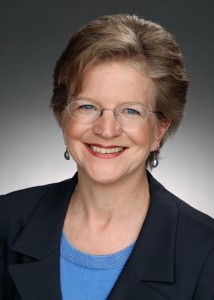
Mary Ellen Bates, president and founder of Bates Information Services is one of the nation's leading experts in customized information research (also known as information brokering) and effective, thorough, and no-nonsense training for corporate researchers and knowledge workers. She also provides detailed consulting and hands-on business coaching for professionals seeking to enter the field of information brokering.
Bates' impressive credentials include a diverse array of research commissions, ranging from assessing the outlook for the pre-fab housing industry in Europe and Japan to studying recent high-tech developments in the grocery industry, and more. She also has written or co-written six books and close to 300 by-lined articles and white papers on various aspects of research and information gathering. In addition, Ms. Bates is a skilled and lively speaker, with more than 250 speaking engagements to her credit since 1993.
In her spare time, Bates is an amateur photographer and a dedicated marathon runner. In the past 10 years, she has completed 15 marathons, and continues to hone her skills in the training and strategy work required for long-distance running.
Phi Beta Iota: MEB as some call her, is a SUPER-SEARCHER, along with Reva Bausch, now retired, perhaps the absolute best in the USA–it would be fun to see her and Arno Reuser having a duel, but more likely they would just be ga-ga with one another's skills. She pioneered cost-effective citation analysis using the DIALOG File 7 (Social Science Citation Index) and a program she personally constructed that OSS.Net, Inc. used to idnetify the top people in the world across a very wide variety of threat and policy domains. She is unique, and we are are over-joyed to know, still going strong.
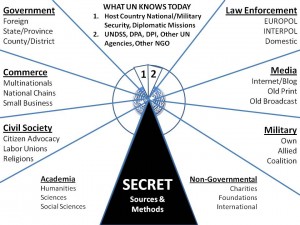
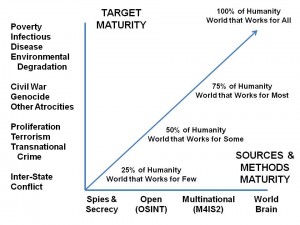
Phi Beta Iota: We are detecting a fascinating evolutionary process within the United Nations “system” which is not a system at all, more like an archipelago with a different cat in charge of each island. Information-sharing is coming into vogue, but more importantly, the United Nations, perhaps stimulated by the report of the United Nations High-Level Panel on Threats, Challenges, and Change, A more secure world: our shared responsibility, appears to finally be realizing that all threats are connected and that poverty is the foundation for all of the other threats thriving–one cannot defeat transnational crime (threat #10) without first addressing poverty (threat #1).
With the top United Nations anti-drug official urging concerted global action to “break the vicious circle between insecurity and underdevelopment” being increasingly fuelled by criminal networks, drug smugglers and human traffickers, the Security Council today called on the world body’s Member States to increase international and regional cooperation to tackle transnational organized crime.
The Council invited Secretary-General Ban Ki-moon, who opened today’s meeting, to consider transnational threats as a factor in conflict prevention strategies, conflict analysis, integrated missions’ assessment and planning and to consider including in his reports, as appropriate, analysis on the role played by those threats in situations on the Council’s agenda. [Phi Beta Iota: Emphasis Added.]
UNITED NATIONS (Reuters) – International criminal gangs and traffickers are exploiting large geographic blind spots where radar, satellite or other surveillance is minimal or nonexistent, the U.N. crime and drugs czar said on Wednesday.
Antonio Maria Costa, head of the Vienna-based U.N. Office on Drugs and Crime (UNODC), told members of the 15-nation U.N. Security Council that countries must improve their systems of sharing intelligence to reduce these surveillance gaps.
“We need a change in attitude,” Costa told the council. “It is time to regard information sharing as a way of strengthening sovereignty, not surrendering it.”

 A C-130 was lumbering along when a cocky F-16 flashed by.
 The C-130 droned along for about 5 minutes and then the C-130 pilot came back on and said, “What did you think of that?”