Berto Jongman: Existential Risk to Humanity

Collective Intelligence, Commercial Intelligence, Cultural Intelligence, Ethics
Berto Jongman
Berto Jongman

How are humans going to become extinct?

By Sean Coughlan

EXTRACT

Dr Bostrom believes we've entered a new kind of technological era with the capacity to threaten our future as never before. These are “threats we have no track record of surviving”.

Lack of control

Likening it to a dangerous weapon in the hands of a child, he says the advance of technology has overtaken our capacity to control the possible consequences.

Experiments in areas such as synthetic biology, nanotechnology and machine intelligence are hurtling forward into the territory of the unintended and unpredictable.

Synthetic biology, where biology meets engineering, promises great medical benefits. But Dr Bostrom is concerned about unforeseen consequences in manipulating the boundaries of human biology.

Nanotechnology, working at a molecular or atomic level, could also become highly destructive if used for warfare, he argues. He has written that future governments will have a major challenge to control and restrict misuses.

There are also fears about how artificial or machine intelligence interact with the external world.

Such computer-driven “intelligence” might be a powerful tool in industry, medicine, agriculture or managing the economy.

But it also can be completely indifferent to any incidental damage.

Continue reading “Berto Jongman: Existential Risk to Humanity”

Berto Jongman: 25 Things to Know About the Future

Commercial Intelligence
Berto Jongman
Berto Jongman

25 Things You Need to Know About the Future

Watch video      Buy Kindle

How will we live in the future? And what will the human race become? Will we nurture designer babies, be served by intelligent robots, have personal 3D printers, and grow products on-the-vine using synthetic biology? Or will shortages of oil, fresh water and other natural resources constrain our lifestyles and lead to industrial decline?

Amazon Page
Amazon Page

In this fascinating guide, futurist Christopher Barnatt examines 25 known challenges and technologies that will help shape the next few decades. From Peak Water to vertical farms, nanotechnology to augmented reality, and electric cars to space travel, a startling picture is painted of future possibilities that no individual or business will be able to ignore.

Highlighting life-changing research and innovation from over 250 companies, universities and non-profit organizations around the globe, 25 Things You Need to Know About the Future is a startling, frightening and powerful blueprint for anybody who wants to future gaze and future shape.

Published on 19th January 2012 by Constable & Robinson in paperback and e-book formats. 416 pages. A Korean translation was published on 21st November 2012.

Click any part or chapter below for more information and online references.

Continue reading “Berto Jongman: 25 Things to Know About the Future”

Jean Lievins: The Economist Rocks, Sharing Economy Highlighted

03 Economy, 11 Society, Collective Intelligence, Commercial Intelligence
Jean Lievens
Jean Lievens

Economist: Sharing Economy

All Eyes on the Sharing Economy

Collaborative consumption: Technology makes it easier for people to rent items to each other. But as it grows, the “sharing economy” is hitting roadblocks

By The Economist, March 9 2013.

WHY pay through the nose for something when you can rent it more cheaply from a stranger online? That is the principle behind a range of online services that enable people to share cars, accommodation, bicycles, household appliances and other items, connecting owners of underused assets with others willing to pay to use them. Dozens of firms such as Airbnb, which lets people rent out their spare rooms, or RelayRides, which allows other people to rent your car, act as matchmakers, allocating resources where they are needed and taking a small cut in return.

Read full article.

Phi Beta Iota:  The Economist is the first mainstream media source to open up to the emergent possibilities.  There are three major changes being facilitated by the Internet and the related applications, generally those that are NOT proprietary, NOT owned by a major corporation, and NOT predatory:

01  Collaborative Sharing  of products, services, and places

02  True history of products, services, and places (e.g. “my fish today”)

03  True cost of products, services, and behaviros.

It is the last one that is awaiting a major breakthrough that combines the open source crisis making and global diaspora translation and posting, with the still missing heavy lifting of research such as was done for a single cotton T-shirt.

See Also:

Graphic: True Cost of a Cotton T-Shirt

John Robb: The Future of Food — Total Transparency & The Beginning of True Cost Economics

01 Agriculture, 03 Economy, 03 Environmental Degradation, 07 Health, 11 Society, Advanced Cyber/IO, Civil Society, Commerce, Commercial Intelligence, Ethics, Liberation Technology, True Cost Meme
John Robb
John Robb

Here's How to Build a More Resilient Food System…

By John Robb

Want to get a glimpse of the future of food?

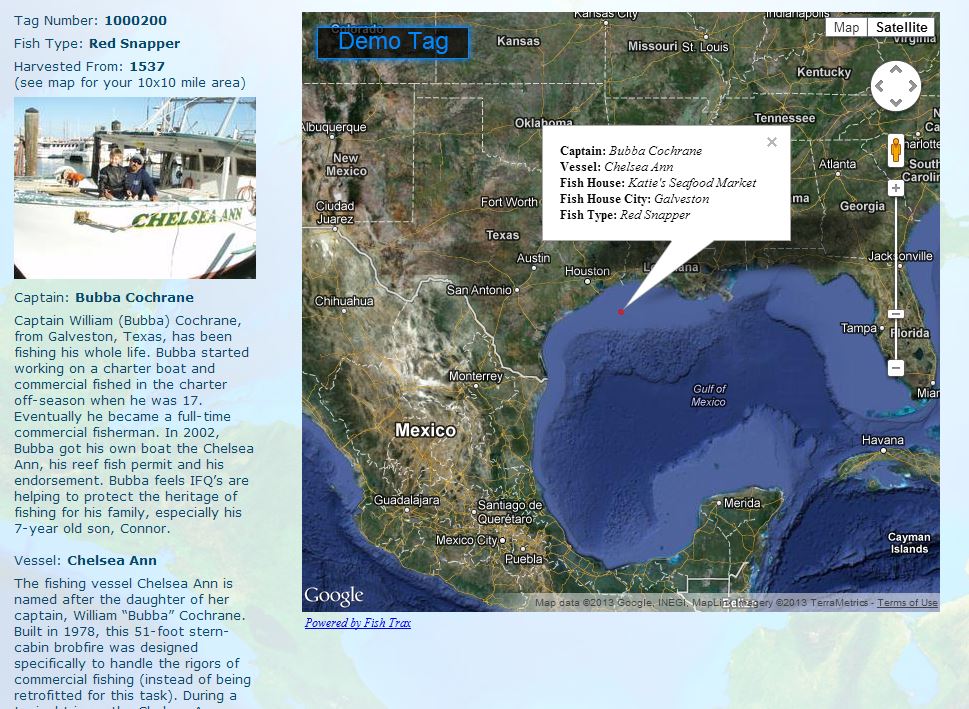
This is the page from Gulf Wild program. When you buy a fish that has a Gulf Wild ID number on it, you can find out everything about it.

Simply enter this ID number on their website or (cell phone) and it will provide you with:

Click on Image to Enlarge
  1. The bio and history of the fisherman who caught the fish.
  2. What the fish is, where the fish was caught (with a map) down to 10 miles, and when it was caught.
  3. Info on fishing practices (e.g. was it caught as part of a sustainable fisheries program?).

NOTE: Canada has a similar program called “This Fish

I believe we're going to see programs like this for all of the food (and an increasing number of products) we buy, from meats to vegetables.

Why? Info like this is addicting. Once you get it, you want it on everything.

Fortunately, it's also really easy to put a service like this together for local producers, and that's a good thing.

Here's why: This type of insight would positively differentiate fresh, high quality local produce from the generic products of indefinite age, quality, and origin we get from the global industrial system.

That would be a good thing, since it would help make local food more plentiful and that makes us ALL more resilient.

Resiliently Yours,
JOHN ROBB

Cheery Waves: Mapping the Abuse of Power

Commercial Intelligence, Cultural Intelligence
Cheery Waves
Cheery Waves

The format is too confining to me with all that info appearing all at once but it's a good start and good to see people emerging who are working to map the abuse of power and how to regain control of our “collective future.”

The Ultimate History Lesson — Knowledge Map

Centered on Cybernetics.

Phi Beta Iota:  Caveat —  Wikipedia is a controlled asset.  Most of the pages that matter are being actively manipulated by corporations with vested interests in retarding public intelligence and public access to both the truth and to connections among cause and effect, true cost of goods, etcetera.

Rickard Falkvinge: Swarm Economy and BitCoin, Plus Pirate (People’s) Parties Rising in Iceland & Croatia

03 Economy, Commercial Intelligence, Cultural Intelligence, Money, P2P / Panarchy
Rickard Falkvinge
Rickard Falkvinge

Why Expensify Endorsing Bitcoin Is A Really Big Deal: Social Virality

Swarm Economy: Yesterday, news broke that the Expensify service has enabled bitcoin payments. With the rapidly expanding number of businesses accepting bitcoin as payment method, one could think that this was merely another player in the pool of bitcoin’s expanding economy (which just broke the one-billion-USD barrier, by the way). But Expensify is something much more than that.

Let’s first discuss the concept of expense reports to understand Expensify’s important role in the subsurface payments ecosystem. On all companies I’ve worked for lately, you don’t ask the company to buy something you need for your work – it’s just too much paperwork, too much red tape to make it happen. Instead, you get a small budget for discretionary stuff you need to do your job, and you just buy stuff as you need it with your private credit card, send in the receipts to your employer, and get reimbursed on the next paycheck, which arrives before the credit card bill is due.

This system is pervasive and ubiquitous. Sending in receipts for payment like this is known as submitting an expense report. It’s still bureaucracy and red tape and it still sucks, but it sucks considerably less than asking for approval in advance.

Enter Expensify, a service that markets itself straightforwardly as “Expense reports that don’t suck”. I’ve been using Expensify through its development for the past couple of years and have also contributed my use case (frequent travel outside of internet coverage), which led them to implement important new features – meaning, they’re a responsive bunch, too.

Read full article.

Related:

Two More Pirate Parties On Cusp Of Electoral Success: Iceland, Croatia

Rickard Falkvinge: Banks Lose Public Trust, Run on Banks Looming

Commerce, Commercial Intelligence, Corruption, Government

Rickard Falkvinge
Rickard Falkvinge

After Cyprus, New Tolls For The Euro

Reflections: After the attempted tolls on bank savings in Cyprus for saving the Euro, a new kind of tolls can be heard in the distance for the currency. The fundamental trust in the currency as a store of value has been broken, according to multiple signs across Europe. Even with the Cypriot parliament backpedaling frantically, the situation appears snowballing – there could be a bank run in two weeks.

. . . . . . . . .

In the past days with the Cypriot bailout measure, these first signs of a currency collapse scenario have materialized. People are now actively seeking to trade off their Euros, no longer trusting them as a store of value. When this has happened in the past to currencies, they have not survived.

Read full article.

noble gold