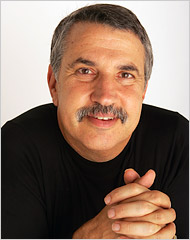
Tom Friedman: Four Things Wanted from a Winning President

Cultural Intelligence

American Voters: Still Up for Grabs

By

New York Times, January 21, 2012

A Washington Post-ABC News poll released on Friday found that two-thirds of Americans would consider voting for a third-party presidential candidate, while 48 percent definitely wanted a third party in the race. Now what does that tell you? It tells you that with the campaign about to go into full swing, as the president delivers his State of the Union address next week, voters are still casting about for a leader with a winning message. I can save both parties a lot of money. I am one of those voters, and I can tell you exactly for whom I want to vote — and I don’t think I’m alone.

I want to vote for a candidate who advocates an immediate investment in infrastructure that will create jobs and upgrade America for the 21st century — ultrafast bandwidth, highways, airports, public schools, mass transit — and combines that with a long-term plan to fix our fiscal imbalances at the real scale of the problem, a plan that could be phased in as the economy recovers.

. . . . . . . .

Second, I want to vote for a candidate who is committed to reforming taxes, and cutting spending, in a fair way. The rich must pay more, but everyone has to pay something. We are all in this together.

Third, I want to vote for a candidate who has an inspirational vision, not just a plan to balance the budget.

. . . . . . .

Finally, I want to vote for a candidate who supports a minimum floor of public financing of presidential, Senate and House campaigns. Money in politics is out of control today. Our Congress has become a forum for legalized bribery. Americans are losing faith in the instruments of government because they think the game is rigged by big money — and they’re right.

Any candidate with that four-part agenda would win — and so would the country, because he would win with a mandate to do what needs doing.

Read full article.

Phi Beta Iota:  Friedman makes four sensible points.  He has absolutely no clue what is going on outside the two-party tyranny, nor does he have any clue (or he is actively dishonest) with respect to everything that needs to happen to restore integrity to our electoral system–money is the LEAST of our problems in relation to ballot access and gerrymandering and electronic fraud– but his four points stand on their own as a useful contribution.  Learn more at We the People Reform Coalition.

Penguin: Gabriel Kolko on CIA’s Contradictions / Cassandras

10 Security, Blog Wisdom, Corruption, Cultural Intelligence, Government, IO Impotency, Officers Call
Who, Me?

GABRIEL KOLKO is the leading historian of modern warfare. He is the author of the classic Century of War: Politics, Conflicts and Society Since 1914 and Another Century of War?. He has also written the best history of the Vietnam War, Anatomy of a War: Vietnam, the US and the Modern Historical Experience.

Paid to be Ignored

The CIA’s Cassandras

GABRIEL KOLKO

Counterpunch, 20-21 January 2012

At no time has the U.S. based its foreign policies on facts — as opposed to its conceptions reliant on sheer wishes, interests, or pretensions, (its ambitions are often a mixture of all of these). Nor has it had fears that are warranted by reality. It has needs, whether economic or geopolitical. It has, however, often had the correct intelligence and the facts before it to warrant entirely different policies on its part.  At the same time as it gets into tenuous military situations, situations it is often destined to lose and pay a great deal for while in the process of doing so, it employs people to produce rational analyses—which it then ignores.  Why?

Read full article.

Phi Beta Iota:  This is one of the longest, most cogent pieces we have seen on the internal and external contradictions inherent in the CIA archipelago of contrasting functions, values, and marginal outputs.  It is totally consistent with the many books reviewed here on intelligence.

Jon Lebkowsky: The Meaning of the Internet Blackout

Advanced Cyber/IO, Blog Wisdom, Civil Society, Cultural Intelligence, Ethics
Jon Lebkowsky

JOHO: Messages from the Dark

At “JOHO the Blog,” David Weinberger has a simple and very cool summary of the meaning of yesterday’s SOPA-induced blackout. “This is our Internet. We built it. We built it for us, not for you. We get to turn off the lights, not you.” Yes, indeed. It took a long time for the the Internet to smell like money to those folks who like that smell more than they like the smell of creativity, innovation, fellowship, commons, etc. Now it’s a platform for all media in digital formats that are easily replicated, therefore distribution is hard to control. Much of what flows across the Internet is freely shared by its creators, and there’s also channels for media that people pay for (like Netflix). A system that facilitates all that sharing, along with a high degree of interactivity, also makes it easy to do the natural sort of sharing that peopel will inherently do. Content providers could spend less time figuring out how to stop sharing, and more time figuring out how to build a business model that works in a social/sharing environment.  People who invest time and money in media creation and production have a right to charge for it, but we need to rethink how that works in the 21st century networked world.

Four messages from the dark

Posted on:: January 19th, 2012

The black that covered so many sites yesterday spoke well. I think there were four messages.

First, This is our Internet. We built it. We built it for us, not for you. We get to turn off the lights, not you.

Second, we are better custodians of culture than are culture’s merchants because we understand that culture is what we have in common. We feel pain every time something is held back from this Commons.

Third, just as we can make someone famous rather than having to passively accept the celebrities you foist upon us, we can make an idea politically potent. Going dark was the self-assertion with which political engagement begins.

Fourth, there’s a growing “we” on the Internet. It is not as inclusive as we think, it’s far more diverse than we imagine, and it’s far less egalitarian than we should demand. But so was the “we” in “We the People.” The individual acts of darkness are the start of the We we need to nurture.

Bojan Radej: God Loves the 1% – They Tell Us So

Corruption, Cultural Intelligence

For God So Loved the 1 Percent…

By KEVIN M. KRUSE

New York Times, 17 January 2012

EXTRACT:

Realizing that they needed to rely on others, these businessmen took a new tack: using generous financing to enlist sympathetic clergymen as their champions. After all, according to one tycoon, polls showed that, “of all the groups in America, ministers had more to do with molding public opinion” than any other.

Read full article.

Phi Beta Iota:  The 1% actually believe in “survival of the fittest” and earnestly consider most humans to be less than human, mere animals to be exploited as is their God-given right.  Religions that regard others as heathen–this includes the Catholic, Islamic, Jewish, and Mormon religions–that “do not count,” are as corrupt as the governments they join in serving the 1%.  Sluts lack integrity.  It's time we stop following sluts, be they securlar or sanctimonious.

See Also:

2012 Reflexivity = Integrity: Toward Earth/Life 4.0

George Soros Nails It: Intelligence with Integrity

Journal: Politics & Intelligence–Partners Only When Integrity is Central to Both

Reference: Cyber-Intelligence–Restore the Republic Of, By, and For…

Reference: Empire of Lies & Secrecy

Review: Who’s To Say What’s Obscene – Politics, Culture, and Comedy in America Today

Search: Integrity

Angelo Codevilla: Who Rules America?

07 Other Atrocities, 09 Justice, 10 Transnational Crime, 11 Society, Blog Wisdom, Civil Society, Commerce, Corruption, Counter-Oppression/Counter-Dictatorship Practices, Cultural Intelligence, Government, IO Impotency, Officers Call
Angelo Codevilla

America's Ruling Class — And the Perils of Revolution

Angelo M. Codevilla

American Spectator, July-August 2010

The only serious opposition to this arrogant Ruling Party is coming not from feckless Republicans but from what might be called the Country Party — and its vision is revolutionary. Our special Summer Issue cover story.

Read full article.

Integral to the above piece:

Who Rules America: Power Elite Analysis and American History

by Charles A. Burris

Lou Rockwell.com, 18 January 2012

When Codevilla’s article appeared I stated that it was the most important essay I had ever read. I still believe this because it is a superb synthesis of class analysis with keen insights on contemporary power elite relationships regarding today’s rulers and the ruled.

This class division of present-day America into two factions, Court and Country, has absolutely nothing to do with any Marxian view or analysis. It is a reaffirmation of the seminal insights of Bernard Bailyn’s Pulitzer Prize winning volume, The Ideological Origins of the American Revolution, and Murray N. Rothbard’s Conceived in Liberty.

These books demonstrate that the Founders’ world-view saw the crucial struggle of the Revolution as a battle of liberty versus power. Codevilla posits today’s battle in the same dramatic terms.

Read full article.

Codevilla’s Not-Quite Manifesto

Gary North

American Vision, 8-15 January 2012

Every political movement needs a manifesto.  The Tea Party surely needs one.  So do other grassroots political resistance organizations.  They don’t have it yet, but they now have its preliminary foundation, Angelo Codevilla’s essay, “America’s Ruling Class — And the Perils of Revolution.”

. . . . . . .

I regard this essay as the finest statement on the two-fold division in American political life written in my lifetime — more than this, in the last hundred years.  He has laid it out clearly, accurately, and eloquently.

. . . . . . .

Codevilla correctly identifies the source of legitimacy for the ruling class: Darwinism.  Darwinism removed God from the vocabulary of self-accredited academia.  Once liberated from the doctrine of original sin, the Progressives regarded as illegitimate the Constitutional limits placed on the Federal government.

Read full article.

Printable Paginated Safety Copies:

» 2012-01-18 Gary North on Angelo Codevilla,
Download file: 2012-01-18 Gary North on Angelo Codevilla.doc
» 2012-01-18 Charles Burris on Who Rules America,
Download file: 2012-01-18 Charles Burris on Who Rules America.doc
» 2012-01-18 Codevilla America's Ruling Class,
Download file: 2012-01-18 Codevilla Americas Ruling Class.doc

Theophillis Goodyear: Sign the Pledge – Die Off for Humanity

Cultural Intelligence, Earth Intelligence
Theophillis Goodyear

Sign the Pledge! Volunteer to “Die Off” for the Good of Humanity

Eagle: Ron Paul an Intellectual Revolution? Who Cares?  said: “The way we live, work and play–all soon to be extinct, buried in the ground never to be seen again unless humans die off and just a few of us are left to start over.”

That's about the most idiotic argument I've ever heard. Humanity can only survive if most of us die? That's literal nihilism. Anyone who could make that kind of statement has completely run out of ideas and has no business telling anyone how to make the world a better place—–because they've already given up. It makes the kind of “doublethink” in the novel 1984 seem like profound wisdom by comparison. If humanity wants to survive we all need to die? Even the brainwashed citizens of Oceania wouldn't fall for that one; which makes me wonder why Eagle seems to have accepted it as a self-evident truth.

That argument not only accepts a dismal prophecy as an absolute certainty—–based on nothing more than an assertion—–it implies that we shouldn't even try to avoid our own extinction. We should embrace it! I wonder if the poster realizes what that statement reveals about his/her psychology? First, since most people want to keep living, Eagle is either suicidal or a blatant misanthrope who sees his fellow human beings as obstacles to a brighter future.

This is an irrational notion that many people subscribe to, at least subconsciously, in one way or another, but usually not to such an absurd degree. Democrats dream of that “great day” when Republicans magically disappear. Republicans dream of that “great day” when Democrats magically disappear. The Nazis dreamed of that “great day” when Jews would magically disappear. But just in case it didn't happen naturally, they though they would help it along a little.

I would like to know if Eagle is planning to sacrifice his/her life so that the remaining “few” can live? Of course it doesn't really matter. If humankind has gotten to the point where we would be happier if most of us died, then humanity is already doomed. If that's the extent to which we care about out fellow human beings, then perhaps we don't deserve to survive as a species.

Wishing that the majority of humanity would just die off, to me, is genocide by default. It's like saying to our fellow human inhabitants of the earth: “We don't care where you go, but you can't stay here.” If we all had that mindset, saving humanity would be impossible. It's what is known as a self-fulfilling prophecy. And since the prophecy is human extinction, forgive me if I don't bow down and worship the prophet.

I have a sneaky suspicion that this absurd mindset is somehow related to anarchy. If so, anarchists are not only bereft of workable solutions, they've mentally excluded them as even remote possibilities! If the best they can offer humanity is extinction, who needs them? I would be the first to stand aside and allow them to sign the pledge to commit suicide for the sake of the rest of humanity.

Venessa Miemis: Intentcasting an Epic Vision – How to Bootstrap Creative Economy 3.0

Cultural Intelligence
Venessa Miemis

Intentcasting an Epic Vision: How to Bootstrap Creative Economy 3.0

Q: How do the Amish raise a barn without money?

A: Community, and the social capital that weaves it together.

In my husband’s Latvian community, they have a concept similar to barnraising called “talka,” which describes collective volunteer work for the good of society and environment.

Several times a year we come together at our camp in the Catskill Mountains, and everybody chips in to maintain the property – clearing branches, building bridges, fixing roofs, painting, and whatever else needs to get done. No one gets paid for it (unless you count food, beer, and bonfires as payment), yet everyone helps.

Why?

Because we’re invested in ourselves and each other and are stakeholders in our community and believe that preserving and cultivating our culture matters.

So. How does that ethic translate to online community, and can we show that we have one?

**Let’s intentcast to bootstrap Creative Economy 3.0**

Read full article.

noble gold