SmartPlanet: Should Bus Fares Go Away — What Is True Cost of Fares, and True Falue of Optimzing Public Transport Use?

Commercial Intelligence

smartplanet logoShould bus fares be free?

By | June 20, 2013

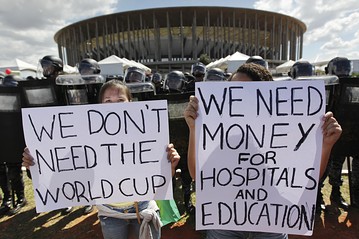
As bus fare hikes in Brazil helped spark the largest protests that the country has seen in 20 years (those fare hikes have since been reversed in Sao Paulo and Rio de Janeiro), The Economist has a provocative proposition: make buses free.

They come to this conclusion looking at the proof-of-payment fare-collection systems that many transit systems have adopted as a way to make transit systems more efficient. But The Economist says that making transit free would take that efficiency a step further. Here’s the argument:

Fares bring in a lot of money, but they cost money to collect—6% of the MTA’s budget, according to a 2007 report in New York magazine. Fare boxes and turnstiles have to be maintained; buses idle while waiting for passengers to pay up, wasting fuel; and everyone loses time. Proof-of-payment systems don’t solve the problem of fare-collection costs as they require inspectors and other staff to handle enforcement, paperwork and payment processing. Making buses and subways free, on the other hand, would increase passenger numbers, opening up space on the streets for essential traffic and saving time by reducing road congestion.

Transit systems aren’t cheap so, of course, the lost fare revenue would have to be made up somehow. That can be done in a number of ways: a congestion charge for cars entering dense downtowns; funneling money from downtown parking into transit; or getting private sponsorships.

Continue reading “SmartPlanet: Should Bus Fares Go Away — What Is True Cost of Fares, and True Falue of Optimzing Public Transport Use?”

SchwartzReport: US Supreme Court Unethical & Corrupt — As with the Congress, the Time to Flush the Court is Now

Corruption, Cultural Intelligence, Government, Law Enforcement

schwartz reportThis is why the appointment of Supreme Court Justices matters so much. We now have a court which routinely favors corporations over individuals. Here is their latest decision, part of the Legalization Trend. Increasingly monopolistic practices that would previously have been illegal, are now the law of the land. We are becoming a country wh! ere corporate influence makes illegal things legal so that vassal politicians, and corporations can say, “They/we broke no laws. Everything they/we are doing is perfectly legal.”

In Major Blow To Consumers, Supreme Court Protects Mega-Corporations From Liability
NICOLE FLATOW – Think Progress

Continue reading “SchwartzReport: US Supreme Court Unethical & Corrupt — As with the Congress, the Time to Flush the Court is Now”

NIGHTWATCH: Middle Class Youth Turn Violent — Government Remains Corrupt and Ignorant

01 Brazil, Civil Society, Collective Intelligence, Cultural Intelligence, Ethics, Government
Click on Image to Enlarge

Brazil: The demonstrations are starting to turn violent. The day after the government revoked the transportation fare increases the demonstrations swelled again and engaged in more aggressive clashes with police.

President Dilma Rousseff decided to call off a visit to Japan that was planned for next week. The forthcoming visit by Pope Francis might also have to be rescheduled if the demonstrations continue.

In Rio de Janeiro riot police fired tear gas and rubber bullets at groups of masked young men trying to approach the City Hall late on Thursday. At least 29 people were reported to be injured in the clashes.

Some reports suggest about 300,000 people were taking part in an anti-government rally in the city. One news service reported more than 800,000 people participated in demonstrations in the major Brazilian cities

Comment: The polling agency, Datafolha, published its findings from a poll of the demonstrators in Sao Paulo yesterday. More than half of the demonstrators are under 25. Seventy-seven percent have higher education. Eighty-four percent back no political party, suggesting they do not vote.

The dominant issue for more than half was the fare increase which has been withdrawn. Corruption, a better transportation system, against all politicians and against violence and repression were distant other issues.

What the poll and anecdotal reports indicate is that the beneficiaries of Brazilian prosperity are protesting. The poll found no poor or disadvantaged people and few unemployed among the protestors. Brazil has low unemployment even for workers under age 25. The protestors have no organization or leadership. They gather by cell-phone notification. Expect the demonstrations to expand this weekend and become more violent.

Continue reading “NIGHTWATCH: Middle Class Youth Turn Violent — Government Remains Corrupt and Ignorant”

John Robb: Canada Makes It Illegal to Wear Masks — Reflections on the Loss of Government Legitimacy (and Sanity) — Beards May Be Next…

Cultural Intelligence, Government, Idiocy, Law Enforcement
John Robb
John Robb

Canada Makes the Automation of Tyranny Easier

Here's a sign of the times.  Canada has made wearing a mask at a protest a crime.

Why did they do this?   It makes it easier for police to ID people using CCTV and social media photos after a protest occurs.

It also makes it easier to assemble a database of facial portraits, that can be run through rapidly improving facial recognition software, so everyone involved in the protest can be IDed and the information stored in a database, for use in the future.

For me, it's another sign that the big, cumbersome nation-state is in decline.

Decline?

First of all, don't confuse decline with collapse.  The decline of the nation-state doesn't mean it's going away entirely.

Like the feudal system before it, it's got a long life ahead of it (much of it at our expense).

The nation-state's rise to power and innevitable decline reads like a Greek tragedy. The nation-state became globally ubiquitous due to its ability to militarily crush all competitive forms of governance.  That competition was eventually won in the last century, and nuclear weapons seal the peace.  Large scale conventional conflict is now something for the history books (despite the occasional sideshows like Iraq).

However, this success means that the nation-state has lost its raison d'etre, its reason for being.  There aren't any external competitors for the nation-state left to crush, despite a voracious desire to do so.

This loss of legitimacy and an creeping economic impotence (in almost all cases in developed world, they haven't delivered prosperity to most citizens in decades) has led to a gnawing fear within political and bureaucratic elites.  A fear that they are losing control.  A paranoia that turns every citizen into a potential enemy of a nation-state that requires enemies in order to justify its existence.

Continue reading “John Robb: Canada Makes It Illegal to Wear Masks — Reflections on the Loss of Government Legitimacy (and Sanity) — Beards May Be Next…”

David Swanson: Ten Problems with War on Syria

Peace Intelligence
David Swanson
David Swanson

10 Problems with the Latest Excuse for War

If you own a television or read a newspaper you've probably heard that we need another war because the Syrian government used chemical weapons.

If you own a computer and know where to look you've probably heard that there isn't actually any evidence for that claim.

Below are 10 reasons why this latest excuse for war is no good EVEN IF TRUE.

1. War is not made legal by such an excuse.  It can't be found in the Kellogg-Briand Pact, the United Nations Charter, or the U.S. Constitution.  It can, however, be found in U.S. war propaganda of the 2002 vintage.  (Who says our government doesn't promote recycling?)

Click on Image to Enlarge

2. The United States itself possesses and uses internationally condemned weapons, including white phosphorus, napalm, cluster bombs, and depleted uranium.  Whether you praise these actions, avoid thinking about them, or join me in condemning them, they are not a legal or moral justification for any foreign nation to bomb us, or to bomb some other nation where the U.S. military is operating.  Killing people to prevent their being killed with the wrong kind of weapons is a policy that must come out of some sort of sickness.  Call it Pre-Traumatic Stress Disorder.

3. An expanded war in Syria could become regional or global with uncontrollable consequences.  Syria, Lebanon, Iran, Russia, China, the United States, the Gulf states, the NATO states . . . does this sound like the sort of conflict we want?  Does it sound like a conflict anyone will survive?  Why in the world risk such a thing?

Continue reading “David Swanson: Ten Problems with War on Syria”

Neal Rauhauser: Transcript of Meeting Between Julian Assange and Eric Schmidt with Department of State Staff

Commercial Intelligence, Cultural Intelligence
Neal Rauhauser
Neal Rauhauser

All sort of stuff popping up today.  Worth a complete and careful reading.

Transcript of secret meeting between Julian Assange and Google CEO Eric Schmidt

Friday April 19, 2013

On the 23 of June, 2011 a secret five hour meeting took place between WikiLeaks publisher Julian Assange, who was under house arrest in rural UK at the time and Google CEO Eric Schmidt.

Also in attendance was Jared Cohen, a former Secretary of State advisor to Hillary Clinton, Scott Malcomson, Director of Speechwriting for Ambassador Susan Rice at the US State Department and current Communications Director of the International Crisis Group, and Lisa Shields, Vice President of the Council on Foreign Relations.

Schmidt and Cohen requested the meeting, they said, to discuss ideas for “The New Digital World”, their forthcoming book to be published on April 23, 2013.

We provide here a verbatim transcript of the majority of the meeting; a close reading, particularly of the latter half, is revealing.

You can download the recording here (ogg)


[beginning of tape]

Complete Transcript Below the Line

Jean Lievens: Social Media Killing Peer-to-Peer

Collective Intelligence, Cultural Intelligence, IO Impotency
Jean Lievens
Jean Lievens

deadSwap Artistic Statement

A major impact of the commercialization of the Internet has been the undermining of its peer-to-peer architecture. As Capital must always control the circulation of value in order to appropriate surplus, its champions view peer networks as a threat. The Web, although it sits on top of the Internet, is not a peer-to-peer technology but rather a client-server system where the interactions of the users are controlled and mediated by that site's operators.

With such centralization and control, the operators are in the position of capturing the value created by the users of these sites by way of selling this audience of users as a commodity to publishers of marketing and propaganda.

More importantly, the Capitalist-financed operators of such sites, can sell the data of the users, which often includes significant personal and demographic details, raw data for biometrics and detailed relationship graphs, to those that want to use this data to study, manipulate or control these users. These private, centralized services can also silence and lock out any user from participating or act to prevent any type of usage that is contrary to their own interests.

The new “Social Web” has fundamentally replaced the peer-to-peer Internet, and remaining peer communications technology has become marginal or even contraband as participants on peer networks face increasing legal attack and active sabotage from groups representing the interests of Capital.

The Internet is dead. In order to evade the flying monkeys of capitalist control, peer communication can only abandon the Internet for the dark alleys of covert operations. Peer-to-peer is now driven offline and can only survive in clandestine cells.

deadSwap is an offline file sharing system where participants covertly pass a USB stick from one to another. The route of the USB memory stick and the identity of the other participants is not known by the users but controlled by local, independently operated SMS gateways that are kept as a carefully shared secret by their users.

noble gold