John Steiner: THE GLOBAL MARCH TOWARD PEACE by Gareth Evans*

BTS (Base Transciever Station), Culture, Peace Intelligence, Resilience
John Steiner
John Steiner

A starting point for the new Secretaries of State and Defense.

THE GLOBAL MARCH TOWARD PEACE

by

Gareth Evans, Australia’s foreign minister for eight years and President Emeritus of the International Crisis Group, is currently Chancellor of the Australian National University and co-chair of the Global Center for the Responsibility to Protect. As Foreign Minister, he was at the forefront of recasting Australia’s relationship with China, India, and Indonesia, while deepening its alliance with the US, and helped found the APEC and ASEAN security forums. He also played a leading role in bringing peace to Cambodia and negotiating the International Convention on Chemical Weapons, and is the principal framer of the United Nations’ “responsibility to protect” doctrine.

Project Syndicate, 27 December 2012

CANBERRA – If we were hoping for peace in our time, 2012 did not deliver it. Conflict grew ever bloodier in Syria, continued to grind on in Afghanistan, and flared up periodically in West, Central, and East Africa. There were multiple episodes of ethnic, sectarian, and politically motivated violence in Myanmar (Burma), South Asia, and around the Middle East. Tensions between China and its neighbors have escalated in the South China Sea, and between China and Japan in the East China Sea. Concerns about North Korea’s and Iran’s nuclear programs remain unresolved.

Continue reading “John Steiner: THE GLOBAL MARCH TOWARD PEACE by Gareth Evans*”
Michel Bauwens: Noam Chomsky on Passionate Production

Commercial Intelligence, Cultural Intelligence
Michel Bauwens
Michel Bauwens

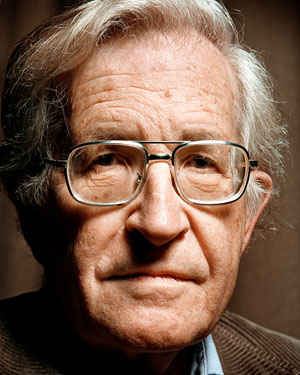
Noam Chomsky on Passionate Production

“The kind of work that should be the main part of life is the kind of work you would want to do if you weren’t being paid for it. It’s work that comes out of your own internal needs, interests and concerns.”

Excerpted from an interview with Noam Chomsky, conducted by Michael Kasenbacher:

(the full original has details on Noam Chomsky’s own career evolution)

MK:The philosopher Frithjof Bergmann says that most people don’t know what kind of activities they really want to do. He calls that ‘the poverty of desire.’ I find this to be true when I talk to a lot of my friends. Did you always know what you wanted to do?

Noam Chomsky
Noam Chomsky

NC: That’s a problem I never had – for me there was always too much that I wanted to do. I’m not sure how widespread this is – take, say, a craftsman, I happen to be no good with tools, but take someone who can build things, fix things, they really want to do it. They love doing it: ‘if there’s a problem I can solve it’. Or just plain physical labour – that’s also gratifying. If you work on command then of course it’s just drudgery but if you do the very same thing out of your own will or interest it’s exciting and interesting and appealing. I mean that’s why people look for work – gardening for example. So you’ve had a hard week, you have the weekend off, the kids are running around, you could just lie down to sleep but it’s much more fun to be gardening or building something or doing something else.

It’s an old insight, not mine. Wilhelm von Humboldt, who did some of the most interesting work on this, once pointed out that if an artisan produces a beautiful object on command we may admire what he did but we despise what he is – he’s a tool in the hands of others. If on the other hand he creates that same beautiful object out of his own will we admire it and him and he’s fulfilling himself. It’s kind of like study at school – I think we all know from our experience that if you study on command because you have to pass a test you can do fine on the test but two weeks later you’ve forgotten everything. On the other hand if you do it because you want to find out, and you explore and you make mistakes and you look in the wrong place and so on, then ultimately you remember.

Read full article (as excerpted).

Phi Beta Iota:  Peter Drucker defined work as a calling, not as labor — work should be a joy, a labor of love, not odious painful labor.

Tom Atlee: Quinn Norton at WIRED – Eulogy for #Occupy

Cultural Intelligence
Tom Atlee
Tom Atlee

Dear friends,

Over the last 15 months I posted many reflections on the Occupy movement. That movement is clearly not over, morphing into new shapes even as its most potent meme – “We are the 99%” – continues to reverberate.

Yet there was something about the original Occupy encampments – those intense micro-communities, living vibrant and threatened in our midst – that still haunts many of us. They were so mixed and extreme, strangely embodying the best and worst of who we are. Diverse people found them inspiring and disgusting, potent and pointless, overflowing with grit, authenticity, passion, pain and whimsy.

I want to share an article that captures a lot of that – the full spectrum of those intense contradictions – and courageously attempts to fathom the meaning of it all – for us, for the Occupiers, for our whole society.

http://www.wired.com/opinion/2012/12/a-eulogy-for-occupy/
“A Eulogy for #Occupy” by Quinn Norton, a Wired magazine reporter who embedded with Occupy Wall Street activists around the U.S. for a year and reported back on what she witnessed. In this article she reflects on what she saw, felt, heard and thinks about it all.

I found “A Eulogy for #Occupy” profoundly insightful and sensitive, exhibiting a rare integration of journalistic integrity, unflinching critique, and deeply personal vulnerability and compassion.

Phi Beta Iota:  This is a gifted report from the heart of America as a combat zone.  Extracts below the line for a quick read.

Continue reading “Tom Atlee: Quinn Norton at WIRED – Eulogy for #Occupy”

Theophillis Goodyear: Tsunami Bombs – Symptom of a World Gone Mad

Cultural Intelligence
Theophillis Goodyear

Tsunami Bombs: A Symptom of a World Gone Mad

From the article:

“A New Zealand author has rediscovered evidence of top secret tests carried out by the United States and New Zealand during World War II. The tests explored the creation of a ‘tsunami bomb' capable of flooding coastal cities of the Allies' enemies [and] according to the Telegraph, 3,700 bombs were detonated during testing that took place between 1944 and 1945 off the coast of New Caledonia and Auckland.”

Psychiatrist R. R. Laing was perhaps the most influential psychiatrist of the 20th century, after Freud. And although he was very controversial, he was also brilliant and enlightened and far ahead of his times in virtually every way. Laing came to the conclusion that what is wrong with human society is that it has gone mad, systemically. But it happened so long ago in human history that we don't see the madness today; we accept it as “just the way things are.” And it can be very hard to get people to see this, because madness has become the norm; and how can anything that's the norm be considered madness? Normally (no pun intended) we think of madness as being abnormal. But that's just it: it is sanity that has become abnormal in contemporary society. That's why it can be so hard to see the madness. It's like the old expression, “you can't get there from here.” As long as we see the madness as normal we can't get to sanity. In fact there's no reason to think we should even go there if we knew where it was.

Continue reading “Theophillis Goodyear: Tsunami Bombs – Symptom of a World Gone Mad”

Howard Rheingold: 24 Jan to 1 Mar Webinar on “Toward a Literacy of Cooperation: Introduction to Cooperation Studies”

03 Economy, 04 Education, 11 Society, Advanced Cyber/IO, Civil Society, Collective Intelligence, Cultural Intelligence, Gift Intelligence
Howard Rheingold
Howard Rheingold

We're convening “Toward a Literacy of Cooperation: Introduction to Cooperation Studies,”  January 24 -March 1.

A detailed syllabus: http://socialmediaclassroom.com/host/cooperation4

Cost: $300; $250 if you've taken a Rheingold U course before; $500 if your company reimburses you.

In addition to the monetary cost, a commitment to participate is required. The real magic is in learning the meta-skill of forming a learning community with strangers around the world in just a few weeks. To get the most out of this experience, you will need to devote 2-3 hours a week to reading, writing, mindmapping. It's the equivalent of a graduate-level seminar.

Read the syllabus carefully. Check the schedule. The reason I'm looking for learners three weeks early is that it works better if everyone gets a week or two head start on the readings. The community is limited to 35 learners. Although the syllabus is freely world-readable, the forums, blogs, and live-sessions are limited to committed participants. This will be the fourth time that this course has been convened. I've learned a great deal about facilitating this community from my co-learners along the way.If you are seriously interested, let me know, and I'll notify you when it's time to pay me via PayPal.

SchwartzReport: Genetic Modication – Case Study in Fraud, Waste, & Abuse Starting with Corruption of Information and Falsification of Intelligence

Commerce, Corruption, Earth Intelligence, Government, Knowledge

schwartz reportGenetic Engineering and the GMO Industry: Corporate Hijacking of Food and Agriculture

“I recognized my two selves: a crusading idealist and a cold, granitic believer in the law of the jungle” – Edgar Monsanto Queeny, Monsanto chairman, 1943-63, “The Spirit of Enterprise”, 1934.

When rich companies with politically-connected lobbyists and seats on government-appointed bodies bend policies for their own ends, we are in serious trouble. It is then that our democratic institutions become hijacked and our choices, freedoms and rights are destroyed. Corporate interests have too often used their dubious ‘science’, lobbyists, political connections and presence within the heart of governments, in conjunction with their public relations machines, to subvert democratic machinery for their own benefit. Once their power has been established, anyone who questions them or who stands in their way can expect a very bumpy ride.

The power and influence of the GMO sector

Read full article.

Continue reading “SchwartzReport: Genetic Modication – Case Study in Fraud, Waste, & Abuse Starting with Corruption of Information and Falsification of Intelligence”

Tom Atlee: Sandy Hook Reflections on Social Madness & Healing

Cultural Intelligence
Tom Atlee
Tom Atlee

Dear friends,

My friend and colleague Miki Kashtan has written a compelling article exploring the interconnectedness of personal, community and social dimensions of the Sandy Hook crisis,  “Adam Lanza and All of Us.”  I highly recommend the whole article, but for the purposes of this commentary, I want to highlight this excerpt:

“I see violence, and the specific problem of mass shootings, as a form of horrific and tragic feedback to society that we are not providing the conditions that allow people to thrive. I am troubled by what I see as medicalizing and individualizing a social problem, because I want the issue to be addressed on a societal level, and I worry that the individual lens will distract us away from the issues I want us to focus on…. I want to keep asking: what is happening on a larger scale that is affecting more and more children? What are we doing, collectively, that is resulting in so many children having so little capacity to manage their inner and outer lives? How can we take societal responsibility for the conditions we have created that affect many more than those who engage in overt violence?”

Another intriguing article on the social dimensions of mental illness is “Sanity in a Culture of Mass Murder” which chronicles a mutual self-help network of activists with mental health issues, who seem quite articulate describing the harsh edge between personal and social dysfunction:

Continue reading “Tom Atlee: Sandy Hook Reflections on Social Madness & Healing”

noble gold