Event: 13-14 July NYC Robert Steele Live at Hackers on Planet Earth (HOPE)

Advanced Cyber/IO, Communities of Practice, Cultural Intelligence, Earth Intelligence, Ethics, Hacking, Knowledge

Hackers on Planet Earth (HOPE) Number 9

HOPE Number Nine will be taking place on July 13, 14, and 15, 2012 at the Hotel Pennsylvania in New York City. H.O.P.E. stands for Hackers On Planet Earth, one of the most creative and diverse hacker events in the world that's been happening since 1994.

Learn more, Register

Robert David STEELE Vivas

Live at the Hotel Pennsylvania in New York City

The opening speaker for HOPE in 1994, he has been invited back to every HOPE since then, offering both a serious briefing, and SPY IMPROV, his “open anything” Q&A.

AnyMan for President

30 Minutes:  Robert Steele: How I Tested the Boundaries of the Two-Party Tyranny – Last Call for Occupy/*

Not to be outdone by Jello Biafra, Robert Steele ran for President in 2012.  Accepted by the Reform Party as a candidate, he tested the boundaries for six weeks, created a world-class presidential platform, a coalition cabinet, and the foundation for a national strike to demand electoral reform.  He also connected with every single other candidate less Romney, and reports his impressions….not pretty at all.  His campaign put forward AnyMan for President, and is the only campaign to focus on a concept instead of a personality.  We the People Reform Coalition
Amazon Page

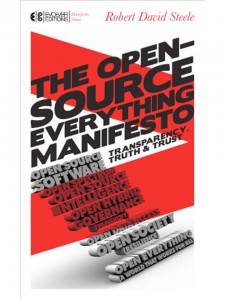
30 Minutes:  2012 The Open Source Everything Manifesto: Transparency, Truth, & Trust (Evolver Editions, June 2012)

If you thought Steele was motivated before, promoting Open Source Intelligence (OSINT), you ain't seen nothin' yet.  Now he's going for the whole enchilada.  In a 215 page pocketbook (use the link above to see the 33 slides and buy it in advance from any number of sources) he lays out how We the People can reconnect with our integrity, harvest the integrity inherent in Nature, and stomp into oblivion the fraud, waste, and abuse characteristic of all of our organizations — academic, civil society, commerce, government, media, military, and non-government/non-profit.  Steele is for intelligence (decision-support) what Stallman is for software. The citizens' intelligence militia is self-organizing, from zip code to global.  Panarchy rules!

2 hours:  SPY IMPROV:  Everything you ever wanted to ask about anything…

Steele, a recovering spy, honorary hacker across multiple continents, and the #1 Amazon reviewer for non-fiction, reading in 98 categories (see the list here) will answer any question on any topic.  Having already set the world record at The Next HOPE (8, 2010) with an eight-hour Q&A, this year the time is being strictly limited to 2 hours.

See Also:

THE OPEN SOURCE EVERYTHING MANIFESTO: Transparency, Truth & Trust

2012 Reality Sandwich: How I Tested the Boundaries of the Two-Party Tyranny

09 Justice, 11 Society, Articles & Chapters, Corruption, Cultural Intelligence, Government, Politics

Eagle-circle_v04-200How I Tested the Boundaries of the Two-Party Tyranny

Robert David Steele Vivas

Reality Sandwich, 24 May 2012

For six weeks in early 2012 I ran for the office of President of the United States of America.  I was accepted by the Reform Party (one of six accredited national parties completely shut out of the political process in the US), was listed at Politics1, participated in a WikiNews interview and got my views posted at On the Issues.  I created We the People Reform Coalition, and I wrote letters to every single candidate for President including Rocky Anderson and Buddy Roemer, throwing in Dennis Kucinich for grins.  This is my report — there are no winners.

Preamble

I was shocked into paying attention by Al Gore's playing dead in 2000 (despite Greg Palast outing the Bush family scheme to disenfranchise 50,000 people of color, doing so three months in advance of election day).  I was radicalized by 9/11 — a clear false-flag operation in which elements of our own government were complicit — and infuriated with the ease by which this nation was taken to war on the strength of 935 now-documented lies — lies that no serving officer — including Colin Powell — was willing to confront.  Then I lost everything in the 2008 economic crash described so well by Matt Taibbi in GRIFTOPIA — it took two years for my company to go out of business — and along came Occupy.  Occupy failed.  This is their story and mine.  If this story moves you, I believe we have 90 days from today to take seven steps that can bury the two-party tyranny and install an honest coalition government.

Continue reading “2012 Reality Sandwich: How I Tested the Boundaries of the Two-Party Tyranny”

Howard Rheingold: Google’s Next Step in Search

Advanced Cyber/IO, Commercial Intelligence
Howard Rheingold

This is what “Metaweb” was working on before they were acquired by Google — Howard

“When you search, you’re not just looking for a webpage. You’re looking to get answers, understand concepts and explore.

The next frontier in search is to understand real-world things and the relationships among them. So we're building a Knowledge Graph: a huge collection of the people, places and things in the world and how they're connected to one another.

This is how we’ll be able to tell if your search for “mercury” refers to the planet or the chemical element–and also how we can get you smarter answers to jump start your discovery.”

Introducing the Knowledge Graph

Phi Beta Iota: Google continues to do math hacks on digital garbage. While it is beneficial to connect the Internet of things with the Internet of words and numbers, Google is a) not a search company, something most do not understand, and b) not at all committed to making sense in the public interest. When Google can cannot every mind, written and spoken word, thing, and location relevant to understanding poverty, then we will be impressed. Until then, like Microsoft, Google is part of the problem, not the solution.

Patrick Meier: Stages of Resistance to Innovation — From Naval Gunfire to Blind Spys

Cultural Intelligence
Patrick Meier

From Gunfire at Sea to Maps of War: Profound Implications for Humanitarian Innovation

MIT Professor Eric von Hippel is the author of Democratizing Innovation, a book I should have read when it was first published seven years ago. The purpose of this blog post, however, is to share some thoughts on “Gunfire at Sea: A Case Study in Innovation” (PDF), which Eric recently instructed me to read. Authored by Elting Morison in 1968, this piece is definitely required reading for anyone engaged in disruptive innovation, particularly in the humanitarian space. Morison was one of the most distinguished historians of the last century and the founder of MIT's Program in Science, Technology and Society (STS). The Boston Globe called him “an educator and industrial historian who believed that technology could only be harnessed to serve human beings when scientists and poets could meet with mutual understanding.”

Morison details in intriguing fashion the challenges of using light artillery at sea in the late 1,800's to illustrate how new technologies and new forms of power collide and indeed, “bombard the fixed structure of our habits of mind and behavior.” The first major innovative disruption in naval gunfire technology is the result of one person's acute observation. Admiral Sir Percy Scott happened to watched his men during target practice one day while the ship they were on was pitching and rolling acutely due to heavy weather. The resulting accuracy of the shots was dismal save for one man who was doing something slightly different to account for the swaying. Scott observed this positive deviance carefully and cobbled existing to technology to render the strategy easier to repeat and replicate. Within a year, his gun crews were remarkable accurate.

Continue reading “Patrick Meier: Stages of Resistance to Innovation — From Naval Gunfire to Blind Spys”

JUST OUT: The New Designing A World That Works for All by Medard Gabel & Global Laboratory Participants

Earth Intelligence, Knowledge
Home Page

purchase a paperback copy

download color version pdf (32MB)
download black-and-white version pdf (16MB)

Goals of the Lab

See the movie

Medard Gabel, co-creator with Buckminster Fuller of the analog World Game, is the designer of EarthGame(TM) and the foremost comprehensive architect for a massive multiplayer game that connects all humans with all information in all languages all the time.  A founding member of the guiding council of Earth Intelligence Network, he remains the single most focused personality at the intersection of design, open source, serious games, and informed participatory budgeting and policy making.

PETITION Deadline 19 June, For Open Access to Taxpayer-Funded Research Information

Cultural Intelligence

we petition the obama administration to:

Require free access over the Internet to scientific journal articles arising from taxpayer-funded research.

We believe in the power of the Internet to foster innovation, research, and education. Requiring the published results of taxpayer-funded research to be posted on the Internet in human and machine readable form would provide access to patients and caregivers, students and their teachers, researchers, entrepreneurs, and other taxpayers who paid for the research. Expanding access would speed the research process and increase the return on our investment in scientific research.

The highly successful Public Access Policy of the National Institutes of Health proves that this can be done without disrupting the research process, and we urge President Obama to act now to implement open access policies for all federal agencies that fund scientific research.

Click here to learn more and — if desired — sign the petition.

David Swanson: Even Failed Activism Succeeds

Cultural Intelligence
David Swanson

Why Even Failed Activism Succeeds

I enjoy reading histories of past activism, including memoirs by long-time activists, such as Lawrence Wittner's new book, Working for Peace and Justice.

Almost every such account includes belated discoveries of the extent to which a government was been spying on and infiltrating activist groups.

And almost every such account includes belated discoveries of the extent to which government officials were influenced by activist groups even while pretending to ignore popular pressure.

These revelations can be found in the memoirs of the government officials as well, such as in George W. Bush's recollection of how seriously the Republican Senate Majority Leader was taking public pressure against the war on Iraq in 2006.

Of course, activism that appears ineffectual at the time can succeed in a great many ways, including by influencing others, even young children, who go on to become effective activists — or by influencing firm opponents who begin to change their minds and eventually switch sides.

The beautiful thing about nonviolent activism is that, while risking no harm, it has the potential to do good in ways small and large that ripple out from it in directions we cannot track or measure.

Continue reading “David Swanson: Even Failed Activism Succeeds”

noble gold