Journal: The Economics of West Bank Settlements

Civil Society, Government, Peace Intelligence
Chuck Spinney Recommends

We were looking for a nice, peaceful place near Jerusalem'

Rachel Shabi, Guardian, 24 Sept 2010

If the construction of settlements in the West Bank is meant to be on hold, why are Israeli buyers being offered new properties on Palestinian land at knock-down prices?

The housing project currently under construction in Almon offers enticingly priced, spacious family homes with a garden and a view. The surrounding neighbourhood, also known as Anatot, sits on a ridge overlooking the Judean hills, near Jerusalem, a blaze of cultivated greenery in the parched landscape. Residents have a relaxed air, and newcomers who have recently relocated from Jerusalem wish they'd made the move years ago. If I were a prospective house-buyer, I'd be charmed. But I would not be looking here – because Almon is in the occupied West Bank.

Phi Beta Iota: Worth a full read.  This explains both the economics of the illegal settlements, and the massive financial resources that the Israeli government offers in favor of illegal settlements, at the same time that it lies to a complacent US Government that knows better, but prefers to sacrifice its diplomatic integrity for the pretense of progress.

TED: Sugata Mitra–The child-driven education

04 Education, Academia, Civil Society, Collective Intelligence, Mobile, TED Videos

TED Short Video

Sugata Mitra: The child-driven education

About this talk

Education scientist Sugata Mitra tackles one of the greatest problems of education — the best teachers and schools don't exist where they're needed most. In a series of real-life experiments from New Delhi to South Africa to Italy, he gave kids self-supervised access to the web and saw results that could revolutionize how we think about teaching.

About Sugata Mitra

Sugata Mitra's “Hole in the Wall” experiments have shown that, in the absence of supervision or formal teaching, children can teach themselves and each other, if they're motivated by curiosity… Full bio and more links

Phi Beta Iota: Harrison Owen recommended this.  He has spent his life nurturing self-organizing systems.  This is one of the most moving, impactful ideas and presentations we have seen in our lifetime.  This is one of the keys.

See Also:

Worth a Look: Open Space Re-Invention

Review: Wave Rider: Leadership for High Performance in a Self-Organizing World

Reference: Peggy Holman Free Video on Emergence

Review: The World Is Open–How Web Technology Is Revolutionizing Education

2010 INTELLIGENCE FOR EARTH: Clarity, Diversity, Integrity, & Sustainability

Journal: Unlicensed Spectrum Open for Super Wi-Fi

Autonomous Internet, Commercial Intelligence

Here it comes: ‘Super WiFi'

Todd Bishop on Thursday, September 23, 2010, 11:17am PD

Microsoft, Google and other tech companies won a key victory in Washington, D.C., today as the Federal Communications Commission moved to open up vacant spectrum between television channels for unlicensed use by wireless devices — a development expected to lead to a powerful new form of wireless Internet access.

Tip of the Hat to  Dawn Yankeelov at LinkedIn.

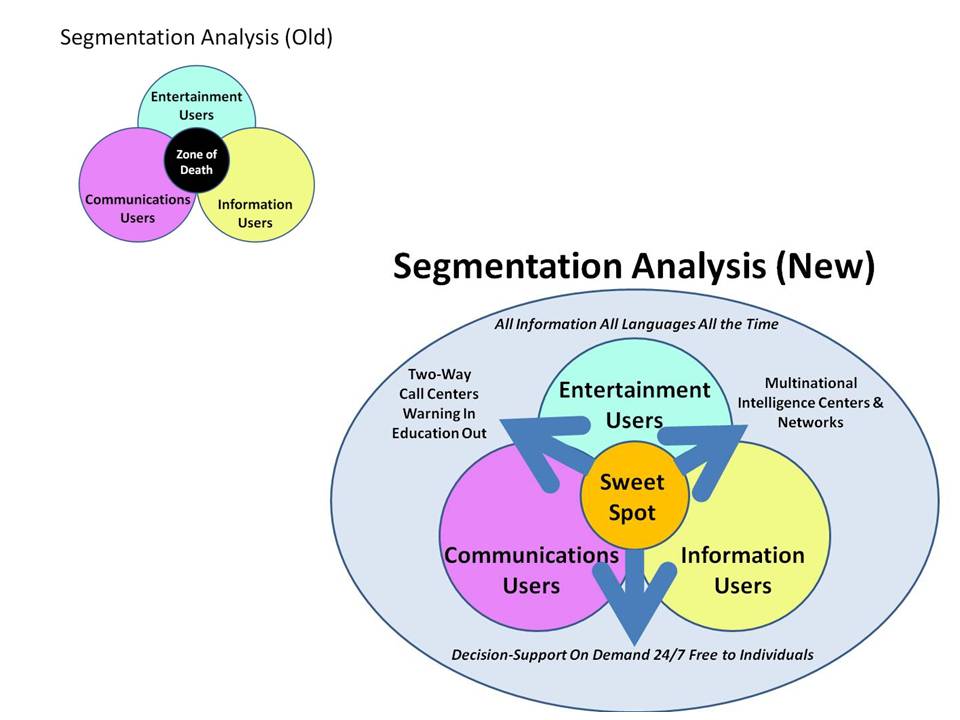
Phi Beta Iota: This is the beginning of the end of any telecommunications business that does not realize that it is in the business of software, services, and sense-making.  Burning Man this year demonstrated that OpenBTS and related open technologies are ready for prime time.   Below is our newest graphic (click to see full size).

Telecommunications Sweet Spot

Journal: Automated Payments/Transaction Tax

Commercial Intelligence

Home Page

The APT Tax

Instead of personal income tax, corporate income tax, state tax, fuel tax, capital gains tax, gift tax. estate tax, excise tax, sales tax

One very low universal tax Automatically and Immediately Collected

No Tax Returns, No Lobbying for Special Interests, No Special Deductions

Is it possible to have a system of taxation which is simple, efficient, progressive, and revenue neutral replacing all those taxes listed above? As it turns out, Yes.

Read  Below or Go Directly to the Site Home Page with Other Links Not Visible Here

Continue reading “Journal: Automated Payments/Transaction Tax”

Journal: When High-Cost is GOOD

Commerce, Commercial Intelligence, Cultural Intelligence

Home Page

Cost reduction for high-end markets

If you sell at the top of the market (luxury travel, services to Fortune 500 companies, financial services for the wealthy…) you might be tempted to figure out ways to cut costs and become more efficient.

After all, if you save a dollar, you make a dollar, without even getting a new customer.

Resist.

The goal shouldn't be to reduce costs. It should be to increase them.

That voice mail service that saves you $30,000 a year in receptionist costs–it also makes you much more similar to a competitor that is more efficiently serving the middle of the market.

Go through all the ways you serve your customers and make them more expensive to execute, not less. Your loyalty and your market share will both grow. People who can afford to pay for service often choose to pay for service.

Phi Beta Iota: What Master Seth is not making explicit is that HUMANS costs more than devices, and the REASON humans cost most is because at the high end, HUMANS offer creative adaptability, instant understanding of nuances, emotional calibration, and a deeply HUMAN connection to the client.  Call centers are the high end of the low end.  Capitalism took a wrong turn in commoditizing humans and treating labor costs as something to be reduced.  It is the human web of knowledge that undergirds the advance of civilization, NOT the “things” that we buy and trash.

See Also:

Review: Philosophy and the Social Problem–The Annotated Edition

NIGHTWATCH Extract: Kyrgyzstan Hybrid Governance

Commercial Intelligence, Cultural Intelligence, Government, Law Enforcement, Military, Peace Intelligence

Kyrgyzstan- Shanghai Cooperation Organization: Shanghai Cooperation Organization (SCO) member states will help Kyrgyzstan stabilize the situation in the country's southern region, a source in the Russian Federal Security Service said 23 September after a regional SCO anti-terrorism council meeting, Interfax reported.

The council decided that law-enforcement agencies of member states will assist Kyrgyzstan maintain security by organizing information exchanges regarding regional militant activities, the source said. The source also said the council elected Chinese Deputy Minister for Public Security Meng Hongwei to chair the anti-terrorism council for one year. The council is set to meet next in Usbekistan in March 2011. Representatives from Kazakhstan, China, Kyrgyzstan, Russia, Tajikistan and Uzbekistan attended the meeting.

NIGHTWATCH Comment: The Moscow-centered Collective Security Treaty Organization (CSTO) declined to undertake a more intrusive intervention mission. The Beijing-led SCO mission is primarily an intelligence exchange, but potentially affords China unprecedented access to information about central Asian security issues. The SCO will accrue positive publicity for its limited mission, upstaging the CSTO.

The Chinese-led organization looks cooperative. The Russian-led organization looks timid. This in fact confuses different missions and burdens, but the public perception is likely to favor the Chinese-led initiative in the Russian sphere of influence.

Kyrgyzstan-Russia: Issues between Russia and Kyrgyzstan over Russia's military bases in Kyrgyzstan have been addressed and an agreement will be signed, probably on the 24

NIGHTWATCH Comment: The Russians have four military facilities or bases in Kyrgyzstan, including Kant air base. Under the new agreement they will be consolidated in a single command structure and all will be governed by the new agreement, instead of four separate agreements. Russia's lease will probably be good for the next four or five decades.

NIGHTWATCH KGS Home

Phi Beta Iota: Reference: Global Governance 2025 completely missed both the Hybrid and the Open models of governance that are displacing institutionalized ineptitude now characteristic of most governments, all unable to micro-manage complexity or achieve resilience.  The above report suggests that Kyryzstan could be an early node where multinational information-sharing and sense-making is more influential, more effective, and more profitable, than standing military bases, but the two can co-exist.  See also Worth a Look: Future of Business is Information Sharing.  To appreciate such nuances one needs a strategic analytic modeland the inclination to actually understand the eight tribes of intelligence, “true costs,” and all other aspect of holistic reality.