Journal: NIGHTWATCH Extract France & Citizenship

08 Wild Cards, 10 Security, 11 Society, Communities of Practice, Cultural Intelligence

NIGHTWATCH HOME.  France: For the record. Prime Minister Francois Fillon said on 3 February he would sign a decree barring a Moroccan man from receiving French citizenship because of his insistence that his French wife conform to the strictest Islamic practices. Fillon said that the man “has no place in our country.”

The French authorities describe the case as being about a religious radical who requires his wife to wear the burqa (the head to toe covering with eye slots); he insists the separation of men and women in his own home, and he refuses to shake the hands of women,” Fillon said.

On 2 February, Immigration Minister Eric Besson said that during checks into the man's application for citizenship, he explicitly stated that he would never allow his wife to leave the house without wearing a full veil and that he believed a woman is “an inferior being.”

Earlier this week a parliamentary panel called for a law to ban the wearing of full Islamic veils in public institutions such as schools, hospitals and transport. “It's French law,” Fillon told Europe 1 radio. “The Code Civile has for a very long time provided that naturalization could be refused to someone who does not respect the values of the French Republic.

A Reader could conclude that political correctness in France favors the Republic’s interests over the individual’s right of self expression and even personal religious observance. In this case, the Republic places respect for women and women’s rights over male dominance prescribed in religious texts. This is a study in democracy.

Continue reading “Journal: NIGHTWATCH Extract France & Citizenship”

Journal: Whither Twitter?

Collective Intelligence, Cultural Intelligence, Geospatial, Mobile, Real Time, Technologies

Twitter not all that popular among teenagers, report finds

“I don't know a single person who uses Twitter,” says Samara Fantie, 17, of Gaithersburg, who added that with so many of her friends on Facebook, Twitter seems beside the point.

Fantie listed its drawbacks, saying it appears to be less secure, more public and too condensed. “Teenagers like to talk, and 140 characters is just not enough,” she said. Facebook “does everything Twitter offers, only it's better. It would be like going backwards.”

Blogs Just Aren't Cool Any More, Teens Say

Blogging is slowly becoming the domain of adults, as a recent Pew study shows more teens abandoning the medium for social networks.

The study, conducted by the Pew Research Center's Internet & American Life Project, showed a decline in the number of teens who say they blog, from 28 percent in 2006 to 18 percent in 2009, when the study was conducted. Just 52 percent comment on their friends' blogs, versus 76 percent three years ago.

By contrast, the survey found that about 10 percent of adults maintain a blog, a figure that has remained unchanged.

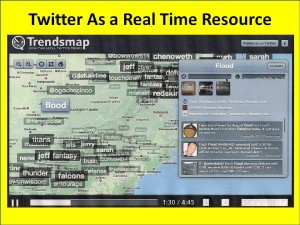
Phi Beta Iota: We appear to be in an interregnum, with some very serious perople such as Pierre Levy and Jeff Jarvis seeing the enormous potential of Twitter, while the run of the mill “crowd” may be bored.  Our view: Twitter is a game changer in part because geospatial location and identity are embedded, it is both mobile and real-time, and back office trends and aggregation and clustering can be attached.  Something really cool is happening, and Pew missed it.

See also:

Continue reading “Journal: Whither Twitter?”

Journal: Earth-Homes and Trash for Building

Earth Intelligence

Full Story Online

Rammed Earth Construction (Using Tires)

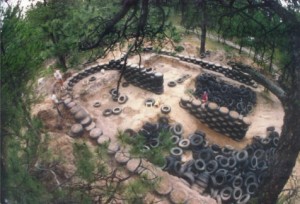
In the tire method, a row of used automobile tires is simply laid atop the concrete footing, perhaps centered around steel reinforcing bars that extend out of the footing. The tires are then filled with soil. About 1,000 tires are used to build the walls of a 2,000 sq ft 1609.6 sq m) house.

the prepared soil into these molds, which are removed after the walls are completed. The rammed-earth tire method is a commonly used alternative.

Journal: The Twitter Train Has Left the Station

Collective Intelligence, Communities of Practice, Mobile, Real Time
NYT Full Story Online

Hundreds of thousands of people now rely on Twitter every day for their business. Food trucks and restaurants around the world tell patrons about daily food specials. Corporations use the service to handle customer service issues. Starbucks, Dell, Ford, JetBlue and many more companies use Twitter to offer discounts and coupons to their customers. Public relations firms, ad agencies, schools, the State Department — even President Obama — now use Twitter and other social networks to share information.

There are communication and scholarly uses. Right now, an astronaut, floating 250 miles above the Earth, is using Twitter and conversing with people all over the globe, answering both mundane and scientific questions about living on a space station.

Most importantly, Twitter is transforming the nature of news, the industry from which Mr. Packer reaps his paycheck. The news media are going through their most robust transformation since the dawn of the printing press, in large part due to the Internet and services like Twitter. After this metamorphosis takes place, everyone will benefit from the information moving swiftly around the globe.

Reference: Filtering With Your Network

Blog Wisdom, Collective Intelligence
Full Story Online

In yesterday’s post on Personal Aggregate, Filter & Connect Strategies, I didn’t have room for one key point: one of the key filters to use is your network. When he was in Brisbane last month, George Siemans gave a talk

with an example that illustrated this perfectly.

For the past couple of years, he has run a course on Connectivism with Stephen Downes. Here is the definition of connectivism from Downes:

At its heart, connectivism is the thesis that knowledge is distributed across a network of connections, and therefore that learning consists of the ability to construct and traverse those networks.

As I understand it, one of the points of the course is to present students with so much data that they can’t possibly process or understand all of it as individuals. This forces them to create networks to build data-gathering and sense-making networks in order to succeed. There are more details about networks, connectivism and the course in this excellent presentation from Downes (the presentation also discusses Downes’ framework for building knowledge within complex networks, which consists of Aggregate – Remix – Repurpose – Feed Forward).

Reference: Personal Aggregate, Filter & Connect Strategies

Blog Wisdom, Collective Intelligence, Communities of Practice

Full Reference Online

Personal Aggregate, Filter & Connect Strategies

by Jeff Jarvis

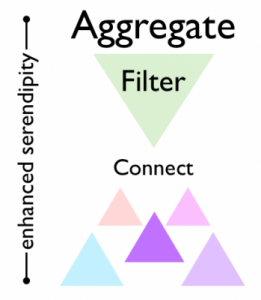
A while back my PhD student Sam and I were talking, and he asked me about my RSS feed. His question was something along the lines of ‘what blogs would I have to read if I wanted to be able to make the connections that you do on your blog?’ As we talked, I realised that it didn’t matter if I gave anyone else my exact RSS feed, they wouldn’t be able to replicate my blog – and the reason for this is aggregate, filter and connect.

When I first thought about aggregate, filter and connect as a framework, it was in an attempt to explain why Amazon’s business model worked better than that of other online bookstores. The first time I talked about it in public, it was to explain how open education might work. I’ve been working on making it in to a general model of how we create something unique when we’re primarily dealing with information.

As such, it can be used to explain business models, like Amazon’s, or blogs, like mine. The more I’ve talked about the model, the more other people are picking it up, which is great. Some of these recent discusssions have gotten me thinking about how aggregate, filter and connect works at a personal level. This was really Sam’s question. I’ve talked about how Charles Darwin basically used an aggregate, filter and connect strategy, Phil Long talks about it as part of personal knowledge management, Harold Jarche has discussed it as both a general model for business and for personal knowledge management (an idea that Jack Vinson picked up, and connected to the concept of enhanced serendipity from Ross Dawson), and Glenn Wiebe used the framework to discuss both Joseph Priestly’s inventions and teaching. So we’re starting to get a bit of discussion Today I’d like to illustrate the concept by discussing how I use it.

Phi Beta Iota: Full reading recommended!  These folks are redefining both the meaning and the practice of being in harmony with reality, with others, and with relevant information.

Reference: How to Use Twitter to Build Intelligence

Blog Wisdom, Collective Intelligence, Communities of Practice
Venessa Miemis

emergent by design

2009 December 21

by Venessa Miemis

1. What is Twitter?

Getting started on Twitter is like walking into a crowded room blindfolded: you know there’s somebody out there, but you’re not quite sure who they are, where they are, or why you should care.

Full Story Online

My initial Twitter experience was kind of like this: The 46 Stages of Twitter (here’s the educator’s version)

After digging deeper, I started to see patterns in the way information was traveling, and in the connections between the people I was following. Based on those observations, this is my current opinion:

Twitter is a massive Idea & Information Exchange.

Granted, there is a TON of noise. I’m not suggesting that Twitter is a utopia where it’s possible to get 100% pure relevant content to what you want to know all the time. BUT, there is a tremendous wealth of information and human capital out there that is certainly worth exploring. Businesses are finding it’s useful for interacting with customers and gauging public opinion, educators are collaborating with one another and integrating it into their “personal learning networks (PLNs),” and individuals are using it to find out more about specific interest areas.

I read a piece recently by Howard Rheingold titled Twitter Literacy, in which he said:

Twitter is not a community, but its an ecology in which communities can emerge.

Phi Beta Iota: Tip of the hat to  Who’s Who in Collective Intelligence: Pierre Levy for the tip-off.  As Haiti demonstrated recently, Twitter was the only intelligence-communications system that worked in the first hours and days, followed by texting.  The US Embassy and CIA fired blanks.  See Journal: Haiti Rolling Directory from 12 January 2010.