Journal: Is There an Ecological Unconscious?

Cultural Intelligence, Earth Intelligence
Full Story Online

“There’s a scholar who talks about ‘heart’s ease,’ ” Albrecht told me as we sat in his car on a cliff above the Newcastle shore, overlooking the Pacific. In the distance, just before the earth curved out of sight, 40 coal tankers were lined up single file. “People have heart’s ease when they’re on their own country. If you force them off that country, if you take them away from their land, they feel the loss of heart’s ease as a kind of vertigo, a disintegration of their whole life.” Australian aborigines, Navajos and any number of indigenous peoples have reported this sense of mournful disorientation after being displaced from their land. What Albrecht realized during his trip to the Upper Valley was that this “place pathology,” as one philosopher has called it, wasn’t limited to natives. Albrecht’s petitioners were anxious, unsettled, despairing, depressed — just as if they had been forcibly removed from the valley. Only they hadn’t; the valley changed around them.

In Albrecht’s view, the residents of the Upper Hunter were suffering not just from the strain of living in difficult conditions but also from something more fundamental: a hitherto unrecognized psychological condition. In a 2004 essay, he coined a term to describe it: “solastalgia,” a combination of the Latin word solacium (comfort) and the Greek root –algia (pain), which he defined as “the pain experienced when there is recognition that the place where one resides and that one loves is under immediate assault . . . a form of homesickness one gets when one is still at ‘home.’ ” A neologism wasn’t destined to stop the mines; they continued to spread. But so did Albrecht’s idea. In the past five years, the word “solastalgia” has appeared in media outlets as disparate as Wired, The Daily News in Sri Lanka and Andrew Sullivan’s popular political blog, The Daily Dish. In September, the British trip-hop duo Zero 7 released an instrumental track titled “Solastalgia,” and in 2008 Jukeen, a Slovenian recording artist, used the word as an album title. “Solastalgia” has been used to describe the experiences of Canadian Inuit communities coping with the effects of rising temperatures; Ghanaian subsistence farmers faced with changes in rainfall patterns; and refugees returning to New Orleans after Katrina.

Phi Beta Iota: Seriously good stuff that comes at the same time that human feelings and emotions are being recognizes as co-intelligence to the science and humanities and (more or less moribund) social sciences.  It's about the Whole.
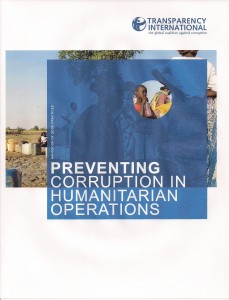
Handbook: Preventing Corruption in Humanitarian Operations–A Handbook of Good Practices

Gift Intelligence, Law Enforcement, Peace Intelligence, Stabilization
Full Document Online

Based on five years of investigation in the aftermath of the 2004 tsunami.  The bottom line from our point of view is three-fold:

1.  All money collected for an ostensible campaign must be “tagged” and audited and pooled so that the US military among others can draw down on the common fund and cover all costs associated with US military mobilization and continuing Stabilization & Reconstruction Operations.

2.  We need a Stabilization & Reconstruction Intelligence Support Plan that includes Peace Jumpers and immediate air breathing wide area surveillance upon which to build a bottom-up needs assessment and Reverse TIPFID.  Push the information perimeter all the way out to pre-loading approval contingent on having a big air docking space and small air or land or sea intermediate delivery channels.

3.  We finally need to get serious about “preaceful preventive measures” as called for by General Al Gray, USMC, then Commandant of the Marine Corps, in his seminal article “Global Intelligence Challenges for the 1990's,” American Intelligence Journal (Winter 1989-1990).  His staff assistant for that piece was Robert Steele.  We need a Whole of Government and Multinational Engagement information sharing and sense-making hub and spoke network built around the US defense open source intelligence program.  IOHO.

Explicatory Online Information:

Continue reading “Handbook: Preventing Corruption in Humanitarian Operations–A Handbook of Good Practices”

Journal: Politics of Fear–Spending on National Insecurity

10 Security, Analysis, Budgets & Funding, Collective Intelligence, Military, Peace Intelligence, Reform, Threats
Chuck Spinney

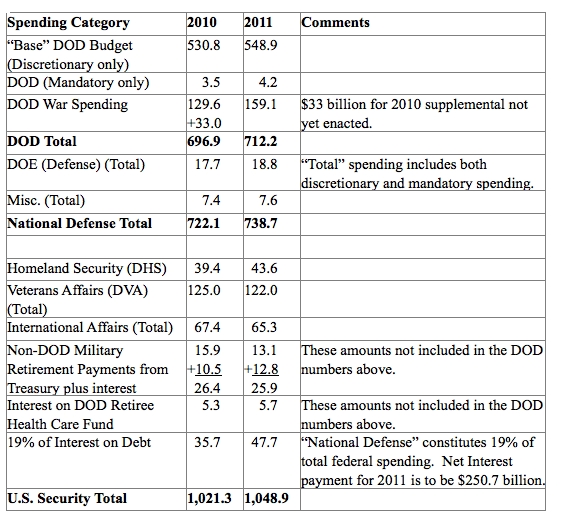
Answer: It all depends on what you think should be included, but once this is clear — this spending will be be exempt from any cutbacks needed to reduce the deficit.

The Table prepared by Winslow Wheeler, Director, Straus Military Reform Project within the Center for Defense Information.

Chuck

Winslow Wheeler, Straus Military Reform Project.

Journal: Apocalypse to Viet-Nam–Worth a Look

03 Economy, 08 Wild Cards, 09 Terrorism, Peace Intelligence

Berto Jongman Recommends...

Afghanistan: Mullah Omar Ready to End Al Qaida Ties (Video)

Apocalyptic thinking and the signs of the coming apocalypse by sheikh IMran N. Hosein

Book announcement: how enemies become friends

Book Reviews, Books by Ronald Crelinsten by Tim Stevens

Conflict in N Dimensions Excellent blog by Tim Stevens

Cyber-War and Critical Infrastructure I

Cyber-War and Critical Infrastructure II

Cyber-War and Critical Infrastructure III

Cyber-War: The costs of databreaches in US and UK

Islamic thinking on the role of money and islamic banking by sheikh Imran N. Hosein.

Peace after  war New study

Terror Risk High as Obama Ponders Afghan Fiasco (November Prediction of Christmas Day False Flag Operation by Christopher Bollyn) November 18, 2009 The risk of another false-flag terror attack like the terror atrocities of 9-11 is currently very high. This is not a prediction but a warning based on my analysis of 9-11 and the predicament that the U.S. and NATO find themselves in as they try to “pacify” occupied Afghanistan, a nation of fighting men who have always resisted foreign occupiers since Alexander the Great conquered the region and built Kandahar (Alexandria) in 330 B.C.

Terror: New study of the WODC (Scientific Research and Documentation Center of the Ministry of Justice) on Dutch jihadists. For the first time reserachers had access to twelve police investigative files on cases in the periode 2001-2005. An English summary can be found on pages 166-171.

Terror: Remarks on terrorist financing

Vietnam new study on role of CIA

Journal: US Office for Contingency Operations

07 Other Atrocities, 08 Wild Cards, Military, Peace Intelligence
Haiti Watch Thread

TIP OF THE HAT to Manna

The idea of a new agency for S&R ops was put forward a few months ago by Stuart Bowen, IG for Iraq reconstruction. After reviewing DoD and DoS efforts there, he proposed a US Office for Contingency Operations (USOCO). A whole of government agency to unify command and avoid the situation mentioned above between USAID and SOUTHCOM. Makes too much sense to get very far.

“That proposal may be controversial in some circles — particularly in areas the development community, where there’s concern that USOCO might represent a more cumbersome bureaucratic structure. But Bowen’s idea is attracting some powerful allies, like the widely admired former U.S. ambassador to Iraq, Ryan Crocker. “I do support the concept,” Crocker, the incoming dean of the George Bush School of Government at Texas A&M University, emailed me. “The current situation requires a perpetual reinventing of wheels and a huge amount of effort by those trying to manage contingencies.”

Proposal Circulates on New Civilian-Military Agency

Iraq Reconstruction Inspector General Urges Office to Report to State, Defense

As the United States’ special inspector general for Iraq reconstruction, Stuart Bowen has blown the whistle on millions of dollars worth of waste, fraud and abuse. But one of his final acts in the job will be to address something more fundamental: the way U.S. civilian officials interact with their military counterparts during the complex wars of the future.

Maybe a role for the “fourth battalion.”

USASFC Command Reorganisation By Sean D. Naylor

Meanwhile, the fourth battalion will convert to a special troops battalion. This will include ele¬ments previously in the group support company, such as the Spe¬cial Forces advanced skills compa¬ny, the signals detachment and the regional support detachment. New organizations will be added, including a military intelligence company, an unmanned aerial systems platoon, two human intelligence sections, a signals intelligence section and other ele¬ments, according to a slide brief¬ing Repass provided to Army Times.

Continue reading “Journal: US Office for Contingency Operations”

Journal: Haiti Update 31 January 2010 PM

08 Wild Cards, Peace Intelligence

Aid organizations are announcing with great pride that they will feed two million over the new two weeks.  What they don't say is that is 143,000 a day–assuming best case circumstances, sucks for those they don't reach in the last ten days of those fourteen days—the last day of which will be roughly thirty days after they stopped getting food and water in the first place.

Full Story Online

Haiti: How to Turn Disaster into Catastrophe

The underdevelopment of Haiti is the underlying cause. Bipartisan U.S. policy for decades (and that of plaint Haitian regimes) has been to displace the rural poor to the capital where they can serve as an extremely lowwage labor force. For one, the destruction of Haiti’s rice farmers, who were unable to compete with U.S. agribusiness, forced many peasants off the land.

SLOW FOOD   CARIBBEAN CRUISES: THE FUN GOES ON   DOCTORS WITHOUT AIRPORTS   LET THEM EAT PEPPER SPRAY   THIRSTY AMERICANS   CUBAN DOCTORS FIRST ON SCENE   SHOCK DOCTRINE   SEARCH AND RESCUE THE RICH   PLENTY OF TROOPS   SEND IN THE DRONES   THE ZIONIZATION OF DISASTER RELIEF

Phi Beta Iota: Above are sub-titles.  The single best overview we have seen, the only three things they miss are the Israeli organ and orphan harvesting,  the tragic farce of US AID civilians, clearly not the normal AID professionals, and the utterly criminal farce of the Red Cross–“we're not ready, give us your money.”

Continue reading “Journal: Haiti Update 31 January 2010 PM”

Worth a Look: 1989 All-Source Fusion Analytic Workstation–The Four Requirements Documents

Analysis, Budgets & Funding, Collaboration Zones, Communities of Practice, Ethics, Historic Contributions, InfoOps (IO), IO Sense-Making, Key Players, Methods & Process, Mobile, Policies, Real Time, Reform, Strategy, Technologies, Threats, Tools

The software chapter in Book: INTELLIGENCE FOR EARTH–Chapter 22 Technical Intelligence Enablers Loaded is being doubled up as our smarter colleagues churn it around, it will probably be extended several pages and have more linked references.

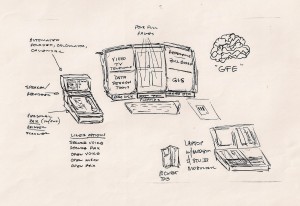
Here are the four requirements documents for the all-source fusion analytic workstation converging in 1989–we do not have this today because no one has ever tried to manage the US Government's approach to IT–distributed chaos and centralized ignorance just will not do.

1989 Webb (US) CATALYST: Computer-Aided Tools for the Analysis of Science & Technology

Reference 1989 Analyst 2000

1988 Generic Intelligence Center Production Requirements

Reference: 1989 USMC Work-Up for JNIDS VI All-Source Fusion Analytic Workstation

See also:

Graphic: Analytic Tool-Kit in the Cloud (CATALYST II)

1988-2009 OSINT-M4IS2 TECHINT Chronology

Search: The Future of OSINT [is M4IS2-Multinational]

2001 Porter (US) Tools of the Trade: A Long Way to Go