To date we have identified over 80 and mapped 50 such Black Spots and begun to assess the types of interactions going on in these areas as well as the various kinds of insecurity that they are exporting and the directions in which it is or may be going. We continually scan the globe for other areas where conditions seem right for the presence of a Black Spot. Using published materials, news-scanning software, formal and informal interviews, and, where feasible, visits to the areas, we piece together a picture of the Global Black Spots, their nature, and their interactions with the outside world.
Paul Kawika Martin, Political and Policy Director for Peace Action, said:
I think the question should be: How much U.S. credit should we use on the war in Afghanistan? As it stands, the over $230 Billion we have already spent has mostly been borrowed money adding to the U.S. deficit. Of course, just like buying a car or home, sometimes it's good to do things on credit. But this isn't the true cost. As Noble Prize-winning economist Joseph Stiglitz and Harvard professor Linda Bilmes points out, that figure fails to include interest on debt, veterans benefits and other costs to society. They estimate the costs for the wars in Iraq and Afghanistan could top a staggering $5 trillion to $7 trillion.
Phi Beta Iota: Other “pundits” can be read within the full story. The cost is far more than the “tangible debt.” It includes the hollowing out of America–the loss of integrity, the failure of paradigms, the cheating culture, and on and on and on. We have in essence sacrified the Republic in the name of partisan politics and corporate greed, enabled by civitas minimus. America is less safe and less prosperous today than it was on 9/12.
Federal Reserve Policy Audit Legislation ‘Gutted,’ Paul Says
Oct. 30 (Bloomberg) –By Bob Ivry
Representative Ron Paul, the Texas Republican who has called for an end to the Federal Reserve, said legislation he introduced to audit monetary policy has been “gutted” while moving toward a possible vote in the Democratic-controlled House.
The bill, with 308 co-sponsors, has been stripped of provisions that would remove Fed exemptions from audits of transactions with foreign central banks, monetary policy deliberations, transactions made under the direction of the Federal Open Market Committee and communications between the Board, the reserve banks and staff, Paul said today.
Last week, the chairman of President Barack Obama’s Council of Economic Advisers — a position that carried the title “chief economist” until Larry Summers took up residence in the White House — testified to the Joint Economic Committee on the economic crisis and the efficacy of the policy response.
Here’s the executive summary in case you missed it:
Metadata in State Documents Is Public Record, Court Rules
Kim Zetter, 30 October 2009
Arizona’s Supreme Court, in a surprising but welcome ruling, has declared that electronic metadata is part of the public record under state law, in a case involving an Arizona police officer who suspects his superiors of backdating a document related to his work performance.
The city argued that metadata — digital information that can reveal when a document was created and subsequently accessed or modified — was not part of the public record. Releasing such information to the public would result in an “administrative nightmare” and force public officials to spend “countless hours” trying to identify the metadata, the city claimed.
If one takes the “battlefield” to include all challenges, not just the challenge of a battle in a singular time and place, then this search is the mother of all searches.
We like to use the analogy of sailboat racing, something we learned from a video, DVD: THE ART OF RACING SAILING. This DVD begins with an inspection of the hull of the sailboat out of the water and the point is that the race is often won or lost BEFORE THE RACE EVEN BEGINS. If you have failed to assure a correct hull; if you have failed to train, equip, and organize the right forces for the right mission, if you have failed to understand the historical, cultural, and geographical reality you are entering into a context with; then no amount of excellence on the field itself will prevail.
One of the great things about being the touchstone for public intelligence is the contacts that are made by students, officers and enlisted personnel serving in the field, and so many others.
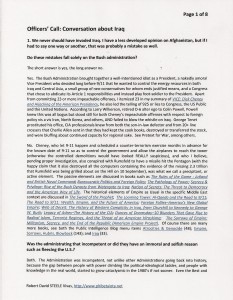
While we were in Denmark, an officer now serving in Iraq sent us some questions that we answered to the best of our ability. The questions alone are listed here. For the answers, click on the cover.
1. We never should have invaded Iraq. I have a less developed opinion on Afghanistan, but if I had to say one way or another, that was probably a mistake as well.
Do these mistakes fall solely on the Bush administration?
Was the administrating that incompetent or did they have an immoral and selfish reason such as fleecing the U.S.?
Was it shortsighted political gain objectives with an underestimation of the downside?
We will have at least double the amount of dead service members before these conflicts are over as were killed during the 9/11 attacks. I read somewhere that we have 75,000 amputees due to the two conflicts not to mention the amount of PTSD. Who has the blood on their hands? Certainly nobody is willing to admit mistakes.
I don't understand how Cheney can even think about spouting off after how the conflicts have gone. Where is the cost vs gain analysis?
2. Once we did invade, we didn't have a solid plan and we didn't bring nearly enough troops if we planned on staying. Was this mainly Rumsfeld's fault?