
Comment: For those in NYC who are interested, visit this event webpage and this flyer (front & back) + Twitter and Facebook.
Also See:

The truth at any cost lowers all other costs — curated by former US spy Robert David Steele.
Comment: For those in NYC who are interested, visit this event webpage and this flyer (front & back) + Twitter and Facebook.
Also See:

Libertarian seasteaders give up on the sea, focus on autonomous regions starting with Honduras.
Former “Seasteaders” Come Ashore To Start Libertarian Utopias In Honduran Jungle
Forgoing the plan to build independent floating cities away from chafing laws, some libertarians—led by Milton Friedman’s grandson, no less—have found something better: desperate countries willing to allow the founding of autonomous libertarian cities within their borders.
The seasteader-in-chief is headed ashore. Patri Friedman (that’s Milton Friedman‘s grandson to you), who stepped down as the chief executive of the Peter Thiel-backed Seasteading Institute in August, has resurfaced as the CEO of a new for-profit enterprise named Future Cities Development Inc., which aims to create new cities from scratch (on land this time) governed by “cutting-edge legal systems.” The startup may have found its first taker in Honduras, whose government amended its constitution in January to permit the creation of special autonomous zones exempt from local and federal laws. Future Cities has signed a non-binding memorandum of understanding to build a city in one such zone starting next year.
. . . . . . .
The brainchild of New York University economist Paul Romer (read his thoughts on FCI here), a charter city combines a host nation’s vacant land (in this case, Honduras) with the legal system and institutions of another (e.g. Canada) and residents drawn from anywhere. Romer’s central insight is that good governance is transplantable—rather than wait for a basket case nation to come around begging, a charter city could help show it the way, as Hong Kong did for Deng Xiaoping.
Phi Beta Iota: The focus on eradicating corruption from day one is most interesting. While the group does not appear to have fully thought through their role as a magnet for criminals, there are regions of Africa, Latin America, and even the now warming Arctic North that could permit this kind of innovation to test its premises.
 In an Open-Source Society, Innovating by the Seat of Our Pants
JOICHI ITO
New York Times, December 5, 2011
The Internet isn’t really a technology. It’s a belief system, a philosophy about the effectiveness of decentralized, bottom-up innovation. And it’s a philosophy that has begun to change how we think about creativity itself.
. . . . . .
The ethos of the Internet is that everyone should have the freedom to connect, to innovate, to program, without asking permission. No one can know the whole of the network, and by design it cannot be centrally controlled. This network was intended to be decentralized, its assets widely distributed. Today most innovation springs from small groups at its “edges.”
. . . . . . .
I don’t think education is about centralized instruction anymore; rather, it is the process establishing oneself as a node in a broad network of distributed creativity.

Gasoline: The new big U.S. export
Steve Hargreaves
CNN Money, 5 December 2011
NEW YORK (CNNMoney) — The United States is awash in gasoline. So much so, in fact, that the country is exporting a record amount of it.
The country exported 430,000 more barrels of gasoline a day than it imported in September, according to the U.S. Energy Information Administration. That is about twice the amount at the start of the year, and experts and industry insiders say the trend is here to stay.
The United States began exporting gas in late 2008. For decades prior, starting in 1960, the country used all the gas it produced here plus had to import gas from places in Europe.
But demand for gas has dropped nearly 10% in recent years. It went from a peak of 9.6 million barrels a day in 2007 to 8.8 million barrels today, according to the EIA.
Phi Beta Iota: The entire Tar Sands scheme is a scam on the US public, and atrocity against the Canadian public. In Canada, they are proposing to use precious water they do not have to spare, to flush tar we do not need out of the sands; in the US, there is no need for the tar sands as the sleazy campaigns suggest, the oil companies want the tar sands so they can externalize the costs to the US public and privatize the profits of exporting the gasoline.

Over 46 Million Americans On Foodstamps For The First Time Ever
Zerohedge.com, 12/05/2011
While the capital markets may be cheering that in the past month 120,000 people supposedly found jobs, even if these were largely temporary or part-time just in time for the year end shopping sprees, we wonder how they will react when learning that according to the latest update from the Supplemental Nutrition
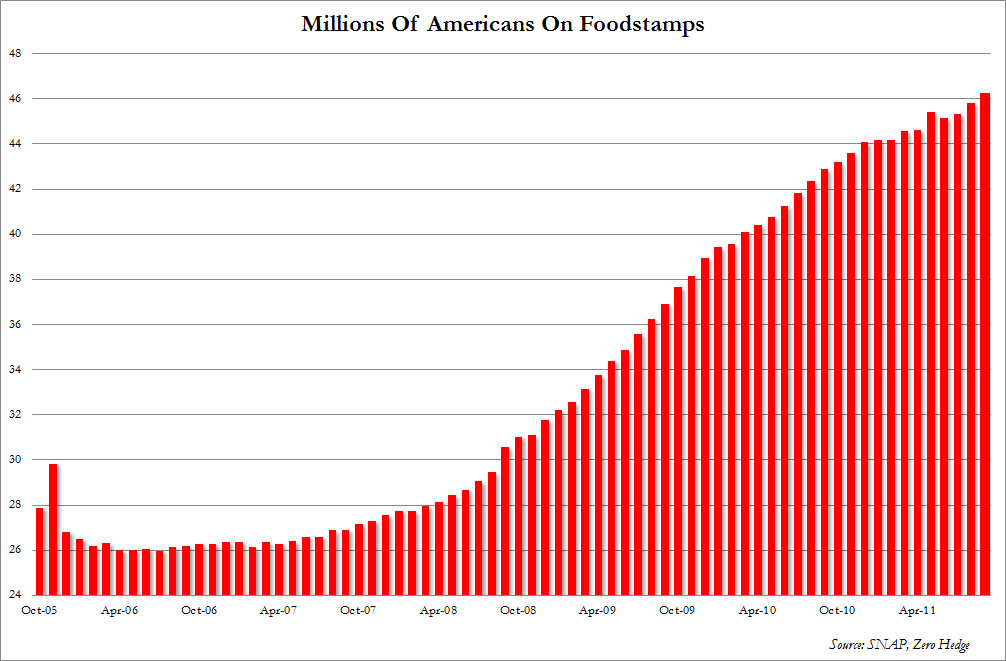
Assistance Program (SNAP), some 423,000 Americans found their way to minimum way subsistence, courtesy of Food Stamp handouts from Uncle Sam. Since the start of the Second Great Depression, food stamp participation has increased by 18.7 million, and is now at an all time higher 46.3 million. All Bush's fault, or something. At least the chart below appears to be plateauing… Actually, sorry, no isn't.
See Also:
Food Stamp Use Surges By Most In Years As Alabama Foodstamp Recipients Double In May
US Food Stamp Usage Hits New Record

Crowdsourcing vs Putin: “Mapping Dots is a Disease on the Map of Russia”
4 December 2011
I chose to focus my dissertation research on the impact of information and communication technologies (ICTs) during elections in repressive states. Why? Because the contentious relationship between state and society during elections is accentuated and the stakes are generally higher than periods in-between elections. To be sure, elections provide momentary opportunities for democratic change. Moreover, the impact of ICTs on competitive events such as contentious elections may be more observable than the impact on state-society relations during the regular calendar year. In other words, the use of ICTs during election periods may shed some light on whether said technologies empower coercive regimes at the expense of civil society or vice versa.
Full Blog with Three Major Graphics Below the Line
Continue reading “Patrick Meier: Crowd-Sourcing Making Putin Nervous”
Equal Voice! Break the Corporate Mega-Media Dictatorship by Reintroducing the Wagner-Hatfield Amendment
The Wagner-Hatfield Amendment was a proposed amendment to the Communications Act of 1934, sponsored by senators Robert F. Wagner, Democrat, of New York and Henry D. Hatfield, Republican, of West Virginia. The amendment would have reserved 25% of all radio stations for non-profit radio broadcasters, including universities. The amendment was enthusiastically supported by educators. Of course it was vigorously attacked by the for-profit radio lobby.
The amendment almost passed but was defeated. If the amendment were reintroduced and passed, it would effectively break the corporate mega-media monopoly. Universities would be more likely than corporations to give alternate voices a chance to be heard.
Using the internet to challenge the corporate mega-media view of things is an admirable use of the internet. But why should we accept that inherent disadvantage? Reintroduce the Wagner-Hatfield amendment and pass it, and the disadvantage will disappear overnight. There were no TV stations when the amendment was proposed. But today it would have to include them to be fair. If universities had their own TV stations they could reach far more people than the average blog. And if they had of had equal access to media since 1934, American history might be quite different.
“Equal Voice” should become an issue of emergent democracy. The average voter doesn't have an equal voice even with their elected representatives, because campaign contributions talk louder. And media outlets have an even louder voice than politicians, who are limited to C-SPAN and periodic coverage by mainstream media of things like press conferences and State of the Union addresses. The public voice is effectively stifled by the arrangement.
No. Equal voice needs to mean equal access to media! That's the only way voters will ever be able to effectively challenge a system that is stacked against them. All we need is a little volume so that our voices can be heard as loudly as the collective voice of mega-media corporations. The Wagner-Hatfield amendment might be just the crowbar we need to pry an opening in the iron wall of corporate mega-media control and give disenfranchised American voters the voice they have long been denied.
